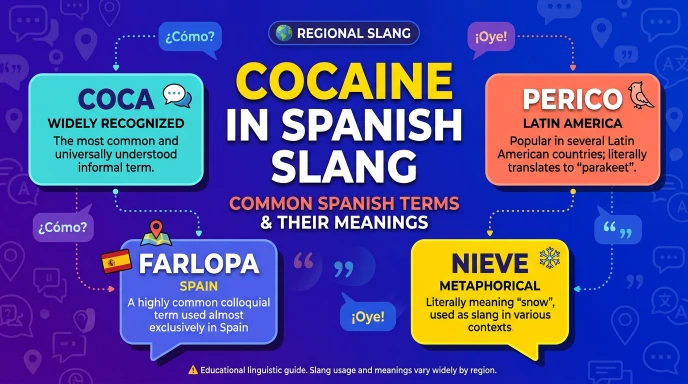
Cocaine in Spanish is called cocaína, but Spanish speakers also use informal words such as coca, perico, la blanca, and nieve to refer to it.
The exact term depends on the country, local culture, and conversation.
You may encounter these expressions in Spanish language movies, music, crime dramas, news reports, and everyday dialogue. Some words are widely recognized, while others are associated with particular countries or communities.
Learning these terms can help you understand Spanish slang more accurately. However, no single slang word for cocaine is used universally throughout the Spanish speaking world.
Quick Answer
The most common Spanish slang terms associated with cocaine include:
- Coca: An informal shortened term for cocaine in some Spanish speaking regions.
- Perico: A slang term for cocaine in several Latin American countries.
- La blanca: Literally “the white one”; a euphemism for cocaine in some contexts.
- Nieve: Literally “snow”; a slang term for cocaine.
- Polvo: Literally “powder” or “dust”; it can refer to cocaine in drug related contexts.
- Talco: Literally “talcum powder”; a slang term associated with cocaine in some regional vocabularies.
- Yeyo: A regional slang term for cocaine, particularly documented in Mexican and Puerto Rican usage.
- Merca: An informal term associated with drugs, including cocaine, in some South American contexts.
- Farlopa: A colloquial Spanish term for cocaine, especially associated with Spain.
- Cocaína: The standard Spanish word for cocaine.
Remember: Some terms have other meanings in ordinary Spanish. The conversation, country, and subject matter determine if a word refers to cocaine.
What Does Cocaine Mean in Spanish Slang?
The standard Spanish word for cocaine is cocaína. It is the clearest term to use when discussing the substance in a medical, educational, legal, or general informational context.
Slang develops differently across Spanish speaking communities. People may shorten a word, use a metaphor, or adopt a regional expression that is familiar within a particular group.
For example, coca is a shortened form associated with cocaine, while nieve uses a word meaning “snow” as a euphemism.
The word perico is another recognized example of drug related slang. However, it also means “parakeet” in ordinary Spanish, so context matters.
A word’s presence in a slang dictionary does not mean every Spanish speaker will understand it the same way. Some expressions are more familiar in one country than another, and some become outdated or change meaning over time.
10 Spanish Slang Words for Cocaine
The following list explains common and regionally documented terms. It is intended to help readers understand language in conversation, music, and media.
1. Coca : An Informal Name for Cocaine
Coca is an informal shortened term used for cocaine in some Spanish speaking communities.
Example:
“En la película, el personaje habla de coca.”
English meaning: “In the movie, the character talks about cocaine.”
The word coca can also refer to the coca plant, from which cocaine is derived. It may also appear in other names and expressions, so it does not always mean the drug itself.
2. Perico : Regional Slang for Cocaine
Perico is a recognized slang term for cocaine in several Latin American contexts.
Example:
“En el diálogo, mencionan la palabra perico.”
English meaning: “In the dialogue, they mention the word perico.”
Outside drug related contexts, perico commonly means a parakeet. In some countries, it can also have additional local meanings.
When you encounter it in a film or song, look at the surrounding words before deciding what it means.
3. La Blanca : “The White One”
La blanca literally means “the white one.” In some drug related conversations, it is used as a euphemism for cocaine.
Example:
“El informe menciona el término la blanca.”
English meaning: “The report mentions the term ‘the white one.’”
This expression is not exclusive to one Spanish speaking country. It is also not a unique identifier for cocaine in every situation, since blanca can simply describe something white.
4. Nieve : “Snow”
Nieve means “snow” in standard Spanish. In drug related slang, it can refer to cocaine.
Example:
“En esa escena, nieve se usa como una palabra de jerga.”
English meaning: “In that scene, ‘snow’ is used as a slang term.”
This is a metaphorical expression similar to the English slang word “snow.” Its interpretation depends on the subject being discussed.
5. Polvo : “Powder” or “Dust”
Polvo means “powder” or “dust.” It can refer to cocaine in a drug related context, but the word has many ordinary meanings.
Example:
“El personaje usa la palabra polvo al hablar de drogas.”
English meaning: “The character uses the word ‘powder’ when talking about drugs.”
Because polvo is a common Spanish noun, it should not automatically be interpreted as cocaine. It may refer to ordinary dust, powdered substances, or other meanings depending on the sentence.
6. Talco : “Talcum Powder”
Talco literally means “talcum powder.” Some regional slang references record it as a term associated with cocaine.
Example:
“En el diálogo aparece la palabra talco.”
English meaning: “The word ‘talcum powder’ appears in the dialogue.”
This use is regional rather than universal. In most everyday situations, talco simply refers to talcum powder.
7. Yeyo : A Regional Slang Term
Yeyo is a slang term for cocaine documented in some Mexican and Puerto Rican usage.
Example:
“El personaje utiliza una expresión regional para referirse a la cocaína.”
English meaning: “The character uses a regional expression to refer to cocaine.”
Its familiarity varies among Spanish speakers. Do not assume that everyone in Latin America recognizes it or uses it in the same way.
8. Merca : Drug Related Slang
Merca is an informal term associated with drugs in some South American contexts, particularly Argentine usage. Depending on the conversation, it may refer to cocaine or drugs more generally.
Example:
“En la historia, el personaje usa jerga relacionada con las drogas.”
English meaning: “In the story, the character uses drug related slang.”
Because its meaning can be broad, merca is not a precise synonym for cocaine in every context.
9. Farlopa : A Term Associated With Spain
Farlopa is a colloquial Spanish slang term for cocaine, especially associated with Spain.
Example:
“El diálogo utiliza una palabra coloquial española para referirse a la cocaína.”
English meaning: “The dialogue uses a colloquial Spanish word to refer to cocaine.”
This term can be useful when interpreting Spanish films, television, or informal dialogue. It is not equally familiar across every Spanish speaking country.
10. Cocaína : The Standard Term
Although cocaína is not slang, it belongs in any explanation of cocaine related Spanish vocabulary.
Example:
“La policía informó que la sustancia era cocaína.”
English meaning: “The police reported that the substance was cocaine.”
Cocaína is the clearest and most widely understood word when the intended meaning needs to be unambiguous.
Cocaine Slang by Spanish Speaking Country
Spanish slang varies considerably by country. A term that is familiar in one place may sound unusual or have another meaning elsewhere.
The following table gives a broad overview of documented associations rather than a definitive map of local usage.
| Country or region | Terms associated with cocaine | Important context |
| Mexico | Coca, perico, yeyo, talco | Terms vary by community and situation. |
| Colombia | Coca, perico | Perico is a recognized regional slang term. |
| Puerto Rico | Coca, perico, yeyo | Usage can vary across communities. |
| Argentina | Coca, merca, blanca | Merca can refer to drugs more broadly. |
| Spain | Cocaína, farlopa | Farlopa is a colloquial term associated with Spain. |
| El Salvador | Coca, talco and other regional terms | Recognition and usage may vary locally. |
| Peru | Coca, blanca, talco in some references | A term’s meaning depends on the conversation. |
| Chile | Coca, nieve and other expressions | Not every slang term is equally common. |
These are examples of regional associations, not exclusive national vocabularies. People move between countries, slang spreads through music and media, and individual communities develop their own expressions.
How Cocaine Slang Appears in Spanish Movies and Music
Drug related slang may appear in films, television, music, documentaries, and crime fiction. Understanding the vocabulary can help viewers follow a scene without confusing literal and figurative meanings.
In Movies and Television
A crime drama might use perico, coca, or la blanca when a character discusses cocaine.
The meaning becomes clearer if other characters are talking about drugs, an investigation, or a criminal case.
However, fictional dialogue may exaggerate regional speech or combine expressions from different countries. A film does not necessarily reflect how ordinary people speak every day.
In Music
Spanish language songs sometimes use drug related vocabulary as part of storytelling, social commentary, or the depiction of a character’s lifestyle.
A word such as nieve might be metaphorical, while cocaína is more direct.
Do not assume that every reference to powder, snow, or white substances in a song refers to cocaine. Lyrics can use metaphor, double meanings, and wordplay.
In News and Documentaries
News reports and documentaries are more likely to use the standard word cocaína, especially when discussing arrests, public health, or legal cases.
Slang may appear when a report quotes a conversation or explains a term used by a particular group.
In these contexts, the surrounding explanation usually provides more reliable clues than the slang word alone.
Literal Meanings vs. Drug Related Meanings
One of the biggest challenges in understanding Spanish slang is that a common word may have both an ordinary meaning and a drug related meaning.
Here are several examples:
| Spanish word | Literal or everyday meaning | Possible drug related meaning |
| Coca | Coca plant or part of a name | Cocaine |
| Perico | Parakeet | Cocaine in some regions |
| Nieve | Snow | Cocaine in slang |
| Polvo | Dust or powder | Cocaine in some contexts |
| Talco | Talcum powder | Cocaine in some regional slang |
| Blanca | White or a white colored thing | Cocaine in some contexts |
| Merca | Merchandise or goods in some contexts | Drugs, sometimes cocaine |
The drug related meaning should only be chosen when the context supports it. If a Spanish speaker says nieve while talking about winter weather, it simply means snow. If a conversation is explicitly about narcotics, a slang interpretation may be more likely.
Is Cocaine Slang the Same Across Latin America?
No. There is no single set of cocaine slang words shared by every Spanish speaking country.
Latin America includes many countries, each with its own speech patterns, regional expressions, and social influences. Even within a country, slang can differ by city, age group, and community.
For example, perico is recognized as a cocaine related term in several countries, but that does not mean it is the most common term everywhere. Farlopa is more closely associated with Spain, while merca has regional associations in South America.
It is also important to distinguish between a word being understood and a word being naturally used. Someone may recognize a term from television without ever using it in everyday conversation.
For learners, the safest approach is to learn the country associated with a term and check the context before assuming its meaning.
Is It Appropriate to Use These Words in Everyday Spanish?
Most cocaine related slang is best understood as vocabulary for interpreting conversations rather than language to use casually.
In a medical, educational, legal, or professional setting, cocaína is generally clearer and more appropriate than a slang expression.
Some informal terms may sound vulgar, secretive, or connected with criminal activity. Others are simply regional euphemisms. The social meaning depends on who is speaking and why.
If you are learning Spanish for travel or everyday conversation, prioritize broadly useful expressions before memorizing drug related slang. Knowing a term’s meaning can help you understand a movie or conversation, but it does not mean you need to use it yourself.
Common Mistakes When Learning Cocaine Slang in Spanish
1. Assuming Every Term Works in Every Country
A word used in Mexico may not be common in Spain or Argentina. Always consider regional differences.
2. Treating Literal Words as Drug References
Nieve, polvo, and talco have ordinary meanings. Their drug related meanings depend on context.
3. Confusing Cocaine With Other Drugs
Not every Spanish slang term for drugs refers to cocaine. For example, mota commonly refers to marijuana in several regions, while chiva can refer to heroin in some drug related vocabularies.
4. Assuming Slang Is Always Current
Some expressions appear in older dictionaries, historical documents, or dated media. Their present day frequency may be different.
5. Treating Informal Sources as Universal Authorities
Slang dictionaries often list words without explaining how common they are or where they are used. A term appearing in a glossary does not prove that every local speaker knows it.
Good slang interpretation requires both vocabulary and cultural context.
Frequently Asked Questions
What is the Spanish slang word for cocaine?
Commonly documented terms include coca, perico, la blanca, and nieve. Other terms, such as yeyo, talco, and farlopa, are associated with particular regional vocabularies.
Does “perico” mean cocaine in Spanish?
It can. Perico is a recognized slang term for cocaine in several Latin American contexts. It also means “parakeet” in ordinary Spanish, so the surrounding conversation matters.
What does “nieve” mean in drug slang?
Nieve literally means “snow.” In some drug related conversations, it is used as a slang term for cocaine.
What does “la blanca” mean?
La blanca literally means “the white one.” In some contexts, it is a euphemism for cocaine, but it can also refer to any white colored object or substance.
What does “coca” mean in Spanish?
Coca can refer to the coca plant or be used informally for cocaine. The meaning depends on the subject of the conversation.
What is cocaine called in Mexican Spanish?
The standard word is cocaína. Informal terms such as coca and perico are also documented, while yeyo and talco appear in some regional slang references. Usage varies among communities.
What is cocaine called in Spain?
The standard term is cocaína. Farlopa is a colloquial slang term associated with Spain.
What is cocaine slang in Argentina?
Coca and merca are terms associated with Argentine drug related vocabulary. Merca can refer to drugs more generally, so it does not always mean cocaine specifically.
Is “polvo” always a slang word for cocaine?
No. Polvo normally means “dust” or “powder.” It can refer to cocaine in a drug related conversation, but it has many ordinary uses.
Is there one universal Spanish slang term for cocaine?
No. Regional differences are significant, and a term may be common in one country, unfamiliar in another, or have an unrelated meaning.
Final Thoughts
Cocaine is called cocaína in Spanish, while slang terms include coca, perico, la blanca, and nieve. Other expressions, such as yeyo, talco, merca, and farlopa, have regional associations.
The most important thing to remember is that Spanish slang depends on context. A word can have a literal meaning in ordinary conversation and a different meaning in a discussion about drugs.
If you are interpreting a song, film, or conversation, consider the country, the speaker, and the surrounding sentence. When clarity matters, cocaína is the most direct and widely understood term.
Discover More Articles:

I research internet slang, texting abbreviations, and online language to create clear, accurate, and easy-to-understand content. My goal is to make modern internet language simple by publishing well-researched, regularly updated explanations based on trusted sources.