Salvadorian slang, more commonly called Salvadoran slang, refers to the informal Spanish words and expressions people use in El Salvador.
These expressions make everyday conversations sound more natural and local. Words such as chero, maje, chivo, and pisto are useful examples for anyone learning Salvadoran Spanish.
You may hear these words in conversations between friends, on social media, in music, or while traveling around El Salvador. Some expressions are friendly, while others can sound rude depending on the speaker’s tone and relationship with the listener.
If you want to understand Salvadoran slang, learning the words alone is not enough. You also need to understand their context, tone, and everyday use.
Quick Answer
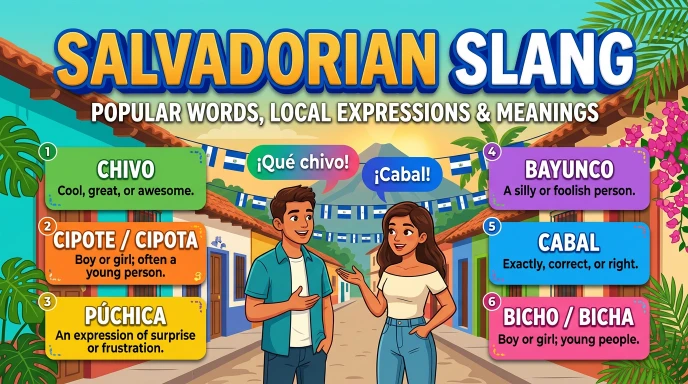
Salvadorian slang is informal Spanish used in El Salvador. It includes local words for friends, money, children, everyday objects, and common reactions.
Here are some popular examples:
- Chero: Friend or buddy.
- Maje: Dude, guy, or buddy; sometimes an insult.
- Chivo: Cool, great, or awesome.
- Pisto: Money.
- Bicho / bicha: Boy, girl, or young person.
- Cipote / cipota: Child or young person.
- Cabal: Exactly, right, or that’s correct.
- Púchica: An expression of surprise, frustration, or amazement.
- Bolado: A thing, object, or matter.
- Guanaco: An informal name for a Salvadoran person.
These expressions are not all exclusive to El Salvador, and their meanings can vary by region and situation.
What Is Salvadorian Slang?
Salvadorian slang is the informal vocabulary and expressions associated with Salvadoran Spanish, the variety of Spanish spoken in El Salvador. Many speakers also use the term caliche when referring to local slang or informal language.
Unlike formal Spanish, which is used in official documents and professional situations, slang often appears in relaxed conversations. Friends may use it to joke, greet one another, talk about money, or describe something exciting.
For example, a Spanish learner might say:
“Mi amigo es muy divertido.”
This means “My friend is very funny.”
A Salvadoran speaker might use chero when talking about a friend:
“Mi chero es bien divertido.”
The meaning is similar, but chero gives the sentence a more local, informal flavor.
Salvadoran slang is not a separate language. It is part of the country’s Spanish vocabulary and reflects local culture, communication habits, and history.
30+ Common Salvadorian Slang Words and Their Meanings
The following words are useful starting points for understanding everyday Salvadoran Spanish. Example sentences are illustrative and may sound different depending on the speaker or region.
1. Chero Friend or Buddy
Chero is a common informal word for a friend, pal, or buddy. The feminine form chera can refer to a female friend.
Example:
“¿Qué onda, chero?”
Meaning: “What’s up, buddy?”
You may hear this word when friends greet each other or talk about someone they know. It is casual rather than formal.
2. Maje Dude or Guy
Maje can mean “dude,” “guy,” or “buddy,” depending on the conversation.
Example:
“¿Qué hacés, maje?”
Meaning: “What’s up, dude?”
Among friends, it can sound relaxed and familiar. However, maje can also sound insulting or dismissive when said aggressively or to someone the speaker does not know well.
3. Chivo Cool or Awesome
Chivo is used to describe something cool, good, enjoyable, or impressive.
Example:
“¡Qué chivo está ese lugar!”
Meaning: “That place is really cool!”
You can use it when talking about a place, an experience, or something you like.
4. Pisto Money
Pisto is an informal word for money in Salvadoran Spanish and some neighboring Central American varieties.
Example:
“No tengo pisto para salir hoy.”
Meaning: “I don’t have money to go out today.”
It is useful in casual conversations about shopping, paying for things, or making plans.
5. Bicho / Bicha Kid or Young Person
In El Salvador, bicho can refer to a boy, child, or young person, while bicha can refer to a girl or young woman.
Example:
“Los bichos están jugando afuera.”
Meaning: “The kids are playing outside.”
This is an important regional distinction because bicho means “bug” or “insect” in standard Spanish. In Salvadoran conversation, the intended meaning may instead be a young person.
6. Cipote / Cipota Child or Young Person
Cipote means a boy, child, or young person. Cipota is the feminine form.
Example:
“Cuando era cipote, jugaba fútbol todos los días.”
Meaning: “When I was a kid, I played soccer every day.”
It is a familiar expression for talking about children or remembering childhood.
7. Cabal Exactly or That’s Right
Cabal can mean “exactly,” “correct,” or “that’s right.”
Example:
“¿Nos vemos a las cinco?”
“Cabal.”
Meaning:
“Are we meeting at five?”
“Exactly” or “That’s right.”
This word is especially useful when agreeing with someone or confirming information.
8. Púchica Wow or Darn
Púchica is an exclamation used to express surprise, frustration, disappointment, or amazement.
Example:
“¡Púchica, se me olvidaron las llaves!”
Meaning: “Darn, I forgot my keys!”
It can be a milder alternative to stronger expressions, although its tone depends on the situation.
9. Bolado Thing or Object
Bolado is an informal word for a thing, object, or matter when the speaker does not name it specifically.
Example:
“Pasame ese bolado.”
Meaning: “Pass me that thing.”
The word is useful in casual conversation when both people understand which object is being discussed.
10. Buena Onda Good Vibes or Nice
Buena onda describes a person, situation, or experience that feels friendly, pleasant, or positive.
Example:
“Tu hermana es bien buena onda.”
Meaning: “Your sister is really nice.”
The opposite expression, mala onda, can describe someone or something unpleasant, unfriendly, or negative.
11. Dale Okay or Go Ahead
Dale is used in many Spanish speaking countries, including El Salvador. Depending on context, it can mean “okay,” “go ahead,” or “sure.”
Example:
“Nos vemos mañana.”
“Dale.”
Meaning:
“See you tomorrow.”
“Okay.”
It is a convenient expression for accepting a plan or encouraging someone to continue.
12. Simón Yes
Simón is an informal way of saying “yes” or “yeah” in Salvadoran and other Latin American speech.
Example:
“¿Vas a venir con nosotros?”
“Simón.”
Meaning:
“Are you coming with us?”
“Yeah.”
It is casual and is best suited to relaxed conversations.
13. Chele / Chela Fair Haired or Light Complexioned Person
Chele can describe someone who is fair haired, light skinned, or light complexioned, depending on local usage. Chela may be used as the feminine form.
Example:
“Ese chele es mi compañero de clase.”
Meaning: “That fair haired or light complexioned guy is my classmate.”
The word’s precise implication depends on the speaker and context. As it describes appearance, use it respectfully.
14. Chucho Dog
In Salvadoran Spanish, chucho commonly means “dog.”
Example:
“Mi chucho siempre duerme cerca de la puerta.”
Meaning: “My dog always sleeps near the door.”
This is another example of regional vocabulary: the word may have different meanings in other Spanish speaking countries.
15. Chuco Dirty or Filthy
Chuco can mean dirty or filthy when describing something messy or unclean.
Example:
“Tus zapatos están bien chucos.”
Meaning: “Your shoes are really dirty.”
The word can also have other regional meanings, so consider the subject of the conversation.
16. Bolo / Bola Drunk
Bolo is an informal Salvadoran term for someone who is drunk. Bola may appear as a feminine form in some usage.
Example:
“Regresó bolo de la fiesta.”
Meaning: “He came back drunk from the party.”
Because this term can sound mocking or judgmental, be careful when using it to describe someone.
17. Chula / Chulo Pretty or Attractive
Chulo and chula can describe someone or something as attractive, pretty, or nice. The exact meaning varies across Spanish speaking regions.
Example:
“¡Qué chula está tu casa!”
Meaning: “Your house looks so nice!”
This word is widely understood beyond El Salvador, so it is not exclusively Salvadoran slang.
18. Dundo Foolish or Silly
Dundo can describe someone as foolish, silly, or not very clever.
Example:
“No seas dundo.”
Meaning: “Don’t be silly” or “Don’t be foolish.”
Depending on tone, it may sound playful among friends or insulting in a serious argument.
19. Baboso Fool or Idiot
Baboso is an informal insult that can mean “fool,” “idiot,” or “foolish person.”
Example:
“¡Qué baboso fui por olvidar eso!”
Meaning: “I was such an idiot for forgetting that!”
It may be used jokingly in some conversations, but it can offend someone if said harshly.
20. Bayunco Silly or Unrefined Person
Bayunco can describe someone whose behavior or appearance is considered silly, immature, or lacking good taste.
Example:
“No seas bayunco en la reunión.”
Meaning: “Don’t act foolishly at the meeting.”
It is more context dependent than basic words such as chivo or pisto, so listen to how local speakers use it.
21. Chachalaco Talkative Person
Chachalaco can refer to someone who talks a lot or is especially chatty.
Example:
“Mi primo es bien chachalaco.”
Meaning: “My cousin talks a lot.”
The term may be teasing rather than insulting, depending on the relationship between the speakers.
22. Chunche Thing or Object
Chunche is a familiar word for a thing or object. It is also used in other parts of Central America.
Example:
“¿Dónde está ese chunche?”
Meaning: “Where is that thing?”
Like bolado, it is useful when the speaker does not know or does not want to say the object’s exact name.
23. Galán Great or Impressive
In some informal Salvadoran usage, galán can express approval, similar to “great” or “excellent.” It can also describe an attractive man in broader Spanish usage.
Example:
“¡Galán, nos vemos mañana!”
Meaning: “Great, see you tomorrow!”
Because this expression has different meanings across Spanish, the surrounding sentence is especially important.
24. Al Chilazo Quickly or Right Away
Al chilazo is an informal expression associated with doing something quickly or immediately.
Example:
“Vení al chilazo.”
Meaning: “Come right away.”
It is casual and may be more familiar to some speakers than others.
25. Guanaco A Salvadoran Person
Guanaco is a well known informal term for a Salvadoran person. Many Salvadorans use it as a marker of national identity, sometimes with pride or humor.
Example:
“Soy guanaco y me encanta la comida de mi país.”
Meaning: “I’m Salvadoran, and I love the food from my country.”
The word has a complicated history and can carry different implications depending on the speaker. In particular, using it for someone else may not have the same tone as using it for oneself.
26. Vaya Pues Okay Then or All Right
Vaya pues is an everyday expression that can indicate agreement, acceptance, or a conversational farewell.
Example:
“Nos vemos después.”
“Vaya pues.”
Meaning:
“See you later.”
“All right.”
Its tone can be friendly, resigned, or matter of fact depending on the situation.
27. De a Huevo Definitely or Really
De a huevo is a strong informal expression used in parts of Central America, including El Salvador. Depending on context, it can communicate enthusiasm, certainty, or that something is excellent.
Example:
“¿Te gustó el concierto?”
“¡De a huevo!”
Meaning: “Did you like the concert?” “Absolutely!” or “It was awesome!”
This expression is coarse or vulgar to some speakers, so it is better to understand it before using it in formal or unfamiliar situations.
28. Andar Pelado To Be Broke
Andar pelado can mean having little or no money.
Example:
“Este mes ando pelado.”
Meaning: “I’m broke this month.”
The phrase is informal and can be used when talking about a tight budget or being unable to afford something.
29. Cherada Group of Friends
Cherada refers to a group of friends or one’s circle of buddies, formed from the word chero.
Example:
“Voy a salir con la cherada.”
Meaning: “I’m going out with my group of friends.”
It is a useful word for conversations about social plans and friendships.
30. Chibola Soft Drink or Soda
In some Salvadoran usage, chibola can refer to a carbonated drink or soda. Usage can vary, and the word has other meanings in different regions.
Example:
“Voy a comprar una chibola.”
Meaning: “I’m going to buy a soda.”
Because this term is more region dependent, do not assume every Spanish speaker will understand it in the same way.
31. ¡Qué Chilero! How Cool!
Chilero is used in parts of Central America to describe something cool, nice, or enjoyable. It is not exclusive to El Salvador.
Example:
“¡Qué chilero estuvo el viaje!”
Meaning: “The trip was so cool!”
Salvadoran speakers may also use chivo for a similar idea.
32. Púchica, Qué Chivo Wow, That’s Awesome!
This combines two familiar expressions: púchica, an exclamation, and chivo, meaning cool or great.
Example:
“¡Púchica, qué chivo está ese carro!”
Meaning: “Wow, that car is awesome!”
It is an example of how slang words work together in a natural, informal sentence.
Common Salvadorian Slang Phrases in Everyday Conversations
Knowing individual words helps, but phrases show how people use them together. Here are some practical examples.
| Salvadoran phrase | English meaning |
| ¿Qué onda, chero? | What’s up, buddy? |
| ¡Qué chivo! | That’s awesome! |
| No tengo pisto. | I don’t have money. |
| Simón, está bien. | Yeah, that’s fine. |
| Cabal, tenés razón. | Exactly, you’re right. |
| Pasame ese bolado. | Pass me that thing. |
| Los bichos están jugando. | The kids are playing. |
| Ando pelado. | I’m broke. |
| ¡Púchica! ¿Qué pasó? | Wow! What happened? |
| Vaya pues, nos vemos. | All right then, see you. |
These sentences use informal language. Some also use voseo, a way of saying “you” that is common in El Salvador and other parts of Latin America.
For example, tenés means “you have” in this form of Spanish, while tienes is associated with the tú form. Voseo is not slang by itself, but it is an important feature of everyday Salvadoran speech.
Salvadorian Slang for Friends and Family
Several Salvadoran words help people talk about friends, children, and familiar relationships.
- Chero / chera: A friend or buddy.
- Cherada: A group of friends.
- Maje: Dude, guy, or buddy, depending on tone.
- Bicho / bicha: A child or young person.
- Cipote / cipota: A child or young person.
- Guanaco / guanaca: A Salvadoran person, with tone depending on context.
For example:
“Voy al parque con mi chero.”
Meaning: “I’m going to the park with my friend.”
“Los cipotes están en la escuela.”
Meaning: “The kids are at school.”
Choose words such as chero carefully when speaking to strangers. Some informal expressions are natural between friends but can sound overly familiar in a formal situation.
Salvadorian Slang for Money and Everyday Things
Salvadoran informal speech also includes words for money and objects.
Pisto means money, while bolado and chunche can refer to a thing or object.
Examples:
“No tengo pisto para comprarlo.”
Meaning: “I don’t have money to buy it.”
“Guardá ese bolado.”
Meaning: “Put that thing away.”
“¿Qué es ese chunche?”
Meaning: “What is that thing?”
These expressions are useful because people often use informal vocabulary when talking about shopping, possessions, plans, and daily tasks.
Remember that some of these words are shared with neighboring countries, so they should not all be described as unique to El Salvador.
Salvadorian Slang Used in Text Messages and Social Media
Salvadoran slang also appears in text messages, online chats, captions, and comments. People may use local expressions to make their messages sound casual or familiar.
Here are a few examples:
Example 1
“Qué chivo estuvo ayer 😂”
Meaning: “Yesterday was awesome.”
Example 2
“Simón, ahí llego.”
Meaning: “Yeah, I’ll be there.”
Example 3
“No tengo pisto ahorita.”
Meaning: “I don’t have money right now.”
Example 4
“¿Qué onda, maje?”
Meaning: “What’s up, dude?”
Example 5
“Cabal, eso mismo pensé.”
Meaning: “Exactly, that’s what I thought.”
People may shorten words or use emojis in digital conversations, but there is no single spelling or texting style followed by every Salvadoran speaker.
Is Salvadorian Slang Different From Mexican Slang?
Yes, there are differences, although the two varieties share many Spanish words and expressions.
For example, chero is strongly associated with Salvadoran usage as a word for a friend. In Mexico, güey or cuate may be used informally for a friend or guy, depending on the region.
Similarly, pisto commonly means money in El Salvador and some neighboring countries, while lana is a familiar informal word for money in Mexico.
| Meaning | Common Salvadoran expression | Example from Mexican Spanish |
| Friend | Chero | Cuate |
| Dude or guy | Maje | Güey |
| Money | Pisto | Lana |
| Cool or awesome | Chivo | Chido |
| Child or young person | Cipote or bicho | Chamaco or chavo |
These are broad comparisons, not strict rules. Slang changes across regions, age groups, and social circles, so a word may be understood in more than one country.
Is Salvadorian Slang Rude?
Some Salvadoran expressions are friendly, while others can be insulting or vulgar.
Words such as chivo, cabal, and chero are often used in relaxed, friendly conversations. By contrast, baboso can be an insult, and maje may sound friendly or disrespectful depending on tone.
Even a familiar word can become offensive when used aggressively or toward someone who does not know you well.
If you are learning Salvadoran Spanish, start with relatively neutral expressions such as:
- Cabal exactly or that’s right.
- Chivo cool or great.
- Dale okay or go ahead.
- Buena onda nice or good vibes.
- Chero friend, when the situation is informal.
It is wise to learn stronger expressions so you can understand them, but avoid using vulgar language with strangers or in professional situations.
How to Learn Salvadorian Slang Naturally
The easiest way to learn Salvadoran slang is to study words in real conversational contexts rather than memorizing a long list.
Try these methods:
- Learn the most useful words first. Start with cabal, chivo, pisto, and chero.
- Read the full sentence. A word such as maje can sound friendly or insulting depending on how it is used.
- Listen to local speakers. Pay attention to how people greet friends, agree with someone, or talk about everyday activities.
- Practice complete phrases. Learn “¿Qué onda, chero?” rather than memorizing chero alone.
- Notice regional differences. Some words are used across Central America, while others are more strongly associated with El Salvador.
- Use slang with the right audience. Friendly expressions are generally easier to use than vulgar or highly informal words.
The goal is not to use slang in every sentence. It is to recognize when an expression sounds natural and understand what the speaker intends.
Frequently Asked Questions
What is the most common Salvadorian slang word?
There is no single word that is objectively the most common in every setting. Chero, maje, chivo, pisto, bicho, and cipote are all useful examples of everyday Salvadoran vocabulary.
What does “chero” mean in El Salvador?
Chero means friend, pal, or buddy. It is informal and commonly used in conversations with friends. Chera is a feminine form used for a female friend.
What does “maje” mean in Salvadorian slang?
Maje can mean dude, guy, or buddy. It can also be insulting, depending on the speaker’s tone and the relationship between the people talking.
What does “pisto” mean in El Salvador?
Pisto means money. For example, “No tengo pisto” means “I don’t have money.”
What does “chivo” mean in Salvadorian slang?
Chivo means cool, great, or awesome. It can describe a place, an activity, or something the speaker likes.
What does “cipote” mean?
Cipote means a child or young person. The feminine form is cipota. The word is used in El Salvador and other parts of Central America.
What does “bicho” mean in El Salvador?
In Salvadoran Spanish, bicho can mean a boy, child, or young person, while bicha can refer to a girl or young woman. In other Spanish contexts, bicho usually means an insect.
What does “guanaco” mean?
Guanaco is an informal term for a Salvadoran person. It can be used as a national or cultural identifier, although its tone depends on who says it and how it is used.
What does “cabal” mean in Salvadorian slang?
Cabal means exactly, correct, or that’s right. It is often used to agree with someone or confirm a statement.
Is Salvadorian slang the same as Spanish slang?
No. Salvadoran slang is part of Spanish, but it includes local vocabulary and expressions associated with El Salvador. Some words are shared with neighboring countries, while others have particularly strong local associations.
Final Thoughts
Salvadorian slang is an important part of everyday communication in El Salvador. Words such as chero, maje, chivo, pisto, bicho, and cipote help express friendship, approval, money, and everyday experiences.
Some terms are friendly, while others can sound rude depending on tone and context. A few are strongly associated with El Salvador, but many are also used elsewhere in Central America.
If you are learning Salvadoran Spanish, start with common expressions such as “¿Qué onda, chero?”, “¡Qué chivo!” and “Cabal.” Practice them in complete sentences, listen to local speakers, and pay attention to how the meaning changes with the situation.
Discover More Articles:

I research internet slang, texting abbreviations, and online language to create clear, accurate, and easy-to-understand content. My goal is to make modern internet language simple by publishing well-researched, regularly updated explanations based on trusted sources.