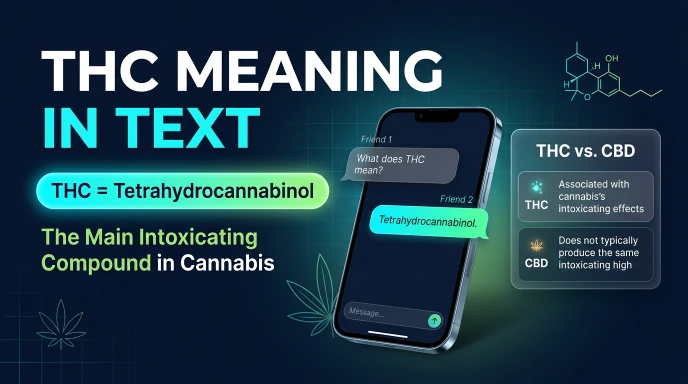
THC in text usually stands for tetrahydrocannabinol, the main mind altering chemical in cannabis that produces a “high.”
People use it in text messages, Snapchat chats, TikTok captions, and online conversations when discussing cannabis, product strength, or its effects.
Although THC often appears in casual conversations, it is technically a scientific abbreviation rather than traditional internet slang. Its meaning usually stays the same if someone mentions it in a private message, a social media post, or a discussion about cannabis products.
If you have seen someone write “Does it have THC?” or “This has high THC,” the surrounding conversation can help you understand exactly what they mean. Here is how to recognize and interpret the abbreviation.
Quick Answer
THC means tetrahydrocannabinol. It refers to the primary intoxicating compound in cannabis that can change how a person feels, thinks, and perceives things.
In texting and online conversations, people commonly use THC when discussing:
- Cannabis or marijuana.
- The strength or potency of a cannabis product.
- The effects associated with cannabis.
- if a product contains THC.
- Differences between THC and CBD.
Example:
Friend 1: “Does that gummy contain THC?”
Friend 2: “Yes, check the label before using it.”
Here, THC refers to the compound that can produce intoxicating effects.
What Does THC Stand For?
THC stands for tetrahydrocannabinol. The name refers to a naturally occurring compound found in cannabis plants. Delta 9 tetrahydrocannabinol, commonly called delta 9 THC, is the form most people mean when they use the abbreviation in everyday conversation.
You do not need to remember the full scientific name to understand a text message. Most people simply write THC because it is shorter and widely recognized.
For example, someone might send:
- “This product has THC.”
- “I need to check the THC percentage.”
- “Is it THC free?”
- “The label lists both THC and CBD.”
In all these examples, THC refers to the same compound. The exact conversation determines if the person is discussing a product label, its potency, or its possible effects.
Is THC Slang or an Abbreviation?
THC is primarily an abbreviation, not a slang word in the traditional sense. However, people frequently use it in informal conversations, so it can appear on slang websites and in online texting dictionaries.
Traditional slang often includes casual expressions with meanings that differ from their literal definitions. THC works differently: it is the shortened form of a scientific name.
That does not mean it sounds formal in every conversation. Friends may casually mention THC in messages, comments, memes, or captions without using any scientific language.
For example:
“Do you know how much THC is in it?”
This is an ordinary conversational question, even though THC is a technical term.
The key point: If you see THC in a message about cannabis, you generally do not need to search for a hidden slang meaning. The abbreviation usually refers directly to tetrahydrocannabinol.
What Does THC Mean in Text Messages?
In text messages, THC usually indicates that someone is talking about cannabis or a product containing its intoxicating compound.
The abbreviation can serve different purposes depending on the message. Someone might ask if a product contains THC, describe its listed concentration, or discuss how THC differs from other cannabis compounds.
Here are some common examples.
1. Asking if Something Contains THC
A person might want to know if a product contains the compound.
Example:
Friend 1: “Can you check the ingredients?”
Friend 2: “Sure. Are you looking for THC?”
The second person is asking if THC is present in the product.
2. Talking About THC Levels
THC also appears in conversations about product potency.
Example:
Person A: “What does 20% THC mean?”
Person B: “It describes the product’s THC concentration by weight.”
The discussion is about the amount of THC in a product, not a separate texting expression.
3. Discussing Possible Effects
People may mention THC when talking about its mind altering effects.
Example:
“I read that THC can affect reaction time.”
Here, the person is discussing the compound and its effects rather than using internet slang.
4. Comparing Products
Someone may use THC when comparing product labels or learning about different cannabis compounds.
Example:
“What is the difference between THC and CBD?”
The person wants to understand how the two compounds differ.
Remember: THC generally keeps its scientific meaning in text messages. The informal setting does not automatically turn it into a different abbreviation.
What Does THC Mean on Snapchat?
On Snapchat, THC generally has the same meaning as it does in regular texting: tetrahydrocannabinol, the primary intoxicating compound in cannabis.
People may use it in private chats, story captions, or conversations about cannabis related topics.
For example:
- “Does that contain THC?”
- “I was reading about THC and CBD.”
- “The package lists the THC content.”
- “What does THC free mean?”
The meaning depends on the content of the conversation. A question about a product label points to the compound itself, while a message about its effects may focus on how THC affects the body and mind.
Snapchat does not give THC a separate, universal meaning. If someone sends only the letters “THC” without any explanation, you may need to look at the previous messages to understand why they mentioned it.
What Does THC Mean on TikTok?
On TikTok, THC often appears in educational videos, product discussions, cannabis related content, and conversations about the differences between cannabis compounds.
A creator might explain what THC means, compare it with CBD, or discuss how to read a product label. Viewers may then use the same abbreviation in comments.
For example:
TikTok caption: “THC vs. CBD: What’s the difference?”
Comment: “I didn’t realize they had different effects.”
In this context, THC refers to the compound rather than a secret code or a trendy expression.
You might also encounter THC in videos about cannabis laws, product testing, or health related topics. The abbreviation alone does not tell you if the creator supports or opposes cannabis use. You need to consider the video’s full message.
What Does THC Mean on Instagram?
On Instagram, THC may appear in captions, comments, educational posts, product descriptions, and conversations about cannabis.
Its meaning generally remains consistent across these settings.
For example:
- “This post explains THC and CBD.”
- “I didn’t understand the THC percentage before.”
- “Does this product contain THC?”
- “The caption discusses the effects of THC.”
The abbreviation may appear alongside hashtags or other cannabis related terminology. Those extra words can help clarify the subject, but THC itself still refers to tetrahydrocannabinol in the usual context.
If you see THC in an unrelated conversation, avoid assuming that the person means cannabis automatically. Initialisms can have specialized meanings in organizations, science, business, or other fields. The surrounding words are the best guide.
THC Meaning in Gaming and Online Communities
THC is not a standard gaming abbreviation with one widely recognized meaning across all gaming communities.
However, you could encounter the letters in a gaming chat, livestream, forum, or community server if members are discussing cannabis, a product, or another topic involving the compound.
For example:
Player 1: “I saw a video explaining THC.”
Player 2: “Was it about the difference between THC and CBD?”
Here, the abbreviation retains its familiar meaning even though the conversation happens in a gaming community.
In other cases, THC might be an organization’s initials, a team name, or a community specific abbreviation. If the conversation has nothing to do with cannabis, look for clues in the surrounding messages before deciding what it means.
Context matters more than the platform. A term does not acquire a new meaning simply because someone uses it in Discord, a gaming chat, or a livestream.
THC vs. CBD: What’s the Difference?
THC and CBD are two different compounds found in cannabis plants. People often mention them together, but they do not have identical effects.
| Term | Full name | Main distinction |
| THC | Tetrahydrocannabinol | The primary intoxicating compound associated with the cannabis high |
| CBD | Cannabidiol | A compound that does not typically cause the same intoxicating high as THC |
What Does THC Mean?
THC is associated with the intoxicating effects of cannabis. It can affect perception, coordination, attention, memory, and reaction time. Its effects vary depending on factors such as the dose, the product, and the individual.
What Does CBD Mean?
CBD stands for cannabidiol. It does not typically produce the same high associated with THC, although it can still have effects on the body and may interact with certain medications.
Why Do People Compare THC and CBD in Texts?
People may be comparing product labels, trying to understand ingredients, or discussing the different effects of these compounds.
For example:
“I thought CBD and THC were the same thing.”
This message suggests that the person is learning about the differences between the two.
Easy way to remember: THC is the compound most associated with cannabis’s intoxicating high, while CBD does not typically produce that same effect.
Examples of THC Used in Text Conversations
Seeing THC in complete sentences makes its meaning easier to recognize. Here are realistic examples of how people might use the abbreviation in everyday conversations.
Example 1: Asking About Ingredients
Text:
“Does this oil contain THC?”
Meaning:
The sender wants to know if the oil contains tetrahydrocannabinol.
Example 2: Discussing a Product Label
Text:
“I checked the label, and it lists the THC percentage.”
Meaning:
The person is talking about the amount or concentration of THC indicated on the label.
Example 3: Learning About Cannabis
Text:
“I just learned what THC stands for.”
Meaning:
The sender has learned that THC is short for tetrahydrocannabinol.
Example 4: Comparing Compounds
Text:
“Is THC different from CBD?”
Meaning:
The person wants to understand how the two compounds differ.
Example 5: Talking About Effects
Text:
“The article explained how THC can affect reaction time.”
Meaning:
The sender is discussing the compound’s effects on a person’s mental or physical functioning.
Example 6: Discussing a THC Free Product
Text:
“The package says THC free, but I want to understand the label.”
Meaning:
The person is referring to a claim that the product does not contain THC. The exact meaning of such a claim depends on the product and how it was tested.
Example 7: Asking About a Test
Text:
“Can a drug test detect THC?”
Meaning:
The person is asking about testing for THC or its metabolites. Different tests detect different substances over different periods.
Example 8: Talking About a Video
Text:
“I watched a video about THC and its effects.”
Meaning:
The sender is talking about educational content related to tetrahydrocannabinol.
Across these examples, THC keeps its usual meaning. You can identify the intended use by looking at the words around it.
How Should You Reply When Someone Says THC?
Your reply depends on what the other person is asking. If the message is clear, you can respond directly. If the sender only writes “THC,” ask for clarification instead of guessing.
Here are some possible responses.
If someone asks what THC means:
- “It stands for tetrahydrocannabinol.”
- “It’s the compound in cannabis associated with the intoxicating high.”
If someone asks if a product contains THC:
- “Check the product label for its ingredients and THC information.”
- “I would want to verify the label before answering.”
Someone asks about THC and CBD:
- “They’re different cannabis compounds with different effects.”
Someone sends only the letters “THC”:
- “What about THC?”
- “Are you asking what it means?”
You do not need to use a special slang reply. A simple, clear response usually works best.
Common Mistakes People Make About THC
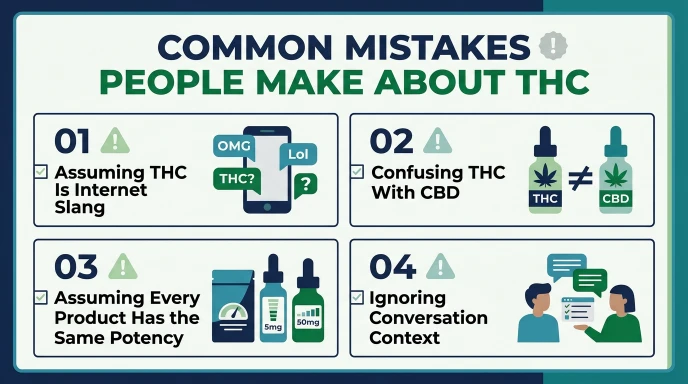
People sometimes misunderstand THC because they encounter it in casual conversations rather than scientific explanations. A few distinctions can prevent confusion.
Mistake 1: Assuming THC Is Just Internet Slang
THC is a recognized scientific abbreviation. People use it informally, but its usual meaning comes from the name of a chemical compound.
Mistake 2: Confusing THC With CBD
THC and CBD are different compounds. They should not be treated as interchangeable terms.
Mistake 3: Assuming THC Always Means a Product Is Strong
The presence of THC alone does not tell you the product’s exact potency. The amount, concentration, product type, and other factors matter.
Mistake 4: Assuming Every Use Has a Cannabis Meaning
THC can also stand for other terms in specialized contexts, including business, science, and organizations. If the conversation is unrelated to cannabis, consider the broader context.
Mistake 5: Assuming THC Free Means Every Cannabinoid Is Absent
A claim that a product is THC free does not automatically mean it contains no CBD or other cannabis derived compounds. Product labels and testing details matter.
The best approach is to read the full message rather than interpreting three letters in isolation.
Frequently Asked Questions About THC in Text
1. What does THC mean in a text message?
THC usually stands for tetrahydrocannabinol, the main intoxicating compound in cannabis. People use it when discussing cannabis, product ingredients, potency, or effects.
2. Is THC a slang word?
Not exactly. THC is primarily a scientific abbreviation, although people commonly use it in casual messages and online conversations.
3. What does THC mean on Snapchat?
On Snapchat, THC generally refers to tetrahydrocannabinol. The exact subject may involve a product, cannabis related content, or the compound’s effects.
4. What does THC mean on TikTok?
On TikTok, THC usually has the same meaning. It often appears in educational videos, captions, comments, and discussions about cannabis.
5. What does THC stand for in medical or scientific discussions?
THC stands for tetrahydrocannabinol. In medical or scientific contexts, it refers to a compound found in cannabis that can produce intoxicating effects.
6. Is THC the same as marijuana?
No. THC is a chemical compound found in cannabis, while marijuana refers to cannabis used as a drug. The terms are related, but they do not mean the same thing.
7. Does THC always mean someone is talking about getting high?
No. Someone might discuss THC in relation to scientific research, product testing, ingredients, regulations, or health effects without discussing personal use.
8. What is the difference between THC and CBD?
THC is associated with cannabis’s intoxicating high. CBD generally does not produce that same high, although it can still affect the body.
9. What does high THC mean?
High THC generally describes a cannabis product with a relatively high THC concentration. It does not guarantee a particular effect because responses can vary between individuals and products.
10. How can I tell what THC means in a message?
Look at the surrounding conversation. Words such as “cannabis,” “CBD,” “percentage,” “product,” or “drug test” strongly suggest the usual chemical meaning. If the conversation concerns a company, team, or technical subject, the letters could mean something else.
Final Thoughts
THC in text usually means tetrahydrocannabinol, the primary intoxicating compound in cannabis. It is an abbreviation rather than a traditional slang expression, but people frequently use it in casual conversations, Snapchat messages, TikTok comments, Instagram posts, and online communities.
When you see THC in a message, check if the person is discussing cannabis, product ingredients, potency, or possible effects. If the conversation is about something unrelated, consider if the letters have a specialized meaning in that context.
The simplest rule is to remember that THC usually refers to the cannabis compound, but context helps confirm its meaning.
Discover More Articles:

I research internet slang, texting abbreviations, and online language to create clear, accurate, and easy-to-understand content. My goal is to make modern internet language simple by publishing well-researched, regularly updated explanations based on trusted sources.