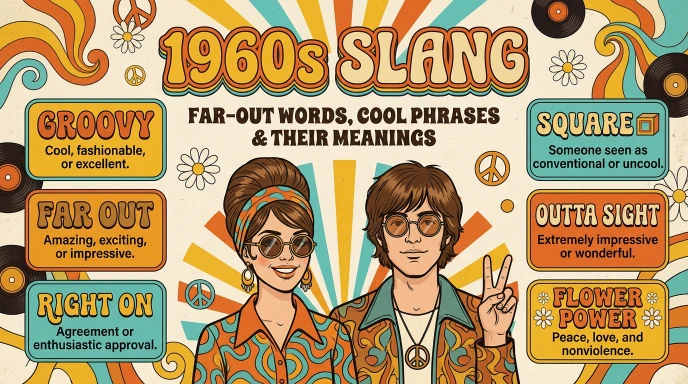
1960s slang was full of groovy expressions, cool compliments, playful insults, and phrases that reflected the music, fashion, and counterculture of the decade.
Words like groovy, far out, hippie, and mod became closely associated with the swinging sixties, while phrases such as right on! expressed excitement, agreement, or support.
The 1960s were a period of major cultural change. Rock and roll, Motown, the British Invasion, the civil rights movement, and the hippie counterculture all influenced the way people spoke. Teenagers, musicians, activists, and everyday Americans used distinctive expressions to communicate their identities and attitudes.
Some of these phrases existed before the 1960s and simply became more popular during the decade. Others became strongly associated with particular youth movements or musical scenes. Not everyone used the same slang, either: expressions varied by region, age, community, and social group.
If you want to understand vintage movies, classic songs, old television shows, or the language of the sixties, learning these expressions is a great place to start.
Quick Answer
1960s slang refers to the informal words and expressions popular among different groups during the 1960s. Many reflected youth culture, rock music, fashion, social change, and the emerging counterculture.
Here are some famous examples:
- Groovy: Excellent, fashionable, or enjoyable.
- Far out: Amazing, unusual, or impressive.
- Right on!: I agree, that’s correct, or I support you.
- Cool: Stylish, impressive, or acceptable.
- Hip: Fashionable, informed, or aware of current culture.
- Dig it: Understand it, appreciate it, or enjoy it.
- Flower power: A slogan associated with peace and nonviolent counterculture.
- Hippie: A person associated with the counterculture and alternative lifestyles.
- Mod: A member of a youth subculture known for modern fashion and music.
- Outta sight: Extremely impressive or exciting.
The best known sixties expressions often communicated enthusiasm, individuality, and a desire to challenge conventional attitudes. However, their meanings depended on the speaker and situation.
50+ Popular 1960s Slang Words and Their Meanings
The following expressions help capture the language and cultural atmosphere of the decade. Some were especially associated with the 1960s, while others were older expressions that remained popular during that era.
1. Groovy
Meaning: Excellent, fashionable, enjoyable, or appealing.
Groovy is one of the most recognizable expressions associated with the 1960s. It was used to praise music, clothes, people, and experiences.
Example: “That is a groovy song!”
Today, the word often creates a playful vintage feeling.
2. Far Out
Meaning: Amazing, extraordinary, or unconventional.
People used far out to react to something exciting, surprising, or unusual. It became strongly associated with psychedelic music and counterculture.
Example: “You got tickets to the concert? Far out!”
3. Right On!
Meaning: I agree, that’s right, or I support you.
Right on expressed approval and encouragement. It could be used in conversations about music, politics, social issues, or everyday situations.
Example: “Everyone deserves to be treated fairly.” “Right on!”
4. Cool
Meaning: Good, impressive, fashionable, or acceptable.
Cool was not invented in the sixties, but it remained a widely understood expression during the decade.
Example: “You got a new guitar? Cool!”
5. Hip
Meaning: Fashionable, knowledgeable, or aware of current trends.
Someone described as hip was seen as understanding the latest music, fashion, ideas, or cultural movements.
Example: “He’s really hip to the new music scene.”
6. Dig It
Meaning: Understand, appreciate, or enjoy something.
Dig it was a casual way to ask if someone understood or liked an idea.
Example: “Listen to that bass line. Dig it?”
7. Outta Sight
Meaning: Extremely good, impressive, or exciting.
This expression was used to show enthusiasm about something outstanding.
Example: “That band’s performance was outta sight!”
8. Boss
Meaning: Excellent, impressive, or stylish.
In some youth slang, boss was an approving way to describe something particularly good.
Example: “Those boots are boss!”
9. Neat
Meaning: Good, enjoyable, or pleasing.
Neat was a friendly expression of approval that appeared in everyday American speech.
Example: “We had a neat time at the party.”
10. Bummer
Meaning: A disappointing, unfortunate, or frustrating situation.
Bummer was used to express sympathy or disappointment.
Example: “The concert was canceled.” “What a bummer!”
11. Heavy
Meaning: Serious, emotionally powerful, intense, or thought provoking.
Heavy could describe a difficult conversation, meaningful music, or a powerful experience.
Example: “That movie has a heavy message.”
12. Trippy
Meaning: Strange, surreal, dreamlike, or psychedelic.
The word was associated with psychedelic art, music, and experiences during the decade.
Example: “Those colors look really trippy.”
13. Psychedelic
Meaning: Relating to art, music, or experiences characterized by vivid colors, unusual imagery, or altered perceptions.
Psychedelic became an important cultural term during the sixties.
Example: “The band used psychedelic artwork on its album cover.”
14. Hippie
Meaning: A person associated with the 1960s counterculture, often linked to peace, communal living, alternative fashion, and opposition to certain social conventions.
Example: “The festival attracted a crowd of hippies.”
The term covered a diverse movement rather than one single lifestyle.
15. Flower Power
Meaning: A slogan associated with peace, love, and nonviolent protest.
Flower power became a recognizable symbol of the counterculture, particularly in opposition to war.
Example: “The poster used flowers to represent flower power.”
16. Peace, Man
Meaning: A casual expression of peace, friendliness, or goodwill.
The word man could be added as an informal form of address.
Example: “See you later. Peace, man!”
17. Make Love, Not War
Meaning: A slogan promoting love and peace over armed conflict.
The phrase became closely associated with antiwar activism and the counterculture of the era.
Example: “Their signs read, ‘Make Love, Not War.’”
18. Mod
Meaning: A member of a British youth subculture associated with modern fashion, tailored clothing, scooters, and particular music scenes.
The Mod movement began before the 1960s but became especially influential in Britain during the decade.
Example: “He dressed like a Mod in a sharp suit and polished shoes.”
19. Swinging
Meaning: Exciting, fashionable, lively, or culturally vibrant.
The phrase Swinging London described London’s energetic youth culture, fashion, music, and nightlife during the sixties.
Example: “The magazine celebrated swinging London.”
20. Beatnik
Meaning: A person associated with the Beat influenced artistic and literary scene.
Beatnik culture developed mainly in the 1950s but remained part of the cultural landscape as the 1960s began.
Example: “The coffeehouse attracted poets and beatniks.”
21. Flower Child
Meaning: A person associated with the peace oriented hippie counterculture.
The phrase often suggested idealism, colorful clothing, and a preference for peace and love.
Example: “She wore flowers in her hair and embraced the flower child look.”
22. Square
Meaning: A conventional, old fashioned, or unadventurous person.
Calling someone a square suggested that they did not understand or accept a particular youth culture.
Example: “Don’t be such a square come to the dance!”
23. Straight
Meaning: Conventional or mainstream, particularly in contrast with counterculture lifestyles.
The word had several meanings, so the intended sense depended on the conversation.
Example: “He preferred a straight, traditional lifestyle.”
24. Establishment
Meaning: The people or institutions seen as holding conventional authority and power.
Counterculture activists often used the establishment when criticizing traditional political and social structures.
Example: “The protesters challenged the establishment.”
25. Hang Loose
Meaning: Relax, stay calm, or avoid worrying too much.
The expression was associated with a laid back attitude and surf culture.
Example: “Hang loose we have plenty of time.”
26. Take It Easy
Meaning: Relax, slow down, or avoid becoming upset.
This expression existed long before the sixties but remained common in casual conversation.
Example: “Take it easy, man. There’s no need to argue.”
27. Catch You on the Flip Side
Meaning: See you later.
This casual farewell was associated with records and the idea of turning a record over to hear the other side.
Example: “I’m heading home. Catch you on the flip side!”
28. What’s Your Bag?
Meaning: What is your interest, concern, attitude, or personal style?
The slang sense of bag could refer to someone’s thing or particular approach.
Example: “Jazz is my bag. What’s yours?”
29. It’s a Gas
Meaning: It’s exciting, entertaining, or a lot of fun.
Gas was used in some informal settings to describe something enjoyable.
Example: “That party was a gas!”
30. The Pits
Meaning: Something terrible, unpleasant, or disappointing.
This expression was used to criticize a bad experience or situation.
Example: “Waiting in the rain for two hours was the pits.”
31. Pad
Meaning: A person’s home or apartment.
Pad was a casual term for a place where someone lived or spent time.
Example: “Come over to my pad after the movie.”
32. Dig
Meaning: Like, appreciate, understand, or enjoy.
As well as appearing in the phrase dig it, the word could stand alone.
Example: “I really dig that band’s sound.”
33. Threads
Meaning: Clothes or an outfit.
Threads was a playful way to talk about clothing.
Example: “Check out his new threads!”
34. Bread
Meaning: Money.
Bread was informal slang for money and was not limited to the 1960s.
Example: “I need to earn some bread before the weekend.”
35. Cat
Meaning: A person, especially a man or someone involved in a music or artistic scene.
The word had a long history in jazz culture and continued to be used in some sixties circles.
Example: “He’s a cool cat who knows his jazz.”
36. Chick
Meaning: An informal term for a girl or young woman.
The word was common in some casual conversations but could sound dismissive depending on the speaker and context.
Example: “She’s a talented chick in the local band.”
37. Doll
Meaning: An affectionate or old fashioned term for a girl or woman.
The word was used before the 1960s and remained familiar during the decade.
Example: “Thanks for your help, doll.”
Its tone could sound charming, dated, or patronizing depending on the situation.
38. Dig the Scene
Meaning: Enjoy or appreciate a particular social environment, music scene, or cultural setting.
Example: “I really dig the local music scene.”
This phrase combines dig, meaning appreciate, with scene, meaning a social or cultural environment.
39. Get With It
Meaning: Become informed, catch up, or adapt to what is happening.
Example: “Get with it the band is starting!”
The phrase could be encouraging or mildly critical depending on tone.
40. Don’t Flip Out
Meaning: Don’t panic, lose your temper, or overreact.
Example: “Don’t flip out, it’s only a small mistake.”
The expression was informal and continued beyond the sixties.
41. Freak Out
Meaning: React with extreme excitement, fear, surprise, or distress.
The exact meaning depends on the situation.
Example: “She’ll freak out when she sees the concert tickets.”
42. Far Out Fashion
Meaning: Unusual, bold, or unconventional clothing.
Far out could describe fashion that looked different from mainstream styles.
Example: “His far out jacket turned heads at the party.”
43. Keep on Truckin’
Meaning: Keep going, continue your effort, or persevere.
The phrase became especially recognizable through counterculture imagery and popular graphic art in the late 1960s and early 1970s.
Example: “Things are tough, but keep on truckin’!”
44. Right On, Brother
Meaning: A statement of agreement, solidarity, or support.
Example: “We need to stand up for what’s right.” “Right on, brother!”
The phrase was especially suited to informal conversations and public expressions of shared values.
45. Sock It to Me
Meaning: Give it to me, bring it on, or deliver something with energy.
The expression became widely recognizable in popular entertainment during the decade, including television comedy.
Example: “You’ve got a surprise for me? Sock it to me!”
Its exact meaning depends on the situation.
46. Can You Dig It?
Meaning: Do you understand, appreciate, or agree with this?
Example: “We’re going to play all night. Can you dig it?”
It could be a genuine question or an enthusiastic way to emphasize an idea.
47. Outta This World
Meaning: Extraordinary, fantastic, or unbelievably good.
The phrase was used to praise something impressive and remained popular beyond the sixties.
Example: “That live performance was outta this world!”
48. Far Out Man
Meaning: A casual expression of amazement or approval, often associated with counterculture speech.
Example: “You built that guitar yourself? Far out, man!”
49. What a Trip!
Meaning: What a strange, surprising, or memorable experience!
The expression could describe something funny, unusual, confusing, or extraordinary.
Example: “That dream was wild. What a trip!”
50. Good Vibrations
Meaning: Positive feelings, a pleasant atmosphere, or a sense of optimism.
The phrase became particularly recognizable through popular music in the 1960s.
Example: “This place has good vibrations.”
51. Sock Hop
Meaning: A casual dance event, often associated with teenagers and popular music.
The term originated before the 1960s but remained part of the era’s youth culture vocabulary.
Example: “The school organized a sock hop on Friday night.”
52. Cruisin’
Meaning: Driving or riding around for enjoyment, often without a particular destination.
Example: “We spent Saturday night cruisin’ around town.”
The expression was associated with car culture, youth gatherings, and leisure.
53. Scene
Meaning: A particular social group, cultural environment, or area of interest.
Example: “She’s part of the local folk music scene.”
54. Blow Your Mind
Meaning: Amaze, astonish, or impress someone greatly.
Example: “Wait until you hear this solo it’ll blow your mind!”
55. Far Out Sounds
Meaning: Unusual, experimental, or exciting music.
Example: “The band is experimenting with far out sounds.”
This phrase reflects the era’s interest in new musical techniques and unconventional styles.
1960s Slang for Cool and Amazing Things
The sixties offered plenty of ways to praise something or express excitement. These expressions are useful when you want to recreate the enthusiastic, informal style often associated with the decade.
| Slang | Meaning | Example |
| Groovy | Excellent or enjoyable | “That tune is groovy.” |
| Far out | Amazing or unusual | “Far out! What a show.” |
| Outta sight | Extremely impressive | “Your guitar solo was outta sight.” |
| Boss | Excellent or stylish | “That’s a boss jacket.” |
| Neat | Nice or enjoyable | “We had a neat evening.” |
| Cool | Good or impressive | “Cool, I’ll see you there.” |
| It’s a gas | It’s a lot of fun | “The dance was a gas.” |
| Out of this world | Extraordinary | “The performance was out of this world.” |
Groovy and far out are especially recognizable sixties expressions today, although their popularity and use varied across different groups.
1960s Slang for Friends and People
Many expressions from the decade reflected how people addressed friends, described social groups, or talked about people whose attitudes differed from their own.
| Slang | Meaning | Example |
| Cat | A person, often linked with music or artistic culture | “He’s a cool cat.” |
| Chick | Informal term for a girl or young woman | “She’s a talented chick.” |
| Doll | An affectionate term for a woman | “Thanks, doll.” |
| Hippie | A person associated with counterculture | “The hippies gathered at the festival.” |
| Mod | A member of a British youth subculture | “He’s a Mod with sharp style.” |
| Beatnik | A person associated with the Beat influenced artistic scene | “The cafe attracted beatniks.” |
| Square | A conventional or unadventurous person | “Don’t be a square.” |
| Hip | Fashionable or culturally aware | “She’s hip to the new music.” |
Some of these words were affectionate in certain settings but could be rude, dismissive, or dated in others. Their tone depended on the speaker and the relationship.
1960s Slang for Money, Clothes, and Places
Everyday slang often focused on familiar subjects such as money, clothing, homes, and going out with friends.
| Slang | Meaning | Example |
| Bread | Money | “I need more bread.” |
| Threads | Clothes | “Those are sharp threads.” |
| Pad | Home or apartment | “Meet me at my pad.” |
| Scene | Social environment or cultural group | “The jazz scene is lively.” |
| Cruisin’ | Driving around for enjoyment | “We’re cruisin’ tonight.” |
| Sock hop | A casual dance event | “The school is having a sock hop.” |
These words show how slang can grow from ordinary objects and activities. A word such as bread becomes a metaphor for money, while pad becomes a casual name for a home.
1960s Hippie Slang and Counterculture Expressions
The counterculture became one of the most recognizable parts of the sixties. Some young people challenged conventional expectations about fashion, music, politics, relationships, and lifestyle. The slang associated with these movements reflected ideals such as peace, freedom, self expression, and community.
Flower Power
Flower power represented peace and nonviolent protest. Flowers became visual symbols in demonstrations and counterculture imagery.
Example: “The rally featured flower power posters.”
Peace, Man
A casual expression of friendliness or goodwill.
Example: “See you tomorrow. Peace, man!”
Far Out
A way to express amazement at something unusual, exciting, or unconventional.
Example: “That psychedelic painting is far out.”
Heavy
A way to describe something serious, emotionally powerful, or thought provoking.
Example: “That conversation was heavy.”
Square
A label for someone considered conventional or unwilling to embrace alternative ideas.
Example: “He called the rules square.”
Hang Loose
A relaxed expression meaning to stay calm or take things easy.
Example: “Hang loose we’ll figure it out.”
Keep on Truckin’
A phrase encouraging someone to continue despite difficulties.
Example: “Keep on truckin’, and don’t give up.”
Not every young person in the 1960s was a hippie, and not every counterculture expression was used by everyone. The decade contained many different communities, each with its own language and traditions.
How Music Influenced 1960s Slang
Music helped popularize many expressions associated with the decade. Rock, soul, folk, Motown, surf music, and psychedelic sounds reached large audiences through records, radio, concerts, and television.
The words people used often reflected their musical interests and social circles.
- Groovy: Used to praise music, rhythm, fashion, or an enjoyable experience.
- Cool: A longstanding expression of approval, common in many music communities.
- Dig it: Used to ask if someone appreciated a song or understood a musical idea.
- Heavy: Used for music or lyrics that felt serious or emotionally intense.
- Trippy: Associated with unusual, surreal, or psychedelic sounds and imagery.
- Outta sight: A way to describe an impressive performance.
- Good vibrations: An expression of positive feelings that also became recognizable through popular music.
The decade’s music scenes were diverse. British Mod culture, American surf culture, jazz communities, folk musicians, and psychedelic rock audiences did not necessarily use exactly the same slang.
Music did not create every sixties expression, but it helped some words travel between communities and reach wider audiences.
1960s Slang vs. Modern Slang
Slang changes with time, technology, music, and social habits. Some sixties expressions remain understandable today, while others now sound deliberately vintage.
| 1960s expression | Modern equivalent or similar phrase |
| Groovy | Cool, awesome |
| Far out | That’s wild, amazing |
| Right on | Exactly, facts |
| Bummer | That sucks, what a shame |
| Dig it | Get it, understand |
| Outta sight | Incredible, next level |
| Pad | Place, apartment |
| Bread | Cash, money |
| Heavy | Deep, intense |
| Hang loose | Chill, relax |
| Square | Old fashioned, out of touch |
| Blow your mind | Blow your mind, that’s wild |
These are approximate comparisons, not exact replacements. Modern expressions may have different tones or connotations depending on the community.
For example, right on and facts can both express agreement, but they developed in different cultural settings and are not interchangeable in every situation.
The biggest difference is that slang reflects the era and community in which people use it. Saying groovy today may be a sincere choice, a joke, or a deliberate reference to vintage culture.
How to Use 1960s Slang in a Sentence
If you want to write dialogue, create a retro caption, or understand old fashioned expressions, these examples show how sixties slang can fit naturally into a conversation.
Example 1: Talking About Music
“Man, that band is groovy. I could listen to them all night.”
Meaning: The band is excellent or enjoyable.
Example 2: Reacting to Surprising News
“You got us backstage passes? Far out!”
Meaning: That is amazing news.
Example 3: Agreeing With a Friend
“We should give everyone a fair chance.”
“Right on!”
Meaning: I agree with you.
Example 4: Talking About Home
“Come over to my pad after the movie.”
Meaning: Come to my home or apartment.
Example 5: Describing a Disappointing Situation
“The show got canceled at the last minute.”
“What a bummer!”
Meaning: That’s disappointing.
Example 6: Talking About Clothes
“Those threads are really cool.”
Meaning: The clothes look stylish.
Example 7: Encouraging a Friend
“Things are difficult, but keep on truckin’.”
Meaning: Keep going and do not give up.
Example 8: Asking About Music
“You like this new sound? Can you dig it?”
Meaning: Do you understand or appreciate it?
For authentic dialogue, choose expressions that fit the character’s age, location, interests, and social group. Using too many slang terms in one sentence can make the dialogue feel like a parody rather than a natural conversation.
Frequently Asked Questions About 1960s Slang
What was the most popular slang word in the 1960s?
There was no single slang word used by everyone, but groovy is among the most recognizable expressions associated with the decade. Far out, cool, right on, and dig it are also strongly linked with sixties speech.
What did groovy mean in the 1960s?
Groovy meant excellent, enjoyable, fashionable, or appealing. It could describe music, clothing, people, or an experience.
What did far out mean in the 1960s?
Far out expressed amazement, excitement, or appreciation for something unusual or impressive. It was especially associated with counterculture and psychedelic music.
What did right on mean?
Right on expressed agreement, approval, or support. It could be used in ordinary conversation or when responding to someone’s opinion.
What slang did hippies use?
Expressions associated with hippie and counterculture communities included groovy, far out, heavy, dig it, and peace, man. Flower power was an important slogan, while keep on truckin’ became a recognizable encouragement to persevere.
What did square mean in the sixties?
Square described someone considered conventional, old fashioned, or out of touch with a particular youth culture.
What did bread mean in 1960s slang?
Bread was an informal word for money. It had a longer history and was not exclusive to the sixties.
What did pad mean in the 1960s?
Pad meant someone’s home or apartment. It was a casual way to refer to a place where a person lived.
Is 1960s slang still used today?
Yes. Words such as cool and bummer remain common, while groovy and far out are still understood but may sound nostalgic, playful, or deliberately retro.
Did everyone use the same 1960s slang?
No. Slang varied by location, age, race, music scene, social class, and cultural group. Expressions used by British Mods, American hippies, jazz musicians, and teenagers in different regions could differ considerably.
What is a famous 1960s phrase about peace?
“Make Love, Not War” was a famous slogan associated with peace activism and opposition to war during the era.
What is the difference between 1950s and 1960s slang?
There was overlap between the decades. Some expressions carried over from earlier years, while the sixties also became associated with counterculture vocabulary, psychedelic music, and slogans about peace and social change.
Final Thoughts on 1960s Slang
1960s slang captures the creativity, humor, music, and cultural changes of one of the most recognizable decades in modern history. Expressions such as groovy, far out, right on, and dig it offered casual ways to show excitement, agreement, and appreciation.
Other words, including hippie, Mod, square, and flower child, reflected the identities and social movements of the time. Everyday expressions such as bread, threads, and pad show that slang was not limited to music or politics; people also used it to talk about money, clothes, and home life.
Some of these expressions remain common, while others are mainly used to create a vintage atmosphere or refer to sixties culture.
if you are exploring old movies, studying cultural history, writing retro dialogue, or looking for a fun caption, these expressions offer a glimpse into how people spoke during the decade.
In short, sixties slang was more than a collection of trendy words. It reflected the different communities, creative movements, and changing attitudes that shaped life during the 1960s.
Discover More Articles:

I research internet slang, texting abbreviations, and online language to create clear, accurate, and easy-to-understand content. My goal is to make modern internet language simple by publishing well-researched, regularly updated explanations based on trusted sources.