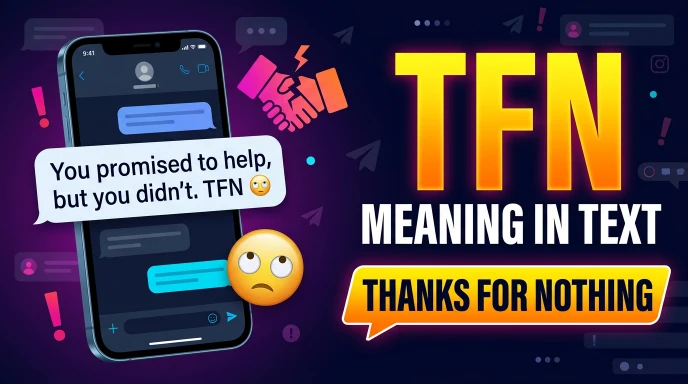
TFN in text most commonly means “Thanks for Nothing” in informal conversations, usually when someone feels disappointed, annoyed, or let down. However, its meaning can change depending on the context and the conversation.
You might see TFN in text messages, social media comments, or online chats when someone wants to express frustration sarcastically.
For example, if a friend promises to help you move but never shows up, you might text, “You left me to do everything alone. TFN 🙄” to express disappointment or frustration.
Understanding the tone is important because TFN can sound sarcastic, hurt, or playful, depending on who sends it and what happened..
Quick Answer of what does tfn mean in text
TFN means “Thanks for Nothing” in texting. People use it to express disappointment, frustration, or sarcasm when someone fails to help or do what they promised. It can be playful between friends or rude in a serious argument.
TFN Meaning in Text
TFN is an abbreviation for “Thanks for Nothing.” It is often used when someone expects help, support, or a favor but receives nothing.
Although the phrase contains the word “thanks,” it usually isn’t genuine gratitude. Instead, it communicates the opposite: the sender feels that the other person has been unhelpful.
For example:
- “You said you’d help me move, but you never came. TFN.”
- “I waited an hour for you. TFN 🙄”
- “TFN for leaving me to do everything myself.”
In these examples, TFN expresses disappointment or annoyance. It may also be used humorously when friends tease each other about a small mistake.
Like many text abbreviations, TFN is not guaranteed to mean the same thing in every conversation. If the message is about a work schedule, a technical subject, or another specific topic, it could have a different meaning.
What Does TFN Stand for?
TFN usually stands for “Thanks for Nothing” in casual texting.
The phrase is often used sarcastically. Instead of thanking someone for being helpful, the sender points out that the person did not help at all.
Here is a simple breakdown:
- T: Thanks
- F: For
- N: Nothing
Imagine asking someone to save you a seat, only to discover that they forgot. You might send “TFN 😂” as a sarcastic response.
The abbreviation is short, but its tone can be strong. It may sound funny between close friends or hurtful when used during a disagreement.
How Is TFN Used in Text Messages?
People may use TFN in different situations, depending on their relationship and the tone of the conversation.
1. To Show Disappointment
Someone might use TFN when another person fails to keep a promise.
Example:
“Thanks for saying you’d pick me up and then forgetting. TFN.”
The sender feels let down and uses the abbreviation sarcastically.
2. To Express Annoyance
TFN can communicate irritation when someone expects help but receives none.
Example:
“I did the whole project myself. TFN for your contribution.”
This message suggests that the sender is frustrated with the other person’s lack of effort.
3. To Make a Sarcastic Joke
Friends sometimes use TFN playfully over small things.
Example:
“You ate the last slice of pizza and didn’t save me any. TFN 😂”
The emoji and the relationship between the people can make the message sound humorous rather than angry.
4. To Respond to Broken Promises
When someone promises to do something and fails to follow through, TFN can be a pointed response.
Example:
“You promised to send me the notes yesterday. TFN.”
Depending on the situation, the message may communicate disappointment or resentment.
10 Real Chat Examples of TFN
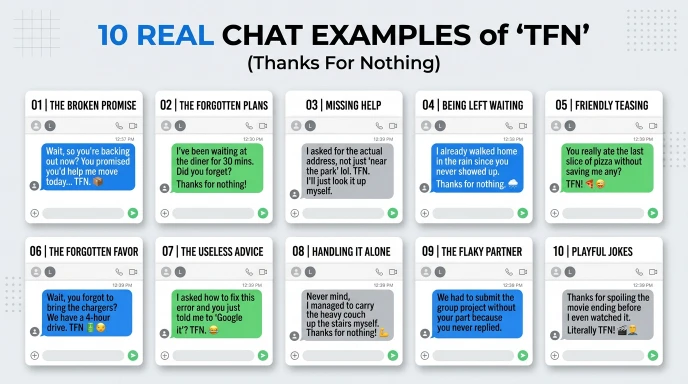
These conversations show how TFN might appear in everyday messages.
Example 1: A Friend Doesn’t Help
Alex: Did you finish helping me clean?
Jordan: Sorry, I forgot to come over.
Alex: TFN 😒
Here, Alex feels disappointed because Jordan did not help as promised.
Example 2: Someone Forgets Your Birthday
Mia: You forgot my birthday!
Lily: I’m so sorry. I completely forgot.
Mia: TFN 😂
Mia might be joking, although the real tone depends on how she feels.
Example 3: A Missing Favor
Sam: Did you bring the book I asked for?
Chris: No, I left it at home.
Sam: TFN lol.
Sam uses TFN to tease Chris for forgetting.
Example 4: A Group Project
Taylor: I finished all the slides myself.
Morgan: Wait, you did the entire presentation?
Taylor: Yep. TFN for the help.
Taylor is expressing frustration about doing all the work alone.
Example 5: A Late Friend
Jamie: I’ve been waiting outside for 30 minutes.
Riley: I’m running late. Give me 10 more minutes.
Jamie: TFN 🙄
Jamie is annoyed about having to wait.
Example 6: A Playful Food Complaint
Ava: You finished all the fries?
Noah: They were too good!
Ava: TFN 😂
This is likely playful sarcasm between friends.
Example 7: Someone Doesn’t Reply
Ethan: Did you ask them about the tickets?
Olivia: I forgot to message them.
Ethan: TFN, now they’re sold out.
Ethan is frustrated because the missed task caused a problem.
Example 8: A Forgotten Assignment
Mason: Did you send me the homework answers?
Sophia: Sorry, I forgot.
Mason: TFN 😭
Mason uses TFN to express disappointment, possibly in an exaggerated or humorous way.
Example 9: A Family Favor
Emma: You said you’d help me carry the boxes.
Lucas: I got busy with something else.
Emma: TFN. I had to do it alone.
Here, TFN communicates genuine frustration.
Example 10: A Small Everyday Mistake
Chris: You didn’t bring me a coffee?
Jamie: I didn’t know you wanted one!
Chris: TFN 😂
Chris is probably joking, especially if the conversation is lighthearted.
What Does TFN Mean on Social Media?
On social media, TFN can be used in comments, captions, private messages, and replies. When it means “Thanks for Nothing,” it generally communicates sarcasm or disappointment.
TFN on TikTok
Someone might use TFN in a comment about a disappointing situation, a failed promise, or a humorous video about an unhelpful friend.
The video’s tone can help you decide whether the comment is serious or sarcastic.
TFN on Snapchat
On Snapchat, TFN may appear in private conversations between friends. It can be a quick response when someone forgets a favor or lets the sender down.
For example:
“Didn’t save me any snacks? TFN 😂”
TFN on Instagram
On Instagram, people may use TFN in direct messages or comments when reacting to an unhelpful action or a disappointing experience.
However, not every occurrence of TFN is necessarily slang. Check the context before interpreting it.
TFN in Group Chats
In group chats, TFN may be directed at someone who forgot a plan, failed to contribute, or left others to handle a task.
Whether it is friendly teasing or genuine criticism depends on the group’s usual communication style.
How to Reply When Someone Says TFN
The best response depends on whether the sender is joking or genuinely upset.
1. If They Are Joking
If you know the person is teasing you, a lighthearted reply may work.
- “LOL, my bad 😂”
- “I’ll make it up to you!”
- “Next time, I’ve got you.”
- “Don’t worry, I’ll redeem myself.”
2. If They Are Genuinely Upset
If your actions caused a real problem, acknowledge the situation instead of responding sarcastically.
- “I’m sorry I let you down.”
- “You’re right. I should have helped.”
- “I understand why you’re upset.”
- “I’ll make sure it doesn’t happen again.”
3. If You Don’t Understand Their Message
If you’re unsure what TFN means in that conversation, ask directly.
- “What do you mean by TFN?”
- “Are you joking or are you upset?”
- “Did I do something wrong?”
4. If Someone Uses It Rudely
You can respond calmly and ask what the issue is.
- “I can tell you’re upset. What happened?”
- “Let’s talk about it instead of arguing.”
- “I’m willing to help, but please explain what went wrong.”
A calm reply can prevent a misunderstanding from turning into a bigger argument.
Is TFN Rude or Offensive?
TFN is not necessarily offensive, but it can sound rude or sarcastic.
Because “Thanks for Nothing” implies that someone has been unhelpful, the phrase may hurt the recipient’s feelings if the situation is serious.
TFN may sound playful when:
- Friends are teasing each other.
- The mistake is minor.
- The conversation includes laughing emojis.
- Both people understand the joke.
TFN may sound rude when:
- Someone genuinely feels abandoned.
- A person failed to keep an important promise.
- The message is sent during an argument.
- The sender wants to blame or embarrass someone.
For example, “You ate my last cookie. TFN 😂” sounds more playful than “I needed your help during an emergency, and you ignored me. TFN.”
The phrase itself does not tell the whole story. Tone, timing, and relationship matter.
Who Uses TFN?
TFN may be used by people who communicate through texts, online chats, or social media. It is not limited to a specific age group.
You might encounter it in:
- Friend conversations: When someone forgets a favor or plan.
- Family chats: When a family member fails to help.
- Group projects: When someone doesn’t contribute.
- Social media comments: When reacting sarcastically to a situation.
- Online conversations: When someone wants to express disappointment briefly.
Not everyone recognizes TFN, so writing out “Thanks for Nothing” may be clearer when talking to someone unfamiliar with the abbreviation.
The Origin of TFN
TFN is formed from the first letters of the phrase “Thanks for Nothing.” The phrase itself expresses sarcastic disappointment, while the abbreviation makes it quicker to type.
It is difficult to identify a single origin for TFN as a texting abbreviation without reliable historical evidence. It is safer not to claim that it began on a specific social media platform or in a particular year.
The meaning comes from the phrase it represents: the sender appears to offer thanks but is actually criticizing someone’s lack of help.
TFN vs. Other Text Abbreviations
TFN is used differently from several common texting abbreviations. The table below explains the differences.
| Abbreviation | Meaning | Type | Usage | Popularity |
| TFN | Thanks for Nothing | Sarcastic expression | Showing disappointment | Context-dependent |
| IDK | I Don’t Know | Text abbreviation | Expressing uncertainty | Widely recognized |
| IDC | I Don’t Care | Text abbreviation | Expressing indifference | Widely recognized |
| IMO | In My Opinion | Text abbreviation | Sharing an opinion | Widely recognized |
| BRB | Be Right Back | Text abbreviation | Temporarily leaving a conversation | Widely recognized |
These abbreviations are not interchangeable. TFN usually expresses disappointment, while IDK communicates uncertainty and BRB tells someone that you will return shortly.
Common Mistakes When Understanding TFN
Assuming It Is Always Serious
TFN can be used as a joke between friends. Check the tone before assuming the sender is angry.
Assuming It Is Always Friendly
The phrase can also communicate real frustration. If someone seems upset, don’t dismiss the message as a joke.
Confusing It With Other Acronyms
TFN can have different meanings in professional, technical, or regional contexts. In some countries and workplaces, it may refer to something unrelated to “Thanks for Nothing.”
Ignoring the Conversation
A short abbreviation can be difficult to interpret without context. Read the messages before and after it to understand the sender’s intention.
Frequently Asked Questions
What does TFN mean in text messages?
TFN commonly means “Thanks for Nothing.” It is used sarcastically when someone feels that another person has failed to help or keep a promise.
What does TFN mean on TikTok?
On TikTok, TFN may mean “Thanks for Nothing” when someone comments on a disappointing or frustrating situation. Its meaning still depends on the context.
Is TFN slang?
TFN can be used as informal texting slang when it stands for “Thanks for Nothing.” It can also have unrelated meanings in other contexts.
Is TFN rude or offensive?
It can sound rude because it often expresses disappointment or criticism. Between close friends, however, it may be used playfully.
How should you reply to TFN?
If the sender is joking, you can respond playfully. If they are upset, acknowledge their feelings and explain what happened.
Does TFN mean “Thanks for Nothing” everywhere?
No. Although “Thanks for Nothing” is a common interpretation in informal texting, TFN can stand for other things in professional, regional, or technical settings.
Can TFN be used sarcastically?
Yes. Sarcasm is a key part of its use as “Thanks for Nothing.” The sender may use it when someone fails to do something they expected.
Should I use TFN at work?
Be careful. It can sound passive-aggressive or unprofessional in workplace messages. A direct, polite explanation is usually a better choice.
Final Thoughts
TFN commonly means “Thanks for Nothing” in text messages. People use it to express sarcasm, disappointment, or frustration when someone fails to help or keep a promise.
Its tone can range from playful teasing to genuine annoyance. Before replying, consider the conversation and your relationship with the sender.
If the meaning is unclear, remember that abbreviations can vary by context. Asking a quick question is often the easiest way to avoid misunderstanding.
Discover More Articles:

I research internet slang, texting abbreviations, and online language to create clear, accurate, and easy-to-understand content. My goal is to make modern internet language simple by publishing well-researched, regularly updated explanations based on trusted sources.