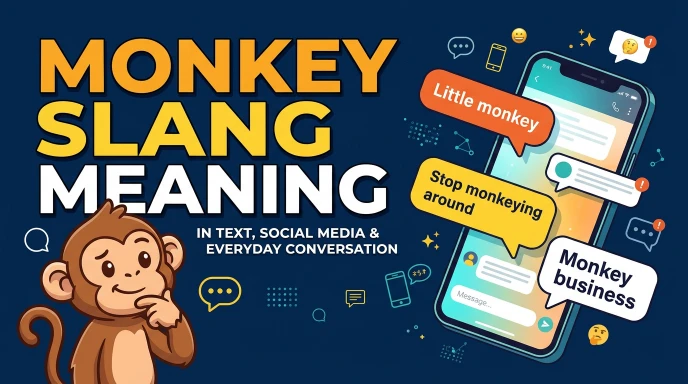
Monkey in slang can describe someone who is playful, silly, mischievous, or acting wildly.
Depending on the context, it can also refer to a person who copies others, behaves foolishly, or is involved in a particular expression, such as “monkey business.” The meaning can be affectionate, humorous, critical, or offensive.
You may see the word “monkey” in text messages, TikTok comments, Instagram captions, memes, and everyday conversations. Friends might use it as a playful nickname, while someone else might use it to criticize another person’s behavior.
The word also appears in popular expressions such as “monkey see, monkey do,” which describes copying someone else’s actions without thinking independently.
However, context matters because comparing a person to a monkey can be insulting. In particular, using monkey comparisons or imagery against someone because of their race can be racist and deeply offensive.
In this guide, you’ll learn the different meanings of monkey slang, how people use it in messages, what it means in common expressions, and how to understand the tone behind it.
Quick Answer of Monkey Slang Meaning
Monkey slang can mean a playful or mischievous person, someone acting silly, or someone who copies others. The exact meaning depends on the situation and the speaker’s intention.
Common examples include:
- “You little monkey!” A playful way to describe someone mischievous.
- “Stop monkeying around.” Stop fooling around or wasting time.
- “Monkey see, monkey do.” Someone copies another person’s behavior.
- “There’s some monkey business going on.” Something suspicious, dishonest, or silly may be happening.
- “He’s acting like a monkey.” He is behaving wildly or energetically; depending on the tone, this can be teasing or insulting.
Important: Calling someone a monkey is not always harmless. The relationship, tone, situation, and cultural context determine how the word comes across.
What Does Monkey Mean in Slang?
In casual English, “monkey” can be used figuratively to describe behavior that seems playful, energetic, silly, or mischievous.
For example, a parent might call a child a “little monkey” after the child climbs on furniture or plays tricks. Friends might use the same expression when someone is being unusually playful.
The word can also describe foolish behavior. If someone keeps joking around when everyone else is trying to work, another person might say, “Stop acting like a monkey.”
Here are the main interpretations:
- Playful: Someone is energetic, cheeky, or full of fun.
- Mischievous: Someone likes playing tricks or getting into trouble.
- Silly: Someone is behaving in a foolish or funny way.
- Imitative: Someone copies another person’s behavior.
- Insulting: Someone uses the word to belittle another person.
The first three meanings often appear in friendly conversations, particularly when talking about children, siblings, or close friends. The imitative meaning appears in familiar sayings, while the insulting meaning depends heavily on context.
The word itself does not tell you if the speaker is joking or being mean. Pay attention to the full sentence and the relationship between the people involved.
Monkey Meaning in Text Messages
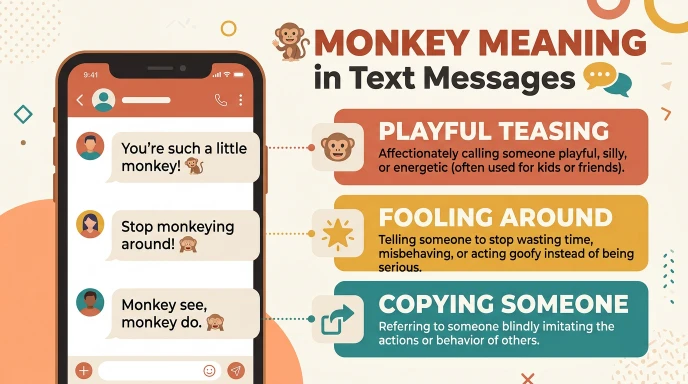
In texting, “monkey” can be a playful nickname, a reaction to someone’s behavior, or part of an expression.
Friends and family members may use it affectionately, especially when someone is acting silly or mischievous.
Example 1: Playful Teasing
Person A: “I climbed onto the sofa and knocked over the cushions 😂”
Person B: “You’re such a little monkey!”
Meaning: Person B is teasing Person A for being playful or mischievous.
Example 2: Fooling Around
Person A: “We spent the whole afternoon joking instead of studying.”
Person B: “Stop monkeying around and finish your homework!”
Meaning: The speaker wants the other person to stop fooling around and focus.
Example 3: Copying Someone
Person A: “He bought the exact same shoes after seeing mine.”
Person B: “Monkey see, monkey do.”
Meaning: Person B suggests that the person copied someone else’s choice.
Example 4: An Unclear or Insulting Message
Person A: “Why did he call me a monkey?”
Person B: “It depends on how he said it and what happened.”
Meaning: The word could have been playful teasing or an insult. More context is needed.
When you receive “monkey” in a message, consider if the conversation is lighthearted or tense before deciding how to interpret it.
Monkey Slang Meaning on TikTok and Instagram
On TikTok and Instagram, the word “monkey” can appear in memes, reaction videos, funny captions, animal videos, and comments about someone’s behavior.
Its meaning depends on what the post shows and what the caption says.
Monkey Slang on TikTok
TikTok users may use “monkey” to describe someone acting silly, being energetic, copying a trend, or making a funny mistake.
Examples include:
- “Bro is a whole monkey 😂”
- “Stop monkeying around!”
- “Monkey see, monkey do.”
- “My little monkey has too much energy.”
In a humorous video, “monkey” might describe exaggerated or chaotic behavior. In a video about a trend, the phrase “monkey see, monkey do” might criticize people for copying others without thinking.
However, the word can also be used as an insult. A comment comparing a real person to a monkey should be interpreted carefully, particularly when race or ethnicity is involved.
Monkey Slang on Instagram
On Instagram, the word may appear in captions about children, pets, siblings, friends, or funny everyday moments.
For example:
- “My little monkey never sits still.”
- “Weekend monkey business 😂”
- “Two monkeys causing trouble again.”
- “Monkey see, monkey do.”
A parent posting a picture of a child climbing around might use “little monkey” affectionately. Friends sharing a playful photo may use it to describe their mischievous behavior.
A monkey reference is not automatically an insult or a hidden slang code. The image, caption, and surrounding conversation help establish the intended meaning.
What Does “Little Monkey” Mean?
“Little monkey” is often an affectionate expression for a child or someone who behaves playfully, energetically, or mischievously.
Parents, grandparents, and close family members may use it when a child climbs, jumps, plays tricks, or gets into harmless trouble.
Examples:
- “Come here, you little monkey!”
- “That little monkey climbed onto the table again.”
- “My little monkey never gets tired.”
- “You’re a cheeky little monkey.”
In these examples, the expression is usually affectionate or teasing rather than a serious insult.
Friends may also use “little monkey” as a nickname when everyone understands that the word is being used playfully.
Still, the expression is not appropriate in every situation. Someone who does not know you well may interpret it differently, and using it toward an adult can sound patronizing or insulting.
What Does “Stop Monkeying Around” Mean?
“Monkeying around” means fooling around, playing unnecessarily, acting silly, or not taking something seriously.
This is a common English expression, not just a social media trend.
For example:
- “Stop monkeying around and get ready.”
- “The kids were monkeying around in the classroom.”
- “We wasted an hour monkeying around.”
- “Quit monkeying around with the equipment.”
The expression usually suggests that someone is distracted, playful, or behaving in a way that prevents them from completing a task.
It can sound friendly when used between friends, but it may sound like a warning when used by a parent, teacher, or supervisor.
For instance, “Stop monkeying around!” said with a laugh is different from the same words spoken angrily during a serious situation.
What Does “Monkey See, Monkey Do” Mean?
“Monkey see, monkey do” is a familiar saying that describes people copying what others do, often without considering if the behavior is sensible.
The phrase is frequently used when someone imitates a friend, follows a trend, or repeats another person’s actions simply because they have seen them.
Examples:
Example 1: Fashion
Person A: “Everyone started wearing those shoes after the celebrity wore them.”
Person B: “Monkey see, monkey do.”
Meaning: People are copying someone else’s style.
Example 2: Social media trends
Person A: “He started using that catchphrase because all his friends do.”
Person B: “Monkey see, monkey do.”
Meaning: He is imitating other people.
Example 3: Classroom behavior
A student copies another student’s silly behavior.
The teacher says, “Monkey see, monkey do.”
Meaning: The student is copying what someone else did.
The saying can be humorous, but it can also criticize people for following others without thinking independently.
What Does “Monkey Business” Mean?
“Monkey business” is an informal English expression meaning silly behavior, mischief, or suspicious activity.
The intended meaning depends on the situation.
When someone uses it to describe children playing around, it usually refers to harmless mischief. When someone uses it in a business or financial discussion, it can suggest dishonesty or something questionable.
Examples:
- “I don’t want any monkey business while I’m away.”
- “There’s some monkey business going on with those numbers.”
- “The kids were up to their usual monkey business.”
- “Let’s finish the job without any monkey business.”
In the first and third examples, the phrase can refer to foolish or mischievous behavior. In the second, it suggests that something may be wrong or dishonest.
This expression is different from simply calling someone a monkey. It is a set phrase with its own established meaning.
Is Calling Someone a Monkey a Compliment or an Insult?
Calling someone a monkey can be affectionate, humorous, or offensive. It depends on the relationship, the tone, the setting, and the cultural context.
| Situation | Possible meaning |
| A parent calls a playful child a little monkey | Affectionate teasing |
| Friends laugh while calling each other monkeys | Playful joking, if everyone is comfortable |
| Someone tells a person to stop monkeying around | A request to stop fooling around |
| Someone uses monkey to mock another person’s intelligence | An insult |
| Someone compares a person to a monkey because of their race | Racist and offensive abuse |
The last example is especially important. Monkey comparisons have a long history of racist use against Black people and other racialized groups. In that context, the word is not harmless playful slang.
If someone calls you a monkey and you are unsure what they mean, consider the situation and how they treat you. You can ask what they meant or tell them that you do not appreciate being called that.
Monkey vs. Other Similar Slang Words
Several English expressions describe someone who is playful, silly, or copying others. However, each has a slightly different meaning.
| Word or expression | Meaning | Example |
| Monkey | A playful or mischievous person; sometimes an insult | “You’re a little monkey.” |
| Goofball | Someone who behaves in a silly or funny way | “He’s such a goofball.” |
| Clown | Someone acting foolishly; can be teasing or insulting | “Stop acting like a clown.” |
| Copycat | Someone who copies another person | “Don’t be a copycat.” |
| Mischievous | Playfully causing trouble | “That mischievous kid hid my keys.” |
| Monkeying around | Fooling around instead of taking something seriously | “Stop monkeying around.” |
These terms overlap, but they are not interchangeable in every sentence.
For example, a “copycat” specifically imitates someone else, while a “goofball” is generally someone who behaves in a silly way. “Monkeying around” focuses on the behavior rather than describing a person’s identity.
How to Reply When Someone Calls You a Monkey
Your response depends on if the person is joking, teasing you affectionately, or trying to insult you.
If It Is Friendly Teasing
You could respond:
- “Haha, I can’t help it 😂”
- “Just keeping things interesting!”
- “You know I’m always up to something.”
- “At least I’m entertaining!”
These replies work when you understand the comment as a harmless joke and feel comfortable with it.
If You Want to Keep Things Casual
Try:
- “What do you mean by that?”
- “Why do you call me that?”
- “I’m not sure how to take that.”
These responses give the other person an opportunity to explain what they intended.
If It Feels Insulting
You can set a clear boundary:
- “Please don’t call me that.”
- “I don’t find that funny.”
- “What was that supposed to mean?”
- “That’s not okay with me.”
You do not have to laugh along with a comment that makes you uncomfortable. If the term is being used in a racist way, it is reasonable to identify it as offensive and seek support if necessary.
Common Misunderstandings About Monkey Slang Meaning
1. Monkey always means a silly person.
Not always. It can describe playful behavior, imitation, or mischief, but it can also be an insult.
2. Calling someone a monkey is always affectionate.
No. The same words can be friendly in one relationship and insulting in another. Cultural and racial context matters.
3. Monkey is always a new internet slang term.
No. Many uses come from established English expressions, such as “monkeying around” and “monkey business.”
4. “Monkey see, monkey do” means someone is intelligent.
The expression usually emphasizes imitation, often without independent thought. Depending on the situation, it can be humorous or critical.
5. Every monkey emoji has the same meaning as the word.
Not necessarily. The 🙈, 🙉, and 🙊 emojis are often used to express embarrassment, not wanting to hear something, or keeping quiet. Their meanings can also change with context.
Frequently Asked Questions
What does monkey mean in slang?
Monkey can describe a playful, silly, energetic, or mischievous person. It can also describe someone who copies others or act as an insult, depending on the context.
What does monkey mean in a text message?
In a text, monkey may be a playful nickname, a comment about someone’s behavior, or part of an expression such as “monkeying around.” The full message helps determine the meaning.
What does it mean when someone calls you a little monkey?
It often means the person thinks you are playful, cheeky, energetic, or mischievous. It may be affectionate teasing, but the relationship and tone matter.
What does monkeying around mean?
Monkeying around means fooling around, playing, or behaving in a silly way instead of concentrating on what needs to be done.
What does monkey business mean in slang?
Monkey business means mischief, silly behavior, or suspicious activity. The exact meaning depends on the situation.
Is monkey a bad word?
The word itself is not always offensive. However, it can be insulting, and monkey comparisons directed at people because of their race can be racist and deeply offensive.
What does monkey see, monkey do mean?
It means someone copies another person’s actions, often without thinking independently about what they are doing.
What does monkey mean on TikTok?
On TikTok, monkey may describe playful or chaotic behavior, appear in a meme, or be part of a familiar expression. The video’s context determines the intended meaning.
Is monkey slang used for friends?
Yes. Friends sometimes use monkey or little monkey as playful nicknames. It is best used only when the other person is comfortable with the expression.
Final Thoughts
The monkey slang meaning can range from playful and affectionate to critical or offensive. In everyday English, it may describe someone who is silly, energetic, mischievous, or copying others. Expressions such as “monkeying around,” “monkey business,” and “monkey see, monkey do” have their own established meanings.
If someone calls you a monkey in a text or online comment, look at the full conversation before deciding how to interpret it. A playful nickname between friends is very different from an insult intended to humiliate someone.
The simplest way to understand monkey slang is to consider the behavior being described, the speaker’s tone, and if the word is being used respectfully.
Discover More Articles:

I research internet slang, texting abbreviations, and online language to create clear, accurate, and easy-to-understand content. My goal is to make modern internet language simple by publishing well-researched, regularly updated explanations based on trusted sources.