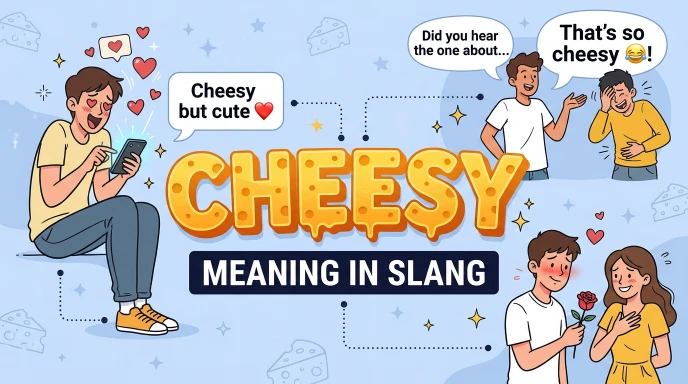
The cheesy meaning in slang usually describes something that feels overly sentimental, corny, predictable, or trying too hard to be funny or romantic.
People use “cheesy” for awkward pickup lines, romantic messages, old fashioned jokes, dramatic movie scenes, and anything that feels a little too sweet or unnatural.
For example, if someone texts, “You must be a magician because whenever I look at you, everyone else disappears,” you might call that line cheesy because it sounds like a familiar, exaggerated pickup line.
However, cheesy does not always mean bad. Sometimes, people use it affectionately to describe something cute, romantic, funny, or delightfully old fashioned.
You might see the word in text messages, TikTok comments, Instagram captions, Snapchat conversations, dating apps, and everyday discussions. Understanding the context helps you tell if someone is teasing you, criticizing something, or expressing affection.
Quick Answer: What Does Cheesy Mean in Slang?
Cheesy means corny, overly sentimental, predictable, or embarrassingly romantic or funny. It describes something that feels exaggerated, cliché, or a little too obvious.
For example:
- Romantic: “That love message was so cheesy.”
- Funny: “His joke was cheesy, but I laughed.”
- Cringey: “That pickup line is way too cheesy.”
- Affectionate: “Our anniversary photos are cheesy, but I love them.”
The tone matters. Calling something cheesy can be a playful compliment, a gentle tease, or a criticism.
What Does Cheesy Mean in Slang?
In casual conversation, cheesy describes something that feels corny, overly dramatic, sentimental, or lacking originality. It often refers to words, jokes, gestures, or scenes that rely on familiar ideas instead of feeling fresh or natural.
Imagine someone sending a message that says, “You are the sunshine that brightens my darkest days.” Some people might find it romantic, while others might call it cheesy because it sounds like a line from a predictable love story.
The word can also describe humor that is so simple or predictable that it becomes funny. A classic dad joke, for instance, might be cheesy without being offensive or genuinely bad.
Here are the most common meanings:
- Corny: A joke or line that feels predictable or old fashioned.
- Overly romantic: A message or gesture that expresses affection in an exaggerated way.
- Clichéd: Something that relies on familiar phrases, scenes, or ideas.
- Embarrassing: Something that makes people cringe a little because it feels awkward or unnatural.
- Sweet in a playful way: Something sentimental that people enjoy despite its cheesiness.
The key idea is that cheesy often describes how something comes across rather than if it is objectively good or bad.
Cheesy Meaning in Text Messages
In texting, cheesy usually means that a message sounds corny, overly romantic, or a little too dramatic. Friends may use it to tease each other, while couples might use it to describe affectionate messages.
For example, someone could send a long paragraph about how their partner makes every day special. Their partner might reply, “Aww, that’s so cheesy 😂❤️.”
That response does not necessarily mean the message was unwelcome. The emojis and the relationship between the people can make it sound affectionate.
Consider these text conversations:
Example 1: A romantic message
Person A: “You make my world brighter every single day.”
Person B: “Stoppp, that’s so cheesy 🥹❤️”
Meaning: Person B finds the message very sentimental but may genuinely appreciate it.
Example 2: A corny joke
Person A: “What did the cheese say to itself in the mirror?”
Person B: “I don’t know.”
Person A: “Looking gouda!”
Person B: “That was so cheesy 😂”
Meaning: The joke relies on an obvious pun, so the response playfully calls it corny.
Example 3: An awkward pickup line
Person A: “Are you a parking ticket? Because you’ve got FINE written all over you.”
Person B: “Bro, that line is cheesy 😭”
Meaning: The pickup line feels predictable or embarrassing.
Example 4: A sweet relationship moment
Person A: “I made us matching phone wallpapers.”
Person B: “That’s cheesy, but I’m keeping mine.”
Meaning: The gesture is sentimental, but the person likes it anyway.
In short, if someone calls your message cheesy, look at the rest of the conversation before assuming they dislike it.
Cheesy Meaning on TikTok, Instagram, and Snapchat
The word “cheesy” keeps its basic meaning across social media, but the situation can change how it feels. A comment under a romantic video may sound different from a comment under a comedy sketch.
Cheesy Meaning on TikTok
On TikTok, people may call a video, caption, trend, or scripted interaction cheesy when it feels overly dramatic, predictable, or deliberately sentimental.
For example:
- “This couple is so cheesy, and I love it.”
- “That motivational speech was cheesy.”
- “The ending was cheesy, but it made me cry.”
- “Why was that pickup line so cheesy? 😭”
A person might use “cheesy” jokingly when a video features couples exchanging exaggerated compliments or recreating a familiar romantic scene.
TikTok example:
A creator posts a video of someone surprising their partner with flowers, candles, and a long love letter.
Comment: “This is cheesy in the cutest way.”
Meaning: The scene is very romantic and sentimental, but the commenter enjoys it.
Cheesy Meaning on Instagram
On Instagram, “cheesy” often describes romantic captions, couple photos, anniversary posts, friendship tributes, and inspirational quotes.
Examples include:
- “Our caption is cheesy, but the photo is perfect.”
- “That anniversary post was so cheesy.”
- “A little cheesy, a lot in love.”
- “I know this quote is cheesy, but I needed to hear it.”
The word can be especially playful when people openly acknowledge that their post is sentimental.
For example, a couple might post a photo with the caption, “You’re my favorite person in every lifetime.” A friend comments, “Y’all are so cheesy 😂❤️.”
That could be friendly teasing rather than a serious insult.
Cheesy Meaning on Snapchat
On Snapchat, someone might call a message, selfie caption, joke, or romantic snap cheesy.
Examples:
- “That snap caption is cheesy lol.”
- “You really sent me a cheesy pickup line 😭”
- “This filter makes everything look cheesy.”
- “Stop being cheesy 😂”
Because Snapchat conversations are often casual, the word can be a quick reaction to something that feels too dramatic or corny.
Still, the sender’s tone matters. A laughing emoji may suggest playful teasing, while a dismissive response may suggest genuine criticism.
Is Cheesy a Compliment or an Insult?
Cheesy can be either a compliment or an insult, depending on the context. It is not automatically negative.
Someone might call a romantic message cheesy because it is sweet and makes them smile. Another person might use the same word to criticize a joke they consider unoriginal.
Here is how to understand the difference.
| Context | What “cheesy” usually means |
| Romantic conversation | Overly sweet, sentimental, or affectionate |
| Comedy or jokes | Corny, predictable, or full of obvious puns |
| Movies and TV shows | Clichéd, dramatic, or emotionally exaggerated |
| Fashion or decorations | Old fashioned, tacky, or too flashy |
| Friendly teasing | Silly, embarrassing, but possibly lovable |
| Serious criticism | Unoriginal, forced, or lacking subtlety |
For example, compare these two comments:
“That was cheesy, but I loved it.”
This is usually positive. The person recognizes that something was sentimental or corny but enjoyed it.
“That was cheesy and completely embarrassing.”
This sounds more negative because the speaker emphasizes embarrassment.
When you see “cheesy” in a text, pay attention to the surrounding words, emojis, and relationship between the people involved.
Cheesy Meaning in Love and Relationships
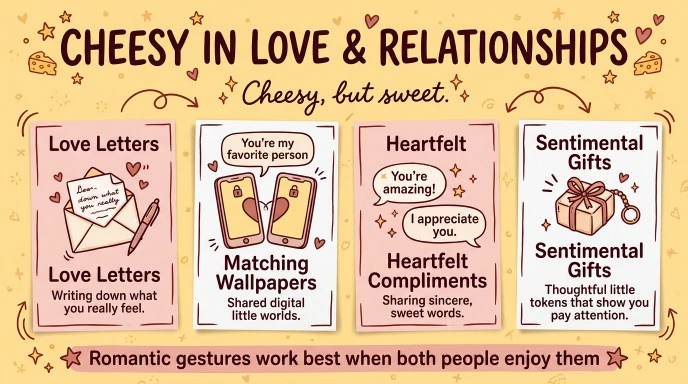
In romantic relationships, cheesy often describes affectionate words or gestures that are extremely sweet, dramatic, or sentimental.
A person might call a love letter cheesy because it includes poetic language, big promises, or familiar romantic expressions. That does not mean the letter is insincere.
Examples of cheesy romantic expressions include:
- “You complete me.”
- “You’re the missing piece of my heart.”
- “Every love song reminds me of you.”
- “I’d choose you in every lifetime.”
- “You’re my favorite notification.”
These phrases may sound cliché because people have heard similar expressions many times. However, the person receiving them may still find them meaningful.
Is Being Cheesy in a Relationship Bad?
Not necessarily. Some people enjoy grand romantic gestures, affectionate nicknames, and sentimental messages. Others prefer humor, simple words, or understated expressions of love.
For example:
Person A: “I wrote you a poem.”
Person B: “Is it going to be cheesy?”
Person A: “Extremely.”
Person B: “Okay, read it to me.”
Here, both people understand the playful meaning of cheesy, and neither treats it as a problem.
Being cheesy is only an issue when the other person feels uncomfortable, pressured, or uninterested. A sweet gesture works best when it fits the relationship and the recipient’s personality.
Cheesy vs. Corny vs. Cringe
“Cheesy,” “corny,” and “cringe” are related slang terms, but they are not always interchangeable.
- Cheesy: Overly sentimental, cliché, exaggerated, or corny.
- Corny: Predictable, old fashioned, or trying too hard to be funny or clever.
- Cringe: Something that creates embarrassment, awkwardness, or secondhand embarrassment.
For example, a romantic poem full of familiar love phrases might be cheesy. A predictable dad joke might be corny. A person repeatedly flirting with someone who has clearly said no might be described as cringe because the behavior is uncomfortable.
Here is a quick comparison:
| Word | Main idea | Example |
| Cheesy | Too sentimental or cliché | “That love letter is cheesy.” |
| Corny | Predictable or old fashioned | “That was a corny joke.” |
| Cringe | Awkward or embarrassing | “Watching him ignore every hint was cringe.” |
| Sappy | Excessively emotional or sentimental | “That movie was too sappy for me.” |
| Tacky | Lacking taste or looking cheap | “Those decorations look tacky.” |
These words can overlap. A cheesy pickup line might also be corny, and someone might find it cringe. The difference comes from what the speaker wants to emphasize.
Cheesy Meaning in Movies, Songs, and Entertainment
When someone describes a movie, song, or television scene as cheesy, they usually mean that it feels exaggerated, predictable, sentimental, or unrealistic.
For example, a movie might end with two characters running through an airport, confessing their love at the last possible moment, and kissing as the music swells. Some viewers might call the scene cheesy because it follows a familiar romantic formula.
However, cheesy entertainment can still be enjoyable. A predictable romantic comedy, an over the top action movie, or a sentimental song may provide exactly the kind of fun the audience wants.
Examples:
- “The movie was cheesy, but it made me happy.”
- “That song has the cheesiest lyrics ever.”
- “The ending was cheesy, but I cried anyway.”
- “I love cheesy holiday movies.”
- “The special effects looked cheesy, but the story was fun.”
The word can describe different things depending on the subject. With a love song, it often refers to sentimental lyrics. With a comedy, it may refer to obvious jokes. With a film, it can describe predictable scenes or unrealistic effects.
Cheesy Meaning in Everyday Conversations
Outside texting and social media, people use “cheesy” in everyday conversations to describe anything that feels overly sentimental, predictable, or old fashioned.
For example:
At a party
Friend A: “Let’s make everyone wear matching shirts that say ‘Best Friends Forever.’”
Friend B: “That’s a little cheesy, isn’t it?”
Meaning: The idea feels overly sentimental or corny.
While watching a movie
Person A: “Did you like the ending?”
Person B: “It was cheesy, but it worked.”
Meaning: The ending was predictable or dramatic, yet enjoyable.
Talking about a gift
Person A: “I bought my partner a mug with our faces on it.”
Person B: “That’s cheesy!”
Meaning: The gift is sentimental or silly. Depending on the tone, the response might be affectionate teasing.
Discussing a joke
Person A: “I told my dad joke at work.”
Person B: “Let me guess. It was cheesy.”
Meaning: The joke was probably predictable or full of a simple pun.
These examples show that “cheesy” can describe a person’s words, a creative idea, a gift, a performance, or an entire experience.
How to Reply When Someone Calls You Cheesy
If someone calls you cheesy, you do not need to take it personally. The best response depends on if they are joking, flirting, or genuinely criticizing what you said.
Funny Replies
Use these when the conversation is playful:
- “Cheesy but iconic 😂”
- “I prefer the term romantically talented.”
- “You love it, admit it.”
- “I’m just bringing the extra cheese.”
- “Corny jokes are my specialty.”
Flirty Replies
If someone calls your romantic message cheesy, you can keep the mood light:
- “Only because you bring out my soft side ❤️”
- “Wait until you hear the next one.”
- “Cheesy works when it’s about you.”
- “At least you know I’m trying.”
- “You smiled, didn’t you? 😉”
Use flirty replies only when the other person seems comfortable with that kind of interaction.
Casual Replies
If you want to acknowledge the comment without making a big deal out of it, try:
- “Fair enough 😂”
- “Yeah, I know.”
- “A little cheesy never hurt anyone.”
- “That’s just my style.”
- “I couldn’t resist.”
If They Mean It Negatively
If someone seems genuinely annoyed, avoid assuming that they are secretly complimenting you. You can respond calmly:
- “Got it. I’ll keep it simpler.”
- “Fair point. I was trying to be funny.”
- “I didn’t mean to make it awkward.”
The goal is to understand the tone rather than automatically treating every use of “cheesy” as flirting or criticism.
Examples of Cheesy in Text Conversations
The following examples show how people might use “cheesy” naturally in everyday messages.
1. A romantic compliment
A: “You’re the best thing that ever happened to me.”
B: “That’s so cheesy 🥹”
Meaning: The compliment is very sentimental.
2. A predictable joke
A: “I used to hate facial hair, but then it grew on me.”
B: “Bro, that joke is cheesy 😂”
Meaning: The joke uses a predictable pun.
3. A couple’s caption
A: “Should I post ‘My forever person’ as the caption?”
B: “It’s cheesy, but it’s cute.”
Meaning: The caption is sentimental but appealing.
4. A motivational quote
A: “Believe in yourself, because the sky is never the limit.”
B: “That sounds a little cheesy.”
Meaning: The quote feels familiar or overly inspirational.
5. A friendship post
A: “Best friends today, tomorrow, and always.”
B: “We’re so cheesy lol.”
Meaning: The friends are playfully acknowledging their sentimental message.
6. A flirtatious message
A: “Are you tired? Because you’ve been running through my mind all day.”
B: “That pickup line is cheesy 😭”
Meaning: The line is corny, possibly in a funny or flirtatious way.
7. A gift idea
A: “I want to make a scrapbook of our pictures.”
B: “That’s cheesy, but honestly, I’d love that.”
Meaning: The idea is sentimental and appreciated.
8. A movie recommendation
A: “Watch this romance movie. The ending is amazing.”
B: “Is it cheesy?”
A: “Very, but that’s why I like it.”
Meaning: The movie uses familiar romantic scenes but remains enjoyable.
Common Misunderstandings About Cheesy
People sometimes misunderstand “cheesy” because they assume it always communicates the same emotion. In reality, the word changes meaning with context.
Misunderstanding 1: Cheesy always means bad.
Not true. Someone can enjoy a cheesy song, joke, movie, or romantic gesture.
Misunderstanding 2: Cheesy always means romantic.
Not true. It can describe corny jokes, predictable stories, tacky looking designs, and exaggerated performances.
Misunderstanding 3: Calling a message cheesy means rejecting the sender.
Not necessarily. A person may be teasing you affectionately or saying that your words are sweet. Look at the complete conversation before drawing conclusions.
Misunderstanding 4: Cheesy and cringe mean exactly the same thing.
They overlap, but “cringe” emphasizes embarrassment or awkwardness, while “cheesy” often emphasizes sentimentality, clichés, or corniness.
Misunderstanding 5: Cheesy is an acronym or secret texting code.
Usually, no. “Cheesy” is an ordinary English adjective that people also use informally. It does not typically stand for a hidden phrase.
Frequently Asked Questions of Cheesy Meaning in Slang
What does cheesy mean in slang?
Cheesy means corny, overly sentimental, predictable, or exaggerated. It often describes romantic messages, pickup lines, jokes, movie scenes, and social media captions.
Does cheesy mean cringe?
Not exactly. Cheesy describes something that feels corny, sentimental, or cliché. Cringe describes something that causes embarrassment or awkwardness. The same situation can be both.
Is cheesy a bad word?
No. “Cheesy” is not generally a swear word or an inherently offensive term. It can be mildly critical or affectionate, depending on how someone uses it.
What does “you’re so cheesy” mean?
It means the person thinks you’re being corny, sentimental, overly romantic, or predictable. They might be teasing you or expressing genuine criticism, depending on the situation.
What does cheesy mean from a girl?
If a girl calls something cheesy, she may think it is overly romantic, corny, predictable, or sweet in an exaggerated way. It does not automatically mean she likes or dislikes you. Her tone and the surrounding conversation matter.
What does cheesy mean from a guy?
If a guy calls something cheesy, he may be reacting to a romantic message, a joke, a dramatic gesture, or a cliché. He could be teasing you, appreciating the sentiment, or expressing that it feels awkward.
What does cheesy mean in a relationship?
In a relationship, cheesy usually describes very sweet, affectionate, or dramatic expressions of love. It can be a playful way to describe romantic messages, matching outfits, couple captions, and sentimental gifts.
What is a cheesy pickup line?
A cheesy pickup line is a flirtatious phrase that sounds predictable, exaggerated, or corny. For example, “Did it hurt when you fell from heaven?” is a classic example.
Is cheesy the same as corny?
They are similar, but not identical. “Corny” often describes predictable jokes or old fashioned humor, while “cheesy” can also describe sentimental romance, clichés, and exaggerated scenes.
Can cheesy be a compliment?
Yes. Someone might say “That’s cheesy, but I love it” to express affection or appreciation. The word can acknowledge that something is sentimental while still communicating that it is enjoyable.
Final Thoughts About Cheesy Meaning in Slang
The cheesy meaning in slang is usually something corny, overly romantic, sentimental, predictable, or exaggerated. People use it for pickup lines, love messages, jokes, movies, captions, gifts, and everyday situations.
The word is not always negative. A cheesy message can be sweet, a cheesy joke can be funny, and a cheesy movie can be entertaining. The meaning depends on the speaker’s tone, the situation, and the relationship between the people involved.
When you see “cheesy” in a text or social media comment, think “corny or overly sentimental,” then use the surrounding context to decide if it is teasing, criticism, or affection.
Discover More Articles:

I research internet slang, texting abbreviations, and online language to create clear, accurate, and easy-to-understand content. My goal is to make modern internet language simple by publishing well-researched, regularly updated explanations based on trusted sources.