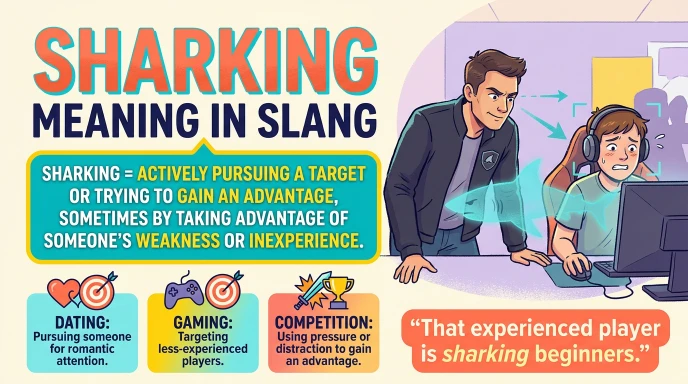
Sharking meaning in slang usually means taking advantage of someone, often by using confidence, pressure, or superior skill to get what you want. However, the exact meaning depends on the situation. In dating, sports, gaming, and everyday conversations, “sharking” can describe different behaviors.
You might see the word in a TikTok comment, a text message, a gaming discussion, or a conversation about relationships. Someone might call a person a “shark” because they are aggressive, highly competitive, or skilled at spotting opportunities.
In some contexts, sharking can refer to approaching people romantically or sexually in a persistent way. In pool and other competitive games, it can describe distracting or intimidating an opponent to gain an advantage.
Sharking is not always positive. It can describe impressive confidence or competitive skill, but it can also suggest manipulation, pressure, or unfair behavior.
Quick Answer of Sharking Meaning in Slang
Sharking means acting like a shark by aggressively pursuing an opportunity, targeting someone, or trying to gain an advantage. Its exact meaning depends on the context.
Common uses include:
- Dating and social situations: Aggressively pursuing someone or repeatedly trying to get their attention.
- Sports and games: Using intimidation, distraction, or psychological pressure against an opponent.
- Business and negotiation: Looking for opportunities to gain an advantage, sometimes at another person’s expense.
- General slang: Taking advantage of someone or targeting a person who seems vulnerable.
Example: “He was sharking people at the pool table.”
Meaning: He was trying to gain an advantage over other players, possibly by intimidating them or exploiting their weaker skills.
The word can be playful, critical, or negative depending on how it is used.
What Does Sharking Mean in Slang?
The slang word “sharking” comes from the image of a shark searching for prey. Figuratively, it describes someone who actively looks for an opportunity, pursues a target, or tries to get an advantage.
The word does not have just one meaning across all communities. The activity being discussed usually tells you what the speaker means.
For example:
- “He’s sharking new players.” This could mean he is targeting inexperienced players to win easily.
- “She was sharking at the party.” Depending on the group, this could refer to aggressively approaching people or looking for romantic attention.
- “Stop sharking me during the game.” This could mean stop distracting or pressuring me while I play.
The central idea is active pursuit or seeking an advantage, but the specific behavior varies by context.
Unlike common texting abbreviations such as LOL or BRB, “sharking” is an ordinary word used figuratively in slang.
What Does Sharking Mean in Dating?
In dating or nightlife conversations, “sharking” can describe someone who actively seeks romantic or sexual attention, sometimes in a persistent or predatory way.
The tone matters. One person may use the term jokingly to describe someone confidently approaching people at a party. Another may use it critically when someone repeatedly targets people who appear uncomfortable or vulnerable.
Examples:
- “He’s been sharking all night.” This may mean he has been approaching people in search of romantic attention.
- “She noticed him sharking around the bar.” This could mean he was actively looking for someone to approach.
- “Don’t shark people who have already said no.” This criticizes persistent behavior that ignores boundaries.
Sharking in dating contexts can carry a negative implication, especially when it involves pressure or ignoring someone’s refusal.
It should not automatically be interpreted as flirting. The surrounding conversation is important, and respectful romantic interest is different from pressuring someone.
What Does Sharking Mean in Gaming?
In gaming, sharking can describe targeting inexperienced players, exploiting weaker opponents, or using psychological tactics to gain an advantage.
The precise meaning varies by game and community. In some settings, a skilled player may deliberately seek out less experienced opponents. In others, sharking may refer to distracting or intimidating someone during a competitive match.
Examples:
- “That experienced player is sharking beginners.” This suggests the player is targeting people with less experience.
- “Stop sharking me while I’m taking my shot.” This means stop distracting or pressuring me.
- “He’s sharking players who don’t know the rules.” This suggests he is exploiting their lack of knowledge.
The term is especially understandable in games where skill differences, wagering, or psychological pressure affect the outcome.
Sharking in gaming often has a negative tone when someone exploits beginners or gains an unfair advantage. However, the term can be used differently in different gaming communities.
What Does Sharking Mean in Pool?
Pool is one of the clearest examples of the term’s competitive use.
In pool, “sharking” commonly refers to behavior intended to distract, intimidate, or unsettle an opponent while they are playing. The aim is to interfere with their concentration and improve one’s own chances of winning.
For example:
A: “Why did you keep moving around while I was taking my shot?”
B: “Sorry, I didn’t mean to shark you.”
Meaning: The speaker acknowledges that their behavior may have distracted the opponent.
Another example:
“Don’t shark your opponent. Let them take their shot.”
Meaning: Do not deliberately distract or intimidate the other player.
In pool, sharking is generally associated with unsportsmanlike conduct when it involves deliberate distraction or intimidation.
This meaning is more specific than the broader idea of taking advantage of someone.
What Does Sharking Mean on TikTok?
On TikTok, “sharking” can appear in videos about dating, social interactions, sports, games, or competitive behavior. The meaning depends on the video and its audience.
For example, a creator discussing someone who aggressively approaches people at a party might use “sharking” in a dating-related sense. A pool player might use the same word to describe distracting an opponent.
Possible examples include:
- “He’s sharking at the club again.”
- “That player was sharking the beginners.”
- “Don’t shark someone when they’re lining up their shot.”
These examples illustrate different contextual uses rather than a single official TikTok definition.
There is no reason to assume every TikTok use of “sharking” refers to dating or relationships. Check the video, caption, and comments to identify the intended meaning.
What Does Sharking Mean in Text Messages?
In text messages, sharking generally carries the same meanings as it does in spoken conversation. It is not a standard abbreviation with a separate texting definition.
Someone might use it to describe a person who is aggressively pursuing someone, exploiting another person’s inexperience, or using pressure to gain an advantage.
Here are a few examples:
Example 1: Dating
A: “Is he still sharking at the party?”
B: “Yeah, he’s been approaching everyone.”
Meaning: He is actively approaching people, possibly in search of romantic attention.
Example 2: Gaming
A: “That player keeps sharking new members.”
B: “They should play against people at their own level.”
Meaning: The player is targeting less experienced participants.
Example 3: Pool
A: “He kept talking during my shot.”
B: “Sounds like he was sharking you.”
Meaning: The behavior may have been intended to distract the player.
Example 4: General Competition
A: “She spotted an easy opportunity and took it.”
B: “She’s always sharking for an advantage.”
Meaning: She actively looks for opportunities to get ahead.
The message’s subject helps determine which interpretation makes sense.
10 Real Chat Examples of Sharking
The following conversations demonstrate how “sharking” can be used in different situations.
Example 1: At a Party
Alex: “Why is Mark talking to everyone here?”
Sam: “He’s been sharking all night.”
Meaning: Mark is actively approaching people, possibly looking for romantic attention.
Example 2: Playing Pool
Chris: “You moved just as I was taking my shot.”
Jordan: “My bad. I wasn’t trying to shark you.”
Meaning: Jordan says the movement was not intended to distract Chris.
Example 3: Online Gaming
Liam: “That high-level player keeps joining beginner matches.”
Noah: “Looks like he’s sharking new players.”
Meaning: The experienced player appears to be targeting weaker opponents.
Example 4: Talking About Dating
Emma: “He kept asking after she said no.”
Olivia: “That’s not okay. He needs to stop sharking her.”
Meaning: Olivia criticizes persistent behavior that ignores someone’s boundaries.
Example 5: At a Competition
Daniel: “Why is that player trying to intimidate everyone?”
Ethan: “Maybe he’s trying to shark his opponents.”
Meaning: The player may be using intimidation to gain a competitive advantage.
Example 6: Discussing Business
Mia: “They offered a very low price when the seller was desperate.”
Ava: “That sounds like sharking.”
Meaning: Ava views the behavior as taking advantage of someone’s vulnerable position.
Example 7: Friendly Teasing
Ryan: “You keep challenging people who just learned the game.”
Jake: “What can I say? I’m sharking today.”
Meaning: Jake jokingly admits to targeting less experienced players.
Example 8: Setting Boundaries
Sophia: “I told him I wasn’t interested.”
Charlotte: “Then he should stop. Don’t let him keep pressuring you.”
Meaning: The conversation is about persistent unwanted attention, though the word “sharking” itself is not required to describe it.
Example 9: Discussing a Pool Match
Ben: “He kept making comments while I was lining up the shot.”
Lucas: “That sounds like pool sharking.”
Meaning: Lucas identifies the behavior as an attempt to distract the opponent.
Example 10: Asking for Clarification
Isabella: “What do you mean when you say he’s sharking?”
Mason: “I mean he’s looking for someone he can take advantage of.”
Meaning: Mason explains the term in a general, negative sense.
Remember: These are illustrative examples. The intended meaning of “sharking” depends on the specific situation.
Is Sharking a Compliment or an Insult?
Sharking can be either playful or negative, but it often carries a critical implication when it involves manipulation or exploitation.
The speaker’s tone and the behavior being described help determine if it is meant as praise or criticism.
| Context | Possible Tone | What It Suggests |
| Dating | Playful or critical | Actively approaching people |
| Pool | Usually critical when deliberate | Distracting or intimidating an opponent |
| Gaming | Often negative | Targeting inexperienced players |
| Business | Often critical | Exploiting someone’s situation |
| Friendly competition | Playful | Looking for an advantage |
For example, calling someone a “pool shark” can be a compliment about their skill. Calling someone out for “sharking” an opponent usually focuses on their behavior rather than their ability.
Being skilled at a game is not the same as sharking someone unfairly. The word often becomes negative when a person deliberately exploits another person’s lack of experience or ignores their boundaries.
Sharking vs. Flirting vs. Hunting for Opportunities
These terms can overlap in certain situations, but they do not mean exactly the same thing.
| Term | Meaning | Typical Context |
| Sharking | Pursuing a target or seeking an advantage, sometimes exploitatively | Games, dating, competition |
| Flirting | Showing romantic or sexual interest | Dating and social situations |
| Hitting on someone | Directly expressing romantic or sexual interest | Dating and nightlife |
| Scouting | Looking for people, talent, or opportunities | Sports, business, recruitment |
| Taking advantage | Using someone’s situation for personal benefit | Relationships, business, everyday life |
For example, a person can flirt respectfully without sharking anyone. Sharking suggests a more active pursuit or, in some contexts, a willingness to exploit an advantage.
Similarly, a pool player can be highly skilled without distracting opponents.
Context and behavior matter more than the word alone.
Is Sharking Rude or Offensive?
The word “sharking” is not inherently a swear word or a universally offensive term. However, it can be critical or insulting when used to accuse someone of predatory, manipulative, or unfair behavior.
For example:
- “Stop sharking the beginners” criticizes someone for targeting inexperienced players.
- “He was sharking her after she said no” describes unwanted persistence.
- “He’s a pool shark” may simply mean someone is an excellent pool player, depending on the context.
The last example is important because “pool shark” and “sharking” are related expressions, but their implications can differ. A “pool shark” may refer to a highly skilled player who wins money by playing others, sometimes by concealing their skill. “Sharking” often emphasizes the behavior used to gain an advantage.
If someone calls you a shark, ask what they mean before assuming it is an insult. They may be praising your ability, teasing you, or criticizing your approach.
Where Did the Slang Word Sharking Come From?
The expression draws on the familiar image of a shark as a predator that searches for prey. English has long used animal comparisons metaphorically to describe human behavior.
The noun “shark” is also used in expressions such as “pool shark,” referring to a skilled or sometimes deceptive pool player. From this usage, “sharking” can describe the behavior associated with seeking opponents, distracting them, or exploiting a competitive advantage.
The term has also been applied more broadly to situations in which someone actively pursues a target or takes advantage of another person’s inexperience.
There is no single modern social media origin that explains every use of “sharking.” Its meaning has developed across different contexts, including games, competition, and social interactions.
Common Mistakes When Understanding Sharking
1. Assuming It Always Means Flirting
Sharking can refer to pursuing romantic attention, but it also appears in sports, pool, gaming, and other competitive situations.
2. Confusing a Pool Shark With Unfair Behavior
A “pool shark” may be a highly skilled player. “Sharking” often refers to tactics used to distract or unsettle an opponent.
3. Assuming It Is Always an Insult
The term can be playful or complimentary in some contexts. The tone and situation determine how it comes across.
4. Treating It as a Texting Abbreviation
Sharking is a word used figuratively in casual language. It is not an acronym like LOL or IDK.
5. Ignoring Consent and Boundaries
In dating-related conversations, repeated unwanted attention is not simply a harmless slang expression. If someone has said no, continuing to pressure them is inappropriate.
Understanding the context helps you recognize if “sharking” refers to competitive tactics, aggressive pursuit, or exploitative behavior.
Frequently Asked Questions
What does sharking mean in slang?
Sharking means actively pursuing someone or seeking an advantage, sometimes by exploiting another person’s weakness or inexperience. The exact meaning depends on the context.
What does sharking mean in dating?
In dating contexts, sharking can refer to aggressively approaching people or persistently pursuing romantic or sexual attention. It may sound negative when it involves pressure or ignoring boundaries.
What does sharking mean in gaming?
In gaming, sharking may mean targeting inexperienced players, exploiting weaker opponents, or using intimidation to gain an advantage.
What does sharking mean in pool?
In pool, sharking commonly refers to distracting or intimidating an opponent to interfere with their concentration during a shot.
Is sharking the same as flirting?
No. Flirting means showing romantic interest. Sharking can involve pursuing people, but it can also refer to competitive tactics or taking advantage of someone.
Is sharking a bad thing?
Not always. The term can be playful, but it often has a negative meaning when someone manipulates, intimidates, or exploits another person.
What does “stop sharking me” mean?
It usually means “stop targeting, pressuring, or trying to gain an advantage over me.” In a pool game, it may specifically mean “stop distracting me while I take my shot.”
What is the difference between a shark and sharking?
A “shark” can describe a person who is highly skilled, competitive, or opportunistic. “Sharking” describes the behavior of pursuing a target or trying to gain an advantage.
Final Thoughts
Sharking in slang generally means pursuing someone or seeking an advantage, sometimes in an aggressive or exploitative way. The word can appear in dating conversations, pool games, gaming communities, and discussions about competition.
In dating, it may describe aggressively approaching people. In pool, it often refers to distracting an opponent.It may mean targeting inexperienced players in gaming.
The word is not always an insult, but it can carry a negative tone when someone takes advantage of another person or ignores their boundaries.
In simple words: sharking means actively going after a target or trying to gain an advantage, and the exact meaning depends on the situation.
Discover More Articles:

I research internet slang, texting abbreviations, and online language to create clear, accurate, and easy-to-understand content. My goal is to make modern internet language simple by publishing well-researched, regularly updated explanations based on trusted sources.