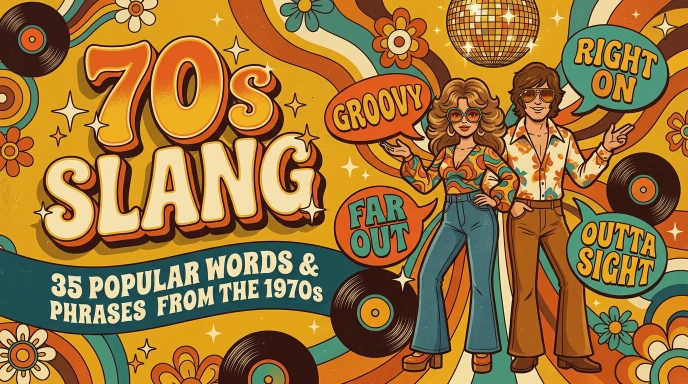
70s slang refers to the informal words and expressions popular during the 1970s, especially in American youth culture, music, disco, movies, and everyday conversations. Words like “groovy,” “far out,” “right on,” and “chill out” captured the decade’s relaxed, expressive, and sometimes rebellious spirit.
If you have watched a classic 1970s movie, listened to disco or funk music, or seen a character wearing bell-bottom jeans, you may have heard some of these expressions. Many came from earlier decades, while others became especially recognizable through the music, fashion, and counterculture of the 1970s.
The most famous 70s slang words include “groovy” for something cool, “far out” for something amazing or unusual, and “right on” for showing agreement or support. Some are still used today, often humorously or nostalgically.
Quick Answer of 70s Slang
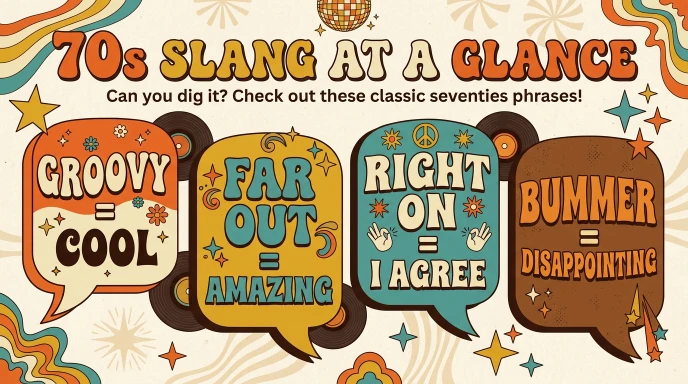
70s slang is the collection of informal expressions associated with the culture and everyday speech of the 1970s. These phrases were influenced by hippie culture, disco, rock music, television, and changing social attitudes.
Here are some classic examples:
- Groovy: Cool, fashionable, or enjoyable.
- Far out: Amazing, unusual, or impressive.
- Right on: Exactly, agreed, or well said.
- Funky: Stylish, distinctive, or associated with funk music.
- Dig it: Understand it, appreciate it, or enjoy it.
- Can you dig it?: Do you understand or like it?
- Keep on truckin’: Keep going and do not give up.
- Bummer: A disappointing or unpleasant situation.
- Chill out: Relax or calm down.
- What’s your bag?: What are you interested in, or what is your thing?
These expressions did not all originate in the 1970s, but they were associated with different parts of the era’s popular culture.
What Is 70s Slang?
70s slang is informal language associated with the decade from 1970 to 1979. It reflects the music, entertainment, fashion, and social movements that influenced how people spoke.
The decade included several overlapping cultural scenes. Hippie and counterculture expressions remained recognizable, disco brought its own party vocabulary, and funk, soul, rock, and early hip-hop influenced language in different communities.
As a result, there was no single way everyone spoke in the 1970s. A teenager listening to disco in New York might use different expressions from a rock fan in California or someone who mainly watched television at home.
Some slang from the decade sounds dated today, while other expressions remain familiar.
For example, people still say “bummer” when something disappointing happens. “Chill out” remains a common way to tell someone to relax. Expressions like “far out” and “groovy” are now often used to create a retro or playful atmosphere.
35 Popular 70s Slang Words and Their Meanings
Here are 35 expressions associated with 1970s culture, along with their meanings and examples.
1. Groovy
Meaning: Cool, enjoyable, fashionable, or pleasing.
“Groovy” was already popular before the 1970s, but it remained strongly associated with the era’s counterculture and entertainment.
Example: “That is one groovy jacket!”
Today, it often sounds playful or deliberately retro.
2. Far Out
Meaning: Amazing, impressive, unusual, or exciting.
People used “far out” to express surprise or admiration.
Example: “You got tickets to the concert? Far out!”
The phrase could also describe something strange, unconventional, or mind-expanding.
3. Right On
Meaning: I agree, exactly, or well said.
“Right on” expressed approval, encouragement, or agreement.
Example:
A: “Everyone deserves a fair chance.”
B: “Right on!”
It could sound enthusiastic, supportive, or politically aware, depending on the conversation.
4. Funky
Meaning: Stylish, distinctive, unusual, or connected to funk music.
The word was particularly relevant to music and fashion during the decade.
Example: “I love those funky shoes.”
Today, “funky” can describe something creative, unusual, or full of personality.
5. Dig It
Meaning: Understand, appreciate, or enjoy something.
“Dig it” was associated with informal speech and counterculture.
Example: “This music is incredible. Do you dig it?”
It could refer to understanding an idea as well as enjoying an experience.
6. Can You Dig It?
Meaning: Do you understand, appreciate, or agree with this?
Example: “We’re going to dance all night. Can you dig it?”
The expression often added confidence or excitement to a statement.
7. Bummer
Meaning: Something disappointing, unfortunate, or unpleasant.
Example: “The concert got canceled? What a bummer!”
Bummer is one of the expressions from the era that remains common today.
8. Keep on Truckin’
Meaning: Keep going, continue making progress, and do not give up.
The phrase became especially recognizable through counterculture imagery and popular art during the late 1960s and 1970s.
Example: “Things are tough right now, but keep on truckin’!”
It communicated perseverance and an easygoing determination.
9. Chill Out
Meaning: Relax, calm down, or stop getting upset.
Example: “Chill out, man. It’s not that serious.”
The expression is still widely understood and used in modern conversation.
10. What’s Your Bag?
Meaning: What is your interest, preference, problem, or personal style?
Example: “Jazz is my thing. What’s your bag?”
The meaning depends on the situation. It could refer to someone’s interests or, in some contexts, their attitude or behavior.
11. Catch You on the Flip Side
Meaning: See you later.
Example: “I’m heading home. Catch you on the flip side!”
This casual farewell was associated with music and counterculture language. It is also familiar in later retro portrayals of the era.
12. The Man
Meaning: An authority figure or an established system seen as controlling or oppressive.
Example: “They don’t want the rules to change, man. That’s the Man.”
The phrase was particularly associated with counterculture and anti-establishment attitudes.
13. Psychedelic
Meaning: Originally related to altered states of consciousness; in popular culture, colorful, surreal, or mind-bending.
Example: “That poster has a psychedelic design.”
The word was closely connected to psychedelic art, music, and the counterculture that influenced the 1970s.
14. Boogie
Meaning: Dance, especially to energetic popular music.
Example: “The DJ put on a great song, so everybody started to boogie.”
The word existed before the 1970s, but disco helped keep it prominent in dance culture.
15. Disco
Meaning: A style of dance music and the nightlife culture associated with it.
Example: “We’re going to the disco tonight.”
During the 1970s, disco became a major music and dance movement, influencing fashion, clubs, and popular entertainment.
16. Hustle
Meaning: A dance associated with the disco era; it can also mean moving quickly or working energetically.
Example: “Come on, let’s do the hustle!”
The word had other meanings before the decade, but the dance became strongly associated with 1970s disco culture.
17. Foxy
Meaning: Attractive, stylish, or sexually appealing.
Example: “That is a foxy outfit.”
It was often used as a compliment in casual speech, although it may sound dated today.
18. Bad
Meaning: Excellent, impressive, or tough in a positive sense.
Example: “That guitarist is bad!”
In certain music and youth-culture contexts, “bad” could mean exceptionally good rather than unpleasant.
Context is essential: the word could still carry its ordinary negative meaning.
19. Heavy
Meaning: Intense, serious, emotionally powerful, or profound.
Example: “That movie was heavy.”
It could describe a serious conversation, powerful music, or an experience that made someone think deeply.
20. Solid
Meaning: Good, dependable, respectable, or impressive.
Example: “That was a solid performance.”
“Solid” was not exclusive to the 1970s, but it fits naturally into the decade’s informal vocabulary.
21. Jive
Meaning: Slang or talk that is misleading, insincere, or nonsensical; the word also has musical and dance-related meanings.
Example: “Don’t give me that jive.”
Its meaning varies by context, and it has a longer history in African American English and jazz culture.
22. Bozo
Meaning: A foolish or ridiculous person.
Example: “That bozo forgot the tickets!”
The word predates the 1970s but remained recognizable in casual insults and comedy.
23. Space Cadet
Meaning: Someone who seems distracted, absent-minded, or lost in their own thoughts.
Example: “I asked him a question, but he was acting like a space cadet.”
The expression could be teasing or mildly critical.
24. Lay It on Me
Meaning: Tell me what you have to say, give me the details, or share the news.
Example: “You’ve got some news? Lay it on me.”
It could communicate openness, curiosity, or readiness to hear something.
25. Don’t Have a Cow
Meaning: Don’t overreact or get extremely upset.
Example: “Don’t have a cow. I’ll clean up the mess.”
The phrase is associated with informal American speech and later pop-culture portrayals of earlier decades. It should not be treated as exclusively 1970s slang.
26. Outta Sight
Meaning: Excellent, impressive, or extraordinary.
Example: “That concert was outta sight!”
It was an enthusiastic way to praise something, similar to “fantastic” or “amazing.”
27. Right-On
Meaning: Correct, admirable, or deserving of support.
Example: “Your idea about helping the community is right-on.”
This is closely related to “right on,” used as an expression of agreement or approval.
28. Peace Out
Meaning: Goodbye or I’m leaving.
Example: “It’s getting late. Peace out!”
The expression became associated with informal youth and hip-hop culture, but its history spans beyond the 1970s. It is often used today in casual or playful speech.
29. Dyna-mite!
Meaning: Extremely exciting, impressive, or excellent.
Example: “That performance was dyna-mite!”
The expression is strongly associated with 1970s television and entertainment, including the character J.J. Evans from Good Times.
30. Good Times
Meaning: Fun, enjoyment, or a period of happiness.
Example: “Great music and good friends good times!”
The phrase is ordinary English rather than uniquely 1970s slang, but it fits the era’s casual, upbeat social atmosphere.
31. Boogie Down
Meaning: Dance enthusiastically or enjoy the music.
Example: “The band is playing our favorite song. Let’s boogie down!”
The expression is linked to dance and music culture, with usage that extends beyond the decade.
32. Solid Gold
Meaning: Excellent, valuable, or highly successful.
Example: “That song is solid gold.”
The phrase existed earlier, but it was also associated with 1970s popular entertainment and music culture.
33. Outta Here
Meaning: I’m leaving, or something is so impressive that it feels unbelievable.
Example: “That guitar solo was outta here!”
The intended meaning depends on the sentence and delivery.
34. What’s Happening?
Meaning: What’s going on? or What’s new?
Example: “Hey, what’s happening?”
This casual greeting was common across different eras and became especially recognizable through popular culture and television.
35. Peace and Love
Meaning: A message of harmony, kindness, and nonviolence.
Example: “Take care, everybody. Peace and love!”
The expression is strongly associated with the broader 1960s counterculture, which continued to influence music and social movements in the 1970s.
70s Slang for Saying Something Is Cool
If you want to compliment something using a vintage expression, these phrases are useful choices.
| Slang | Meaning | Example |
| Groovy | Cool or enjoyable | “That shirt is groovy.” |
| Far out | Amazing or unusual | “Far out, what a concert!” |
| Outta sight | Excellent or impressive | “Your new car is outta sight.” |
| Funky | Distinctive or stylish | “That’s a funky design.” |
| Bad | Excellent in certain contexts | “That band is bad!” |
| Dyna-mite | Exciting or impressive | “That performance was dyna-mite!” |
| Solid | Good or dependable | “That’s a solid idea.” |
If you want the most recognizable retro expressions, start with “groovy,” “far out,” and “outta sight.”
Keep in mind that some of these phrases were used before the 1970s and continued afterward. Their association with the decade does not mean they originated during it.
70s Slang Used by Hippies and Counterculture
The 1970s inherited much of the language and cultural influence of the 1960s counterculture. Some expressions reflected individuality, peace activism, experimentation, and resistance to established authority.
“The Man”
Used to refer to an authority figure or system seen as controlling.
Example: “The Man doesn’t want us to question the rules.”
“Far Out”
Used to express amazement, approval, or a reaction to something unconventional.
Example: “That artwork is far out.”
“Right On”
Used to show agreement or support.
Example: “People should stand up for what they believe in.”
“Right on!”
“Keep on Truckin’”
Used as encouragement to persevere and continue forward.
Example: “Keep on truckin’, even when things get difficult.”
“Peace and Love”
Used to communicate a desire for harmony and kindness.
Example: “Peace and love to everyone at the gathering.”
These phrases reflect overlapping counterculture traditions rather than slang invented exclusively in the 1970s.
70s Disco Slang and Party Expressions
Disco became one of the most recognizable cultural movements of the 1970s. Its music, dance clubs, fashion, and nightlife influenced the language people associated with parties.
“Boogie”
Means to dance or move to music.
Example: “Let’s boogie until midnight.”
“Boogie Down”
Means to dance enthusiastically.
Example: “The music is great. Let’s boogie down!”
“The Hustle”
Refers to a dance associated with the disco era.
Example: “Everybody was learning the hustle.”
“Foxy”
Means attractive or stylish.
Example: “That foxy outfit really stands out.”
“Funky”
Means distinctive, stylish, or associated with funk music.
Example: “The band has a funky sound.”
These expressions are useful if you want to create a 1970s party atmosphere or understand the language associated with disco culture.
70s Slang in Movies and TV Shows
Movies and television helped popularize many expressions associated with the 1970s. Sitcoms, comedy characters, action films, and music programs all contributed to the decade’s public image.
A few examples stand out:
- “Dyna-mite!” became closely associated with J.J. Evans in the sitcom Good Times.
- “Groovy” was already in use and continued to evoke counterculture and youthful enthusiasm.
- “The Man” appeared in counterculture and anti-establishment language.
- “Foxy” was used as a compliment in informal speech and entertainment.
- “Far out” became recognizable as an enthusiastic response to something impressive or unconventional.
When watching older movies, remember that scripts sometimes exaggerate slang to make characters sound distinctive. A phrase appearing in a 1970s film does not automatically mean everyone used it in everyday conversation.
How to Use 70s Slang in Modern Conversations
You can use 70s slang today when joking with friends, creating a retro caption, dressing up for a themed party, or expressing nostalgia for older music and films.
The key is to use expressions that fit the situation.
In Text Messages
- “That concert was groovy!”
- “Far out! You got the job!”
- “That’s a bummer.”
- “Right on, I totally agree.”
- “Keep on truckin’!”
On Social Media
- “Living that groovy life.”
- “Far-out fashion from another era.”
- “Disco vibes and funky moves.”
- “Peace, love, and good music.”
- “This playlist is outta sight.”
At a 70s-Themed Party
- “Let’s boogie!”
- “That outfit is groovy.”
- “This party is outta sight!”
- “Let’s hit the dance floor.”
- “Keep on truckin’!”
Use retro expressions naturally rather than putting several into every sentence. One or two phrases can create the right vintage feel without making the conversation sound like a parody.
Common Mistakes About 70s Slang
1. Assuming Every Phrase Started in the 1970s
Many famous expressions were already used in earlier decades. The 1970s helped popularize or preserve them, but that is not the same as inventing them.
2. Treating All Slang as Universal
Language varied by region, age, community, and cultural background. Not every expression was used by everyone.
3. Confusing Hippie Slang With Disco Slang
Some expressions were associated with counterculture and anti-establishment ideas, while others were linked more closely to dancing, nightlife, and popular music.
The categories overlap, but they are not identical.
4. Assuming Old Slang Is No Longer Used
Words like “bummer” and “chill out” remain familiar today, although their popularity and tone can vary.
5. Ignoring Cultural Context
Some slang expressions originated or developed within particular cultural communities. Understanding that background helps avoid treating a community’s language as merely a costume or a joke.
The most accurate way to understand 70s slang is to consider its meaning, history, and cultural context not just the decade associated with it.
Frequently Asked Questions
What are the most popular 70s slang words?
Some of the best-known expressions associated with the decade include groovy, far out, right on, funky, dig it, bummer, outta sight, and keep on truckin’.
What did “groovy” mean in the 1970s?
“Groovy” meant cool, enjoyable, fashionable, or pleasing. It was popular before the 1970s but remained strongly associated with the era.
What did “far out” mean in 70s slang?
“Far out” was an enthusiastic way to describe something amazing, impressive, unusual, or unconventional.
What did “right on” mean?
“Right on” expressed agreement, approval, or support. It was similar to saying “exactly” or “I agree.”
What did “bad” mean in 70s slang?
In certain contexts, “bad” meant excellent, impressive, or exceptionally skilled. The ordinary negative meaning also remained in use, so context mattered.
What did “dig it” mean?
“Dig it” meant to understand, appreciate, or enjoy something. For example, “Do you dig this music?” meant “Do you like or appreciate this music?”
What slang did people use at 70s disco parties?
Expressions such as “boogie,” “boogie down,” “funky,” and “the hustle” are associated with the decade’s dance and music culture.
Is 70s slang still used today?
Yes. Some expressions, including “bummer” and “chill out,” remain common. Others, such as “far out” and “groovy,” are often used for humor, nostalgia, or a retro style.
What is a funny 70s slang phrase?
“Far out,” “groovy,” “outta sight,” and “dyna-mite!” can sound funny or nostalgic in modern conversations, especially when used playfully.
Did everyone speak this way in the 1970s?
No. Slang varied across regions, communities, age groups, and social settings. Popular movies and television can make certain phrases seem more universal than they actually were.
Final Thoughts
70s slang reflects a decade shaped by disco, funk, rock music, counterculture, television, and changing social attitudes. Expressions such as “groovy,” “far out,” “right on,” and “outta sight” remain recognizable because they capture the era’s distinctive cultural style.
Some phrases were already popular before the 1970s, while others became more visible through the decade’s music, entertainment, and social scenes.
If you want to use 70s slang today, try “groovy” for something cool, “bummer” for a disappointment, “right on” to show agreement, or “keep on truckin’” to encourage someone to keep going.
In simple words: 70s slang is informal language associated with the 1970s, and its expressions can still add a fun, vintage touch to modern conversations.
Discover More Articles:

I research internet slang, texting abbreviations, and online language to create clear, accurate, and easy-to-understand content. My goal is to make modern internet language simple by publishing well-researched, regularly updated explanations based on trusted sources.