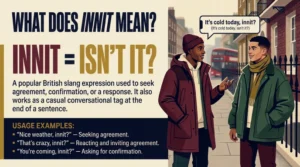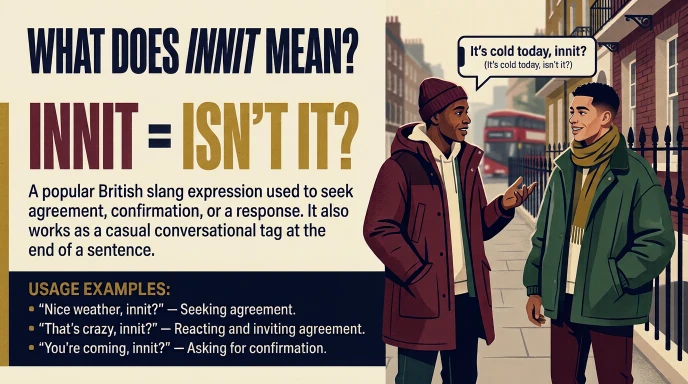
Innit means “isn’t it?” in British slang. People use it at the end of a sentence to ask for agreement, confirm something, or emphasize a statement.
For example, “It’s a beautiful day, innit?” means “It’s a beautiful day, isn’t it?” In casual conversations, people also use innit as a general way to say “right?” or “you know?”
It is strongly associated with British speech, although people in other countries also recognize and use it online.
The word sounds casual, friendly, and sometimes humorous. Its exact meaning depends on the sentence, the speaker’s tone, and the situation. Although it originally comes from “isn’t it,” people often use it more broadly than the standard grammatical question.
Quick Answer
Innit means “isn’t it?” and is commonly used as British slang for “right?” or “don’t you agree?”
Examples:
- “It’s cold today, innit?” = It’s cold today, isn’t it?
- “That movie was amazing, innit?” = That movie was amazing, wasn’t it?
- “You’re coming with us, innit?” = You’re coming with us, right?
In simple words, innit is an informal way to seek agreement or confirmation. It is especially common in casual British conversations.
What Does Innit Stand For?
It is a shortened, informal pronunciation and spelling of “isn’t it?” The expression developed in spoken English and became especially recognizable in British informal speech.
The original phrase contains two words:
- Isn’t: A contraction of “is not.”
- It: A pronoun referring to something already mentioned or understood.
When people say “isn’t it?” quickly in everyday speech, it can sound like “innit.” Over time, the shortened form became widely used as an informal expression in its own right.
For example:
Standard English: “This weather is lovely, isn’t it?”
Informal British English: “This weather is lovely, innit?”
Both sentences ask the listener to agree with the speaker.
However, modern slang uses it in more situations than its original grammatical form. Someone might say, “You’re joking, innit?” to mean “You’re joking, right?”
That broader use is one reason the word appears so frequently in British slang and online conversations.
What Does Innit Mean in Texting?
In texting, it usually means “right?” or “isn’t it?” People use it to make a message sound relaxed, informal, and conversational.
It often appears in messages between friends, classmates, siblings, and people who communicate casually.
For example:
Person A: “This assignment is taking forever.”
Person B: “Tell me about it, innit?”
Here, innit adds a casual tone and suggests that the other person understands the frustration.
More examples include:
- “That was a amazing match, innit?”
- “You’re tired too, innit?”
- “This song is a banger, innit?”
- “We had a great time yesterday, innit?”
In texting, people do not always follow standard grammar when using innit. They often use it as a conversational expression rather than a carefully formed question.
Does Innit Always Mean “Isn’t It?” in Texts?
Not always. Although its original form comes from “isn’t it,” people often use it to mean:
- Right? Asking someone to agree.
- Isn’t that true? Confirming a statement.
- You know? Adding emphasis or checking understanding.
- Don’t you think? Inviting someone to share an opinion.
For example:
“That’s a good idea, innit?”
The speaker is essentially asking, “That’s a good idea, right?”
What Does Innit Mean in British Slang?
In British slang, it is an informal expression used to seek agreement, confirm information, or add emphasis to a statement.
It is especially associated with casual spoken English in the United Kingdom. You may hear it in everyday conversations, comedy, music, television, and social media videos.
For example:
- “It’s proper cold today, innit?”
- “He’s a good player, innit?”
- “We should leave now, innit?”
The word is often connected with informal British speech, including some London and urban youth speech styles. However, it is not limited to one city, community, or age group.
Why Do British People Say Innit?
People use innit because it is short, familiar, and natural in casual conversation.
Instead of saying a complete question such as “You agree with me, don’t you?”, someone may simply add “innit?” to the end of a sentence.
For example:
Formal: “This place is really nice, don’t you think?”
Casual: “This place is really nice, innit?”
The second version sounds more relaxed and conversational.
It can also help speakers create a sense of connection with the person they are talking to. The expression invites a response without requiring a long question.
How Is Innit Used in Everyday Conversations?
It can appear in many different situations. People use it when discussing the weather, making plans, sharing opinions, joking with friends, or reacting to something surprising.
Here are common situations where you might hear it.
1. Asking Someone to Agree
This is one of the most common uses of innit.
Example:
“That’s a beautiful car, innit?”
Meaning: The speaker thinks the car looks beautiful and wants the listener to agree.
2. Confirming Something
People may use it when they believe something is true but want confirmation.
Example:
“You’re coming to the party, innit?”
Meaning: The speaker expects the person to attend and is checking if that is correct.
3. Showing Surprise
It can also appear in surprised or questioning statements.
Example:
“That was your brother, innit?”
Meaning: The speaker thinks the person was your brother and wants confirmation.
4. Adding Emphasis
Sometimes, it adds extra feeling to a statement.
Example:
“This game is difficult, innit?”
Meaning: The speaker strongly feels that the game is difficult and expects the listener to understand.
5. Making a Conversation Sound Casual
People often add it to informal conversations because it matches their usual speaking style.
Example:
“Let’s get something to eat, innit?”
Meaning: The speaker is casually suggesting that they get food.
Innit Meaning on Social Media
On social media, it usually carries the same meaning as it does in everyday British speech. Users add it to comments, captions, memes, videos, and messages to create a casual British tone.
Its use varies slightly depending on the platform.
Innit on TikTok
On TikTok, it often appears in British comedy videos, reaction clips, skits, memes, and casual conversations.
Creators may use it to make dialogue sound more natural or to imitate familiar British speech patterns.
Examples:
- “This trend is getting out of hand, innit?”
- “Bro really thought he was winning, innit?”
- “We all know that one friend, innit?”
It can also appear in videos that make fun of exaggerated British slang or everyday situations.
Innit on Instagram
On Instagram, people may use innit in comments, captions, Stories, and direct messages.
Examples:
- “That view is unreal, innit?”
- “This picture came out nice, innit?”
- “We need another trip like this, innit?”
The word can make a caption sound relaxed and conversational.
Innit on Snapchat
On Snapchat, it appears in quick messages and conversations between friends.
Examples:
- “It’s freezing outside, innit?”
- “That was funny, innit 😂”
- “We should go out tomorrow, innit?”
It works naturally in casual messages, especially when people already use British expressions in their conversations.
Innit on WhatsApp
People also use it in WhatsApp chats and group conversations.
Examples:
- “The match was amazing, innit?”
- “We’re meeting at 7, innit?”
- “You saw that video, innit?”
In these messages, innit makes the conversation feel informal rather than formal or businesslike.
Real Life Examples of Innit in Conversations
The following examples show how it works in different everyday situations.
| Situation | Example | Meaning |
| Weather | “It’s hot today, innit?” | It’s hot today, isn’t it? |
| Friendship | “He’s a good friend, innit?” | He’s a good friend, right? |
| School | “That exam was difficult, innit?” | That exam was difficult, wasn’t it? |
| Music | “This song is amazing, innit?” | This song is amazing, right? |
| Food | “The pizza tastes great, innit?” | The pizza tastes great, doesn’t it? |
| Plans | “We’re leaving at six, innit?” | We’re leaving at six, right? |
| Sports | “That was a great goal, innit?” | That was a great goal, wasn’t it? |
| Entertainment | “The film was hilarious, innit?” | The film was hilarious, wasn’t it? |
More Examples of Innit in Text Messages
Example 1
“It’s been a long day, innit?”
Meaning: The speaker agrees that the day has been tiring and wants the other person to relate.
Example 2
“You saw that goal, innit?”
Meaning: The speaker expects the other person to have seen the goal and is checking.
Example 3
“That’s your favourite song, innit?”
Meaning: The speaker thinks the song is your favourite and wants confirmation.
Example 4
“We had a great time last night, innit?”
Meaning: The speaker is reminding someone of a fun experience and inviting agreement.
Example 5
“It’s too expensive, innit?”
Meaning: The speaker thinks something costs too much and expects the listener to agree.
Is Innit Formal or Informal?
It is informal slang, not a standard choice for formal writing. It is suitable for casual conversations, texts, social media posts, and friendly messages.
You can use it when talking with friends or people who are comfortable with informal British English.
However, it is usually better to avoid innit in:
- Academic essays.
- Professional emails.
- Business reports.
- Formal presentations.
- Official documents.
- Job applications.
For example:
Informal: “The meeting starts at 10, innit?”
More appropriate in professional communication: “The meeting starts at 10, doesn’t it?”
The second version is clearer and more suitable for formal situations.
Is Innit Rude or Disrespectful?
No. it is not inherently rude or disrespectful. It is generally a casual expression used in everyday conversations.
However, the speaker’s tone can change how it sounds.
For example:
Friendly: “That’s a nice jacket, innit?”
This sounds like a casual compliment.
Annoyed: “You forgot again, innit?”
Depending on the speaker’s tone, this may sound sarcastic or frustrated.
Playful: “You’re always late, innit? 😂”
This may simply be friendly teasing.
The word itself is not offensive. The surrounding words, relationship, and tone determine if the sentence sounds friendly, sarcastic, or irritated.
What Is the Difference Between Innit, Isn’t It, and Right?
Innit, isn’t it, and right are closely related expressions, but they are not always interchangeable in every sentence.
Isn’t it? is the standard grammatical question tag used after a statement with the verb “is.”
It is its informal, slang style counterpart in casual speech.
Right? is a more general expression used to ask for agreement or confirmation.
| Expression | Meaning | Example |
| Innit | Informal “isn’t it?” or “right?” | “It’s cold, innit?” |
| Isn’t it? | Standard question tag | “It’s cold, isn’t it?” |
| Right? | Asking for agreement | “It’s cold, right?” |
For example:
- “This place is beautiful, innit?”
- “This place is beautiful, isn’t it?”
- “This place is beautiful, right?”
All three sentences ask for agreement, but they have different levels of formality and grammatical structure.
Innit vs. Init: Are They the Same?
You may sometimes see people write “init” instead of “innit” in informal messages.
Both spellings are used online to represent the same spoken expression, “isn’t it?”
For example:
- “That’s funny, innit?”
- “That’s funny, init?”
The spelling “innit” is more widely recognizable as the conventional slang form. “Init” is often an informal phonetic spelling.
Neither spelling changes the intended meaning in ordinary casual conversation.
Does Innit Have Different Meanings?
The main meaning of innit is “isn’t it?” However, its use in informal British English has expanded.
Depending on context, it can communicate several related ideas.
1. Right?
Example: “You’re coming with us, innit?”
Meaning: You’re coming with us, right?
2. Isn’t That True?
Example: “This weather is terrible, innit?”
Meaning: This weather is terrible, isn’t that true?
3. You Know?
Example: “It’s been a difficult week, innit?”
Meaning: The speaker is sharing an observation and inviting the listener to relate.
4. Don’t You Agree?
Example: “That was the best match, innit?”
Meaning: The speaker thinks it was the best match and wants agreement.
These are not completely separate dictionary definitions. They are different conversational uses of the same informal expression.
Common Mistakes People Make When Using Innit
Although innit is easy to recognize, there are a few mistakes people make when learning or using it.
1. Thinking Innit Is a Completely Different Word
It comes from “isn’t it?” It is not an unrelated expression with an entirely separate original meaning.
2. Assuming It Always Means “Right?”
In casual conversation, it often works like “right?” However, its exact meaning depends on the sentence.
3. Using It in Formal Writing
It is informal British slang. Using it in an academic essay or official email may make the writing sound too casual.
4. Thinking Only Londoners Use It
Although it is strongly associated with some London speech styles, it is recognized and used more widely across Britain and online.
5. Assuming It Is Always a Question
It often appears at the end of a sentence to invite agreement, but speakers may also use it as a conversational habit or emphasis. It does not always function as a carefully formed grammatical question.
6. Believing It Is Offensive
It is not normally an insult or offensive expression. It is a casual slang term, although the tone can sometimes make a sentence sound sarcastic.
Frequently Asked Questions About Innit
What does innit mean in slang?
Innit means “isn’t it?” in British slang. People commonly use it to ask for agreement, confirm something, or add emphasis to a casual statement.
What does innit mean in texting?
In texting, innit usually means “right?” or “isn’t it?” It makes messages sound casual and conversational.
Is innit British slang?
Yes. Innit is strongly associated with British informal English and is widely recognized as a British slang expression.
What does innit mean in American English?
Americans may understand innit as the British slang version of “isn’t it?” or “right?” However, it is not as common in everyday American English.
What does innit mean from a girl?
If a girl uses innit, she is generally adding a casual question tag to her sentence. She may be asking you to agree, confirming something, or simply speaking informally. It does not automatically mean she is flirting.
What does innit mean from a guy?
If a guy says innit, he is usually using informal British speech to mean “isn’t it?” or “right?” The exact meaning depends on the sentence.
Is innit the same as isn’t it?
They are closely related. Innit is the informal spoken and written slang form of “isn’t it?” It is more common in casual speech than formal writing.
Can I use innit in a text message?
Yes. You can use innit in casual messages with friends, family, or people who understand the expression.
Is innit rude?
No. It is not inherently rude. It is an informal expression, although a sarcastic or annoyed tone can make a sentence sound unfriendly.
Do people still say innit?
Yes. Innit remains recognizable in British informal speech, popular culture, and online conversations.
What is the difference between innit and init?
Both spellings can represent the same informal pronunciation of “isn’t it?” Innit is the more widely recognized spelling.
What does “safe, innit” mean?
“Safe” can mean “good,” “cool,” or “thanks” in some British slang contexts. “Safe, it” combines that informal expression with it, often creating a casual statement that something is good or acceptable. The exact meaning depends on the conversation.
Final Thoughts
It means “isn’t it?” and is widely used in British slang to mean “right?” or “don’t you agree?” It is a casual expression that people add to sentences when they want confirmation, agreement, or emphasis.
You may hear it in everyday British conversations and see it in text messages, TikTok videos, Instagram comments, Snapchat chats, and online discussions. It is especially useful in informal communication because it makes sentences sound relaxed and conversational.
For example, when someone says, “That’s a great song, innit?” they are simply saying, “That’s a great song, isn’t it?” Once you understand this connection, recognizing innit in British slang becomes much easier.
Discover More Articles:

I research internet slang, texting abbreviations, and online language to create clear, accurate, and easy-to-understand content. My goal is to make modern internet language simple by publishing well-researched, regularly updated explanations based on trusted sources.