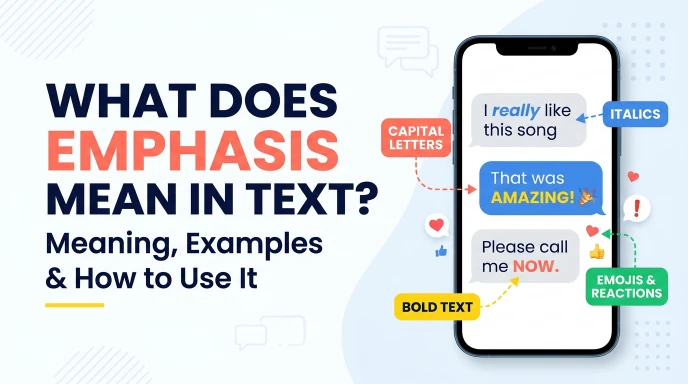
Emphasis in text means giving extra importance, strength, or attention to a particular word, phrase, or message. People use emphasis in texting, social media comments, and online conversations to show excitement, make a point, express strong feelings, or prevent misunderstandings.
For example, if someone texts, “I really like this song,” the word “really” adds emphasis. Similarly, writing “I am SO happy!” makes the excitement feel stronger than simply saying, “I am happy.”
You may see emphasis through capital letters, bold or italic text, repeated punctuation, emojis, or carefully chosen words. The exact meaning depends on the conversation and how the person uses it.
Quick Answer
Emphasis in text means highlighting a word or message to make it feel more important or emotionally powerful. It can show excitement, anger, surprise, seriousness, affection, or urgency.
Examples:
- “I really need your help.” Shows how important the request is.
- “That was AMAZING!” Expresses strong excitement.
- “I said NO.” Stresses a firm refusal.
- “Thank you SO much ❤️” Adds warmth and appreciation.
Emphasis is not a specific texting abbreviation or slang term. It is a way of communicating meaning through words, formatting, and punctuation.
What Does Emphasis Mean in a Text Message?
In a text message, emphasis happens when someone highlights a particular part of their message to make sure the reader notices it. It helps communicate tone and emotion when the other person cannot hear the speaker’s voice or see their facial expressions.
For example, compare these messages:
- “That was good.”
- “That was REALLY good!”
- “That was really good.”
- “That was good 😭❤️”
All four messages express a positive reaction, but they may communicate different levels of excitement, sincerity, or emotion.
The first message sounds neutral. The second sounds enthusiastic. The third places extra attention on the word “really,” while the fourth adds an emotional reaction through emojis.
The main purpose of emphasis is to make a message’s most important part stand out.
However, emphasis does not always mean the sender is angry or shouting. It can also communicate happiness, humor, affection, sarcasm, or urgency.
How Do People Show Emphasis in Texting?
People use several methods to add emphasis to their messages. Each method can create a slightly different effect.
1. Capital Letters
Writing a word or phrase in capital letters makes it stand out.
Examples:
- “I am SO excited!”
- “Please call me NOW.”
- “That was the BEST movie.”
- “I said NO, not maybe.”
Capital letters can express excitement, urgency, frustration, or strong agreement.
However, writing an entire message in capital letters can feel like shouting. For example, “WHY DID YOU DO THAT?” may sound angry, even if the sender simply wants an answer.
Tip: Use capital letters for selected words when you want to highlight a point without making the whole message seem aggressive.
2. Bold Text
Bold text makes specific words visually stronger than the surrounding message.
Examples:
- “You must bring your ID.”
- “That is exactly what I meant.”
- “I am so proud of you.”
Bold formatting is common in messaging apps, online discussions, notes, and social media posts where text formatting is available.
It can highlight an important instruction, clarify a point, or make a key detail easier to notice.
For example, “The meeting is at 3 PM” makes the time stand out.
In casual conversations, bold text may sometimes feel serious or forceful. The effect depends on the relationship between the people and the surrounding message.
3. Italic Text
Italic text can add subtle emphasis or suggest a particular tone.
Examples:
- “I really wanted to go.”
- “That was unexpected.”
- “I said I was fine.”
Italics may suggest sincerity, hesitation, sarcasm, or extra stress on a word.
Consider this message:
“I thought you were coming.”
The italicized word “thought” may imply disappointment or surprise because the sender expected something different.
However, italics do not have one fixed emotional meaning. The surrounding conversation determines how the reader interprets them.
4. Exclamation Marks
Exclamation marks can make a message sound more energetic or emotional.
Examples:
- “Congratulations!”
- “That is amazing!!”
- “Thank you so much!”
- “I finally finished it!!!”
One exclamation mark often adds friendliness or enthusiasm. Several exclamation marks can make the message feel especially excited, dramatic, or urgent.
For example:
“See you tomorrow!”
This sounds cheerful or friendly.
“See you tomorrow!!!”
This may sound more excited or enthusiastic.
Too many exclamation marks can sometimes make a message feel exaggerated, but friends may use them naturally to express excitement.
5. Repeating Letters or Words
People sometimes stretch words or repeat them to show stronger feelings.
Examples:
- “Soooo cute!”
- “Nooooo!”
- “Thank youuuu!”
- “I really, really love it.”
The extra letters or repeated words add emotional intensity.
“Sooo good” may sound more enthusiastic than “So good.” Similarly, “I am very, very happy” places extra weight on the feeling.
This style is especially common in casual texting, comments, and conversations between friends.
6. Emojis
Emojis can reinforce the emotion behind a message.
Examples:
- “I got the job!! 😭❤️”
- “That was AMAZING 🔥”
- “Thank you SO much 🥹”
- “I am serious 😐”
The emojis add emotional information that the words alone may not communicate.
A fire emoji can intensify praise, while a heart can make appreciation feel warmer. A laughing emoji can signal that a dramatic statement is meant humorously.
Still, emojis are context dependent. The same emoji can mean different things to different people.
7. Strong or Descriptive Words
You do not need special formatting to emphasize something. Sometimes, the word itself creates the emphasis.
Examples:
- “That was absolutely incredible.”
- “I genuinely appreciate your help.”
- “I desperately need a break.”
- “I completely agree with you.”
Words such as absolutely, genuinely, completely, seriously, literally, and definitely can add strength to a statement.
For instance, “I agree” expresses agreement, while “I completely agree” makes the agreement more emphatic.
Be aware that words such as “literally” are also used casually for dramatic effect, even when a statement is not meant literally.
What Does Emphasis Mean on Social Media?
On social media, emphasis helps people make captions, comments, replies, and posts more expressive. Since readers usually cannot hear the writer’s voice, emphasis can help communicate the intended mood.
The meaning still depends on the specific post and conversation.
Emphasis on TikTok
On TikTok, people may use capital letters, repeated letters, punctuation, and emojis to highlight reactions.
Examples:
- “THIS IS SO GOOD 😭”
- “I am literally obsessed.”
- “The ending was Amazing.”
- “No because this is actually perfect.”
These styles can make a reaction seem more excited, dramatic, humorous, or emotionally intense.
For example, “THIS IS SO GOOD” emphasizes enthusiasm. It does not automatically mean the person is angry.
Emphasis on Instagram
On Instagram, emphasis commonly appears in captions, comments, stories, and direct messages.
Examples:
- “You look AMAZING!”
- “Best day EVER ❤️”
- “I absolutely love this picture.”
- “This is exactly what I needed.”
Emphasis can make compliments warmer, highlight an important announcement, or express strong approval.
In a comment, “Gorgeous!” may feel more enthusiastic than “Nice.”
Emphasis on Snapchat
On Snapchat, emphasis often appears in short, informal messages and snaps.
Examples:
- “Come NOW 😂”
- “I am SO tired.”
- “That was actually shocking.”
- “You HAVE to see this.”
Because Snapchat conversations are often casual, emphasis can make messages feel playful, urgent, or emotionally expressive.
However, “Come NOW” may indicate a genuine urgent request or simply playful excitement. The situation matters.
Emphasis in WhatsApp and Regular Text Messages
In private conversations, emphasis can help people communicate feelings, make requests clear, and avoid confusion.
Examples:
- “Please don’t forget.”
- “I REALLY mean it.”
- “Thank you so much!”
- “I miss youuu ❤️”
A friend might use emphasis to sound affectionate, while a coworker might use bold text to highlight a deadline.
Emphasis is a communication technique, not a platform specific slang word. Its use is not limited to any one social media app.
Examples of Emphasis in Text Conversations
Here are common examples showing how emphasis changes the tone of a message.
Example 1: Showing Excitement
Person A: “Did you get the concert tickets?”
Person B: “YESSS! I GOT THEM!!”
Meaning: Person B is extremely excited and wants to communicate that excitement clearly.
The capital letters and exclamation marks make the response more energetic than a simple “Yes.”
Example 2: Showing Frustration
Person A: “You forgot to send the file again.”
Person B: “I KNOW. I am trying to fix it.”
Meaning: The capitalized “KNOW” may communicate frustration, defensiveness, or an attempt to acknowledge the problem.
The exact tone depends on the relationship and what happened earlier.
Example 3: Showing Affection
Person A: “I had a really good time today.”
Person B: “I had the BEST time with you ❤️”
Meaning: Person B emphasizes how enjoyable the experience was and adds a warm, affectionate tone.
The emphasis may be friendly or romantic, depending on their relationship.
Example 4: Making an Important Point
Person A: “What time should I arrive?”
Person B: “Please be there at 8 AM.”
Meaning: Bold text highlights the arrival time so the other person does not miss it.
This is a practical use of emphasis rather than an emotional one.
Example 5: Adding Sarcasm
Person A: “I accidentally deleted the whole presentation.”
Person B: “Well, that is just great.”
Meaning: The italicized phrase may suggest sarcasm rather than genuine approval.
The reader needs the surrounding context to understand the intended tone.
Example 6: Expressing Surprise
Person A: “I finished the entire project in one day.”
Person B: “YOU DID WHAT?!”
Meaning: Capital letters and multiple punctuation marks emphasize surprise or disbelief.
The response could be playful, impressed, or genuinely shocked.
Example 7: Emphasizing a Refusal
Person A: “Are you sure you don’t want to come?”
Person B: “I said NO.”
Meaning: The bold word communicates a firm refusal and may suggest that the sender wants the decision respected.
Depending on the situation, it can sound assertive or irritated.
Example 8: Emphasizing Appreciation
Person A: “I helped you prepare for the interview.”
Person B: “I REALLY appreciate that. Thank you!”
Meaning: “Really” strengthens the expression of gratitude and makes the appreciation feel more deliberate.
Does Emphasis in Text Mean Anger?
No, emphasis does not automatically mean anger. It simply makes part of a message stand out. The emotion may be positive, negative, neutral, or playful.
For example:
- “I am SO happy for you!” Excitement or support.
- “That was AMAZING!” Enthusiasm.
- “Please respond ASAP.” Urgency.
- “I said NO.” Firmness, possibly frustration.
- “That is so funny.” Amusement or sarcasm, depending on context.
Some forms of emphasis, especially all capital messages, can feel aggressive because readers may interpret them as shouting.
But a person who writes “OMG YESSS!!!” may simply be excited.
When interpreting emphasis, consider the words, punctuation, relationship, previous messages, and situation rather than judging by capitalization alone.
What Is the Difference Between Emphasis and Tone in Texting?
Emphasis and tone are connected, but they are not the same thing.
Emphasis highlights a word, phrase, or idea. Tone is the overall attitude or feeling communicated by the message.
Consider these examples:
| Text message | Emphasis | Possible tone |
| “I really like it.” | Highlights “really” | Sincere or enthusiastic |
| “I REALLY like it!” | Capitalization and punctuation | Very excited |
| “I really like it…” | Focuses on the statement through context | Hesitant or uncertain |
| “I really like it.” | Highlights “really” | Potentially sarcastic in the right context |
The formatting does not determine the tone on its own. The same emphasized phrase can sound sincere in one conversation and sarcastic in another.
For example, “Great job!” may be genuine praise after a successful presentation. After a clear mistake, it could be sarcastic.
Emphasis is one tool people use to communicate tone in written conversations.
Is Emphasis a Slang Word or Texting Abbreviation?
Emphasis is an ordinary English word, not a specific texting abbreviation like “LOL,” “BRB,” or “IDK.”
It describes the act of giving extra importance or attention to something.
For example:
- “She added emphasis to the word ‘never.’”
- “The capital letters put emphasis on the warning.”
- “He used an emoji for emphasis.”
In everyday conversations, someone might say, “I was emphasizing that point,” meaning they wanted the other person to pay particular attention to it.
If someone asks, “Why did you put emphasis on that word?” they are asking why that word was highlighted or stressed.
The word can appear in writing, speaking, education, business communication, and online conversations.
How to Tell What Someone Means by Emphasis in a Text
If someone sends you an emphasized message, you can use a few clues to understand what they mean.
Look at the Word Being Emphasized
The highlighted word often reveals the main point.
For example, compare:
- “I did tell you.”
- “I did tell you.”
- “I did tell you.”
The first may stress that the statement is true. The second may stress that the action of telling occurred. The third may suggest that the recipient specifically received the information.
These differences are subtle, but emphasis can change what the writer wants to communicate.
Consider the Conversation
A message that looks angry in isolation may make sense in context.
If a friend writes “NO WAY!!!” after hearing exciting news, the message probably expresses surprise. If they write “NO. WAY.” during an argument, the tone may be more serious or confrontational.
Read the surrounding messages before deciding what the sender intended.
Pay Attention to Punctuation and Emojis
Punctuation and emojis can help you understand the mood.
“Okay.” may sound neutral or curt in some conversations, while “Okay!! 😊” may feel friendlier.
Neither interpretation is guaranteed. Some people use punctuation formally, while others use it to express emotion.
Ask If You Are Unsure
If an emphasized message feels confusing, a simple clarification can prevent a misunderstanding.
You could reply:
- “Do you mean that seriously?”
- “Are you excited or upset?”
- “Just checking are you emphasizing that part?”
- “I want to make sure I understood you correctly.”
Asking is often better than assuming someone is angry based on capital letters or punctuation alone.
Common Mistakes People Make About Emphasis in Text
Although emphasis is simple, it is easy to misinterpret.
Mistake 1: Assuming capital letters always mean anger.
Capital letters can show excitement, urgency, humor, or strong agreement. They may feel like shouting, but the meaning depends on the context.
Mistake 2: Thinking every exclamation mark signals excitement.
An exclamation mark can express happiness, surprise, urgency, frustration, or sarcasm.
Mistake 3: Treating emphasis as an acronym.
Emphasis is not a shortened phrase with a hidden expansion. It describes how someone stresses a message or idea.
Mistake 4: Ignoring the relationship between the people texting.
Friends may use dramatic capitalization and repeated letters playfully. In a professional message, the same style might seem unprofessional or overly forceful.
Mistake 5: Assuming formatting has one universal meaning.
Bold, italics, emojis, and punctuation can communicate different things depending on the writer and the situation.
The best approach is to interpret emphasis alongside the message itself rather than treating one visual clue as proof of a particular emotion.
Frequently Asked Questions
1. What does emphasis mean in a text message?
Emphasis means highlighting a word, phrase, or idea to make it stand out. People use it to communicate importance, excitement, urgency, affection, or other strong feelings.
2. What does it mean when someone emphasizes a word in a text?
It usually means the sender wants you to pay extra attention to that word. For example, “I really need help” emphasizes how strongly the person feels about needing help.
3. Does emphasis mean someone is yelling?
Not necessarily. Capital letters can resemble shouting, but emphasis can also show excitement, humor, or urgency. Look at the full message before deciding what the sender means.
4. What does emphasis mean on social media?
On social media, emphasis means making part of a post, caption, or comment more noticeable. People use capitalization, bold text, repeated punctuation, emojis, and expressive wording to communicate their point.
5. Is emphasis the same as bold text?
No. Bold text is one way to create emphasis, but emphasis can also come from italics, capitalization, punctuation, repeated words, or the choice of words themselves.
6. Can emphasis be sarcastic?
Yes. A person can emphasize words to communicate sarcasm, especially when the literal wording contrasts with the situation. For example, “That was just perfect” may be sarcastic after something goes wrong.
7. What is an example of emphasis in texting?
“I am SO happy for you!” is a simple example. The capitalized word “SO” adds strength to the message and makes the excitement more noticeable.
8. Is emphasis considered slang?
No. Emphasis is a standard English term rather than slang. However, people frequently use it when describing texting habits and online communication.
9. Why do people use emphasis in text messages?
People use emphasis to make important information stand out, express emotions, clarify their meaning, and make written conversations feel more expressive.
10. How should I respond to an emphasized text?
Respond to the message’s meaning rather than its formatting alone. If someone is excited, share their excitement. They sound serious, acknowledge their point. If the tone is unclear, ask politely what they mean.
Final Thoughts
Emphasis in text means giving extra attention or importance to a word, phrase, or message. People create emphasis through capital letters, bold and italic formatting, punctuation, repeated letters, emojis, and expressive words.
It can communicate excitement, affection, frustration, urgency, sarcasm, or seriousness. It does not automatically mean that someone is angry or shouting.
When you see emphasis in a text message, consider the highlighted words, the conversation, and your relationship with the sender. These clues will help you understand the intended meaning without jumping to conclusions.
Discover More Articles:

I research internet slang, texting abbreviations, and online language to create clear, accurate, and easy-to-understand content. My goal is to make modern internet language simple by publishing well-researched, regularly updated explanations based on trusted sources.