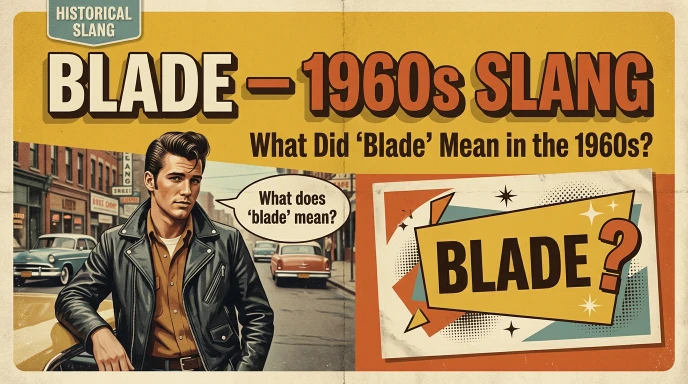
The 1960s slang word “blade” meant a knife in many lists of expressions from the decade. People also used the word in its ordinary sense for a sharp cutting edge. However, older English slang sometimes used “blade” to describe a bold, lively, or confident man, so the exact meaning depends on the historical context.
If you have seen “blade” in a 1960s slang list, a vintage story, or a discussion of old fashioned language, the surrounding sentence can help you understand which meaning applies.
Quick Answer
In 1960s slang, “blade” commonly referred to a knife. The word could describe a sharp object, including a knife carried or used as a weapon.
However, “blade” also has an older slang meaning for a bold, lively, or stylish man. That use existed long before the 1960s and should not automatically be treated as the main meaning in every 1960s reference.
- Term: Blade
- 1960s slang meaning: A knife
- Part of speech: Noun
- Tone: Depends on the situation
- Historical note: The word has several older meanings
- Modern meaning: Usually a sharp cutting edge or a flat, narrow part of a tool or machine
What Did “Blade” Mean in 1960s Slang?
The most straightforward meaning of “blade” in many 1960s slang lists is a knife. The word refers to the sharp part of a knife or, in casual speech, the knife itself.
For example:
- “He had a blade in his pocket.”
- “Keep that blade away from the children.”
- “The character pulled out a blade during the argument.”
In these examples, “blade” means a knife or a sharp edged object, not a fashionable person or a compliment.
The meaning becomes especially clear when the sentence mentions carrying, holding, hiding, or using the object.
The word was not invented during the 1960s. People used “blade” for sharp objects long before that decade, and its literal meaning remains common today.
Why Was “Blade” Used for a Knife?
The word “blade” refers to the sharp, flat part of a cutting tool. People commonly use it when talking about knives, razors, swords, and other objects with sharp edges.
In informal speech, a person may use “blade” as a shorter or more forceful way to refer to a knife.
For example:
“Watch out. He’s carrying a blade.”
Here, the speaker is warning someone that a person has a knife.
This use can sound serious because it sometimes appears in conversations about threats, street conflicts, or weapons. Still, the word itself does not automatically mean that someone intends to hurt another person. The surrounding situation determines what the speaker means.
Examples of “Blade” in 1960s Slang
These examples show how someone might understand the word in a period setting. They are illustrative sentences rather than verified quotations from actual 1960s conversations.
Example 1: Talking About a Knife
Sentence: “The police found a blade in his coat.”
Meaning: The police found a knife or another sharp edged object in his coat.
Example 2: Warning Someone
Sentence: “Be careful. He’s got a blade.”
Meaning: The speaker warns someone that another person has a knife.
Example 3: Describing a Dangerous Situation
Sentence: “Things got ugly when he pulled a blade.”
Meaning: The situation became threatening when he produced a knife.
Example 4: Talking About a Sharp Object
Sentence: “Don’t touch that blade.”
Meaning: The speaker tells someone to stay away from the sharp object.
Example 5: Describing a Character in a Vintage Story
Sentence: “The tough looking character carried a blade.”
Meaning: The character carried a knife. The sentence may help establish a threatening or rough image.
Important: These examples explain the word’s meaning; they do not prove that every person in the 1960s used “blade” in exactly the same way.
Did “Blade” Have Another Meaning in Older Slang?
Yes. Older English slang sometimes used “blade” to describe a man who was bold, lively, adventurous, or socially confident.
This meaning is much older than the 1960s. It appears in historical English usage, so it is useful to know when reading older books or period dialogue.
For example:
“He was a clever old blade.”
In this kind of sentence, “blade” describes a person rather than a knife. Depending on the context, it can suggest someone who is sharp witted, spirited, or something of a character.
Another example:
“He thought himself quite a blade.”
This could suggest that the man considered himself impressive, confident, or sophisticated.
However, do not assume that “blade” means a stylish man whenever you see it in a 1960s slang list. Many lists specifically define it as “a knife.” Check the sentence and source before choosing an interpretation.
Blade Meaning: 1960s Slang vs. Older Slang
The same word can carry different meanings across periods and communities. This table summarizes the main distinction.
| Context | Meaning of “blade” |
| A 1960s slang list | A knife |
| A sentence about a sharp object | The sharp cutting part or the knife itself |
| Older literary or historical English | A bold, lively, or spirited man |
| A conversation about tools | A cutting edge or flat, sharp component |
| A sentence about grass | A narrow leaf, as in a blade of grass |
The key distinction is context. If the sentence describes a person carrying something, “blade” likely means a knife. If it calls a person “a blade” without mentioning a weapon, the older figurative meaning may apply.
Was “Blade” a Popular Word in the 1960s?
“Blade” appears in educational lists of 1960s slang, but that does not necessarily mean it was one of the decade’s most popular everyday expressions.
The 1960s included many different communities, including teenagers, musicians, motorcyclists, students, and counterculture groups. Their language differed according to location, interests, and social background.
Some words became strongly associated with the decade, while others were older expressions that continued to appear in speech or writing.
It is more accurate to say that “blade” was recorded in lists of 1960s slang than to claim that everyone commonly used it. A historical slang list can show that a term was recognized or associated with a period, but it cannot establish how frequently every group used it.
Was “Blade” British or American Slang?
The word “blade” has a long history in English, including both British and American usage. Its literal meaning does not belong exclusively to either country.
The older figurative meaning, in which “a blade” describes a lively or bold man, also appears in historical English.
Meanwhile, lists of 1960s American slang commonly give “blade” the meaning “a knife.”
This distinction matters because slang can vary between countries. A word may carry one meaning in a particular local setting and another meaning in a historical book or regional expression.
When interpreting “blade,” consider the location, the speaker, and the type of source in which the word appears.
Is “Blade” Still Used in Modern Slang?
Yes, people still use the word “blade,” but its meaning depends on the context.
In everyday English, “blade” usually refers to a sharp cutting edge or the sharp part of an object. For example, someone might talk about a razor blade, a knife blade, or a machine blade.
In some informal contexts, people also use “blade” to mean a knife, particularly when discussing weapons or dangerous situations.
The older meaning of a bold or lively man is much less familiar to many modern readers. You may encounter it in older novels, historical dialogue, or discussions of traditional slang.
If you use the word today to describe a person, some readers may not understand the historical meaning without additional context.
How to Understand “Blade” in a 1960s Movie or Book
If you encounter “blade” in a film, novel, or story set in the 1960s, do not choose a meaning based on the decade alone. Read the whole sentence and look at what the character is doing.
Use these clues:
- The character carries, hides, or pulls out a blade: It probably means a knife.
- The sentence describes a sharp edge: It refers to the cutting part of an object.
- The writer calls someone “a blade”: It may use the older figurative meaning for a lively or bold man.
- The meaning remains unclear: Read the surrounding dialogue or paragraph for more clues.
For example, “He was a real blade” and “He carried a blade” do not necessarily mean the same thing.
In the first sentence, the word may describe a person. In the second, it almost certainly refers to a knife or sharp object.
The grammar and surrounding details are often more useful than the date alone.
Blade vs. Other 1960s Slang Words
The 1960s produced and popularized many informal expressions. Comparing “blade” with other period associated terms helps explain why context matters.
| Slang word | Common meaning |
| Blade | A knife in many 1960s slang lists |
| Groovy | Cool, enjoyable, or fashionable |
| Far out | Impressive, unusual, or exciting |
| Square | Conventional or considered uncool |
| Cat | A person, often a cool or socially confident man |
| Boss | Excellent, impressive, or cool in some slang contexts |
| Crash | To go to sleep or settle down to rest |
| Blast | A very enjoyable or exciting time |
These terms did not all have the same level of popularity across the decade. Their meanings and usage could also differ by region and social group.
Unlike “groovy” or “far out,” which often expressed approval, “blade” in a 1960s slang list usually refers to a physical object.
Common Misunderstandings About “Blade”
Several mistakes can lead to confusion when reading older slang.
1. Assuming “Blade” Always Means a Stylish Man
The figurative meaning exists in older English, but many 1960s slang references define “blade” as a knife.
Use the sentence to decide which meaning fits.
2. Assuming the Word Began in the 1960s
The word existed long before the decade. The 1960s association does not mean people invented it then.
3. Assuming Everyone Used It
A term appearing in a slang list does not prove that it was common among all teenagers or adults during that period.
4. Confusing a Blade With a Specific Type of Weapon
“Blade” can refer broadly to a knife or sharp cutting edge. It does not identify one particular knife design unless the context provides more information.
5. Ignoring the Sentence
The phrase “he carried a blade” suggests a weapon, while “he was quite a blade” may describe a person using older figurative slang.
Always interpret the word in its full sentence rather than relying on a single definition.
Frequently Asked Questions
What does “blade” mean in 1960s slang?
“Blade” commonly meant a knife in lists of 1960s slang. The word could refer to a knife itself or, more literally, its sharp cutting edge.
Did “blade” mean a cool guy in the 1960s?
The word has an older slang meaning for a bold, lively, or spirited man. However, many 1960s slang lists define it as a knife. The surrounding sentence determines which meaning is appropriate.
Was “blade” invented in the 1960s?
No. The word and its different meanings existed before the 1960s. The decade is associated with the term in some slang lists, but it did not originate then.
Is “blade” a slang word or a regular English word?
It can be both. “Blade” is a standard English word for the sharp part of a cutting tool, and it also appears in informal speech and older slang.
What does “he has a blade” mean?
It usually means that he has a knife or another sharp edged object. In a threatening situation, the phrase may indicate that the person is carrying a weapon.
What does “he is quite a blade” mean?
In older figurative English, this could describe a bold, lively, or spirited man. It is a dated expression and may not be familiar to modern readers.
Is “blade” still used today?
Yes. People commonly use it for knife edges, razor blades, and other cutting components. The word can also mean a knife in informal contexts. Its older figurative meaning is less common.
What are some other slang words from the 1960s?
Commonly recognized examples include “groovy,” “far out,” “square,” “cat,” and “boss.” Their meanings varied according to the speaker and setting.
Final Thoughts
In 1960s slang, “blade” commonly meant a knife. The term also has an older figurative meaning that can describe a bold, lively, or spirited man, but that interpretation does not fit every historical example.
If you encounter the word in a vintage movie, book, or slang list, pay attention to the sentence. References to carrying or using a blade usually point to a knife, while descriptions of someone as “a blade” may reflect the older figurative meaning.
Understanding that distinction will help you interpret this piece of historical slang without confusing its different uses.
Discover More Articles:

I research internet slang, texting abbreviations, and online language to create clear, accurate, and easy-to-understand content. My goal is to make modern internet language simple by publishing well-researched, regularly updated explanations based on trusted sources.