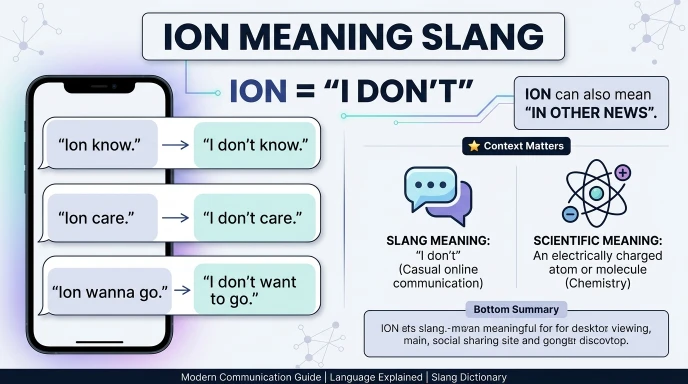
Ion meaning slang is usually “I don’t.” It is an informal spelling that represents how “I don’t” can sound in casual speech, especially in Black English. You may see it in texts, social media posts, comments, and online conversations, as in “ion know” for “I don’t know” or “ion care” for “I don’t care.” Dictionary.com documents this slang use and notes that it emerged in internet writing in the 2000s.
But there is another meaning worth knowing. ION can also mean “in other news,” usually when someone suddenly changes the subject in a conversation. So, if you see “ion” in a message, the surrounding words are important. This guide explains both meanings, where the slang comes from, how people use it, if it is rude, and how to understand it without confusing it with the scientific word ion.
Quick Answer: Ion Meaning Slang
In texting and online slang, “ion” usually means “I don’t.” It is an informal phonetic spelling used in casual communication.
For example:
- “Ion know” = “I don’t know”
- “Ion care” = “I don’t care”
- “Ion wanna go” = “I don’t want to go”
- “Ion think so” = “I don’t think so”
ION can also mean “in other news,” especially when it introduces a new topic. Context tells you which meaning is intended. Dictionary.com documents both uses.
What Does “Ion” Mean in Text?
When someone types “ion” in a casual text, they usually mean “I don’t.”
The spelling is not a traditional abbreviation like “IDK” or “BTW.” Instead, it represents a casual pronunciation of the phrase. Dictionary.com describes it as a spelling based on the colloquial pronunciation of “I don’t,” particularly in Black English.
For example:
“Ion know what you mean.”
Simply translate it as:
“I don’t know what you mean.”
Another example:
“Ion want to go there.”
This means:
“I don’t want to go there.”
The slang is mainly useful in informal writing. It can make a message sound relaxed, conversational, or expressive.
What Does “Ion” Stand For?
In its most common slang use, ion stands for “I don’t.”
It is better understood as a phonetic slang spelling than as a standard acronym.
| Slang | Standard English |
| ion know | I don’t know |
| ion care | I don’t care |
| ion want it | I don’t want it |
| ion like that | I don’t like that |
| ion think so | I don’t think so |
| ion remember | I don’t remember |
| ion understand | I don’t understand |
The spelling can look strange if you have only seen ion as the chemistry term. But in a text conversation, the sentence around it usually makes the intended meaning clear.
The Two Main Meanings of “Ion”
Although “I don’t” is the main slang meaning, ion/ION can appear with another informal meaning.
1. “Ion” = “I Don’t”
This is the meaning you are most likely looking for when the word appears directly before a verb or verb phrase.
Examples:
- “Ion know.” → I don’t know.
- “Ion care.” → I don’t care.
- “Ion wanna argue.” → I don’t want to argue.
- “Ion believe you.” → I don’t believe you.
- “Ion have time.” → I don’t have time.
The exact emotional tone depends on the sentence.
For example:
“Ion know what happened.”
This may simply mean the person is unsure.
But:
“Ion care what they say.”
can sound dismissive or defiant.
So the slang itself does not automatically mean someone is being rude. The surrounding message and relationship matter.
2. “ION” = “In Other News”
A second use of ION is the abbreviation “in other news.”
This version works as a conversation transition.
For example:
“That exam was exhausting. ION, did you watch the game?”
Here, ION means:
“In other news…”
The writer is moving from one subject to another.
Dictionary.com records this use as a transitional phrase for changing topics and notes that the acronym also emerged in internet writing in the 2000s.
How Can You Tell Which Meaning Someone Means?
Look at what comes next.
“Ion” + verb usually means “I don’t.”
ION used as a transition between unrelated subjects may mean “in other news.”
“The weather is terrible. ION, did you hear about the concert?”
Capitalization can give you a clue, but it is not a reliable rule. Online slang is often written inconsistently, so context matters more than capitalization.
Where Is “Ion” Commonly Used?
You may encounter ion in informal digital communication, including:
- Text messages
- Social media comments
- Direct messages
- Online communities
- Casual conversations
- Memes and captions
- Informal posts
Dictionary.com describes the slang use in social media and text messaging, while slang references also document its use in casual online chats.
It is especially useful in conversations where people intentionally write the way casual speech sounds.
Ion on TikTok
On TikTok, slang often appears in captions, comments, and casual text displayed on videos.
You might see:
“Ion even know why I posted this.”
Meaning:
“I don’t even know why I posted this.”
Ion on Instagram
On Instagram, ion can appear in comments, captions, and DMs.
Example:
“Ion care what anyone says 😂”
Meaning:
“I don’t care what anyone says.”
Ion in Text Messages
Texting is one of the easiest places to encounter the term.
For example:
Friend 1: You coming tonight?
Friend 2: Ion think so.
That means:
Friend 2: I don’t think so.
The casual spelling makes the message sound more like everyday speech.
Is “Ion” Rude or Offensive?
Ion is not automatically rude or offensive. It is an informal slang spelling.
However, some sentences using ion can sound dismissive.
Compare:
“Ion know.”
This can sound neutral.
With:
“Ion care what you think.”
This can sound blunt or dismissive.
The difference comes from the message itself, not simply from the word ion.
If you are talking with friends who regularly use internet slang, ion may sound completely natural. In a formal setting, however, standard English is safer.
Is “Ion” Appropriate for School or Work?
Usually, ion is better kept to informal communication.
Casual situations
It can work in:
- Texting friends
- Casual DMs
- Informal group chats
- Social media comments
- Personal conversations
Formal situations
Avoid it in:
- School assignments
- Academic papers
- Professional emails
- Job applications
- Business reports
- Formal presentations
- Official communication
For example, instead of writing:
“Ion know if I can attend.”
in a professional email, write:
“I don’t know if I can attend.”
The full form is clearer and more appropriate.
Real-Life Examples of “Ion” Slang
Example 1: Text Message
Alex: You want pizza tonight?
Sam: Ion really feel like pizza.
Meaning:
“I don’t really feel like pizza.”
Here, ion simply replaces “I don’t.”
Example 2: Group Chat
Friend 1: Did you finish the assignment?
Friend 2: Ion even start it 😭
Meaning:
“I haven’t even started it.”
The slang makes the response casual and expressive.
Example 3: Disagreement
Person A: You should definitely buy those shoes.
Person B: Ion think they’re worth it.
Meaning:
“I don’t think they’re worth it.”
The tone is informal but not necessarily aggressive.
Example 4: Showing Indifference
Person A: People are talking about your post.
Person B: Ion care.
Meaning:
“I don’t care.”
Depending on the relationship, this can sound confident, dismissive, or slightly rude.
Example 5: Changing the Subject
Person A: That movie was way too long.
Person B: Yeah, I almost fell asleep. ION, did you finish your project?
Here, ION means:
“In other news…”
The person is switching topics.
Where Did “Ion” Come From?
The slang spelling ion is not simply a random internet typo.
Dictionary.com explains that the slang form is based on the colloquial pronunciation of “I don’t,” particularly in Black English, and dates its emergence in internet writing to the 2000s.
This distinction is important: the spoken language pattern is older than the internet spelling. Writing “ion” captures a way the phrase can sound in casual speech.
The term later became more visible in online culture, social media, music, and texting. For example, Dictionary.com notes the use of ion in the title of Moneybagg Yo’s 2018 song “Ion Get You.”
The exact path by which slang spreads between speech, music, social media, and wider internet culture is difficult to reduce to one starting point. It is safer to describe documented stages of usage than to claim that one platform or person invented the expression.
Is “Ion” AAVE?
The slang spelling ion is associated with African American English/African American Vernacular English.
Dictionary.com describes it as a Black slang rendering of “I don’t” and connects the spelling to colloquial pronunciation in Black English.
This matters because internet slang does not always originate on the platforms where it becomes widely visible.
A term can come from an existing speech community and later spread through music, social media, memes, and online conversations.
When using or explaining slang from a particular speech community, it is useful to understand that background rather than treating the expression as meaningless internet shorthand.
“Ion” vs. “IDK”
These terms are related to informal communication, but they do not mean exactly the same thing.
| Term | Meaning | Example |
| ion | I don’t | “Ion know.” |
| IDK | I don’t know | “IDK what happened.” |
| IDC | I don’t care | “IDC what they say.” |
| IMO | In my opinion | “IMO, it’s better.” |
| ION | In other news | “ION, did you hear that?” |
The important difference is that ion can replace the phrase “I don’t” before different verbs.
For example:
“Ion want to go.”
But IDK already communicates the complete phrase:
“I don’t know.”
“Ion” vs. the Scientific Word “Ion”
This is one of the easiest ways to get confused.
The slang word ion has nothing to do with the scientific meaning of ion.
In chemistry and physics, an ion is an electrically charged atom or group of atoms formed through the loss or gain of electrons. Dictionary.com gives this scientific definition and traces the scientific term to Michael Faraday’s introduction of the word in 1834.
So compare:
“Ion know what happened.”
This is slang.
With:
“A sodium ion has a positive charge.”
This is science.
The surrounding context makes the difference obvious.
Why Do People Use “Ion”?
People use ion for several practical and expressive reasons.
1. It reflects casual speech
The spelling represents how the phrase can sound in fast, informal speech.
2. It keeps messages short
Typing:
“Ion know.”
is quicker and more casual than:
“I don’t know.”
3. It creates an informal tone
Slang can make a message feel relaxed and conversational.
4. It communicates identity and style
Language can signal participation in a particular online or cultural community.
5. It can add attitude
Depending on the sentence, ion can make a statement sound playful, dismissive, confident, or unconcerned.
The tone comes from the whole message rather than the spelling alone.
Common Misunderstandings About “Ion”
Misunderstanding 1: “Ion” is always a chemistry word.
No. In casual texting, ion can be slang for “I don’t.”
Misunderstanding 2: “Ion” always means “in other news.”
No. ION can mean “in other news,” but lowercase ion commonly means “I don’t” when followed by a verb.
Misunderstanding 3: “Ion” is always rude.
Not necessarily. It is informal. if it sounds rude depends on the sentence and context.
Misunderstanding 4: “Ion” and “IDK” mean exactly the same thing.
Not quite. Ion means “I don’t,” while IDK means “I don’t know.”
Misunderstanding 5: “Ion” is just a typo.
Usually, no. In slang contexts, it is an intentional spelling representing casual pronunciation.
When Should You Avoid Using “Ion”?
You do not need to avoid the term completely. Just match it to the situation.
Avoid it when writing:
- Formal emails
- Resumes
- Cover letters
- Academic assignments
- Business documents
- Professional reports
- Official applications
Use “I don’t” instead.
For example:
Informal:
“Ion think that’s gonna work.”
Formal:
“I don’t think that will work.”
The second version is clearer and more appropriate for professional communication.
Polite Alternatives to “Ion”
If you want to sound more neutral or formal, simply use the complete phrase:
- Ion know → I don’t know
- Ion think so → I don’t think so
- Ion want that → I don’t want that
- Ion agree → I don’t agree
- Ion understand → I don’t understand
- Ion remember → I don’t remember
There is no need for a complicated replacement. Standard English is usually the best alternative.
Quick Facts About Ion Slang
| Feature | Answer |
| Main slang meaning | I don’t |
| Another meaning | In other news |
| Type | Informal slang / abbreviation |
| Common context | Texting and online communication |
| Tone | Casual; can be neutral or dismissive depending on context |
| Formal use | Generally avoid |
| Scientific meaning | Electrically charged atom or group of atoms |
| Origin of slang spelling | Documented in internet writing from the 2000s |
| Cultural connection | Associated with Black English/African American English |
The slang meaning and historical notes above are supported by Dictionary.com; platform-specific usage is also documented by slang references.
Frequently Asked Questions
What does “ion” mean in texting?
In texting, ion usually means “I don’t.” For example, “ion know” means “I don’t know,” and “ion care” means “I don’t care.”
What does ION mean on social media?
On social media, ion commonly means “I don’t.” Depending on context, ION can also mean “in other news,” especially when it introduces a new topic.
Is “ion” a slang word?
Yes. In informal online communication, ion is used as a slang spelling of “I don’t.”
Is “ion” the same as “I don’t”?
In its common slang use, yes. “Ion know” means “I don’t know.”
Is “ion” rude?
The word itself is not inherently rude. However, phrases such as “ion care” can sound dismissive depending on the context and relationship between the speakers.
Can I use “ion” at work?
It is generally better to use “I don’t” in professional communication. Slang can make formal writing look overly casual.
What does ION mean in “ION, did you hear?”
In that sentence, ION most likely means “in other news.” It works as a transition to a different topic.
Is “ion” related to chemistry?
The slang use is unrelated to chemistry. In science, an ion is an electrically charged atom or group of atoms.
How do you pronounce “ion” slang?
The slang spelling represents a casual pronunciation of “I don’t.” The exact pronunciation can vary by speaker and speech variety, so it is better to understand it from context than rely on one fixed pronunciation.
Where did “ion” slang come from?
The spelling is documented in internet writing from the 2000s and reflects a colloquial pronunciation associated with Black English.
Conclusion
The ion meaning slang is usually “I don’t.” You will most often see it in casual texts, social media posts, comments, and online conversations. Expressions such as “ion know,” “ion care,” and “ion want to go” are informal ways of writing “I don’t know,” “I don’t care,” and “I don’t want to go.”
There is also another meaning: ION can mean “in other news,” particularly when someone uses it to shift the conversation to a new subject. Context is the easiest way to tell the two meanings apart.
The spelling is connected to a colloquial pronunciation associated with Black English and is documented in internet writing from the 2000s.
So, when you see “ion” in a text, look at the words around it. If it appears before a verb, “I don’t” is usually the intended meaning. If it introduces a completely new topic, “in other news” may be the better interpretation.
Discover More Articles:

I research internet slang, texting abbreviations, and online language to create clear, accurate, and easy-to-understand content. My goal is to make modern internet language simple by publishing well-researched, regularly updated explanations based on trusted sources.