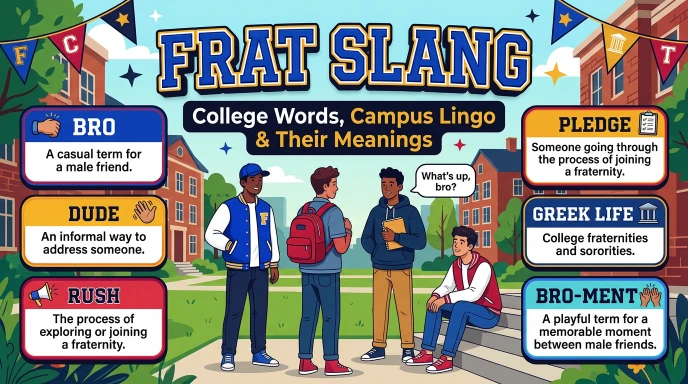
Frat slang is the informal language associated with fraternity life, college parties, campus friendships, and American college culture.
It includes expressions such as “bro,” “rush,” “pledge,” “lit,” and “geed,” which students may use when talking about parties, Greek life, social events, and campus experiences.
You might encounter frat slang in TikTok videos, college memes, movies, group chats, or conversations about American universities. Some expressions are common among college students generally, while others have specific meanings within fraternities and sororities.
Understanding these terms can help you follow college conversations and recognize the cultural references people make online.
Quick Answer
What does frat slang mean?
Frat slang refers to casual words and expressions associated with fraternity culture and American college social life. It often includes party vocabulary, Greek life terminology, nicknames for friends, and humorous expressions.
Common examples include:
- Bro: A male friend or buddy.
- Rush: The process of recruiting potential fraternity or sorority members.
- Pledge: Someone going through a fraternity or sorority’s new member process.
- Lit: Exciting, energetic, or fun, especially at a party.
- Rager: A large or wild party.
- Geed (GDI): A term used in some Greek life communities for someone who is not part of a fraternity or sorority.
- Brothers: Fellow members of a fraternity.
Important: Not every term is exclusive to fraternities. Many expressions associated with frat slang are also used by college students and young adults outside Greek life.
What Does Frat Mean in College Slang?
The word “frat” is a shortened form of “fraternity.” In the United States, a fraternity is a membership based college organization, often associated with Greek letters, social events, community service, and campus traditions.
In everyday conversation, frat can refer to the organization itself, its members, or the broader culture associated with fraternity houses and parties.
For example:
- “He joined a frat.” He joined a fraternity.
- “They’re having a frat party.” They’re hosting a party associated with fraternity culture.
- “That movie has a frat vibe.” The movie resembles a stereotypical American college fraternity setting.
The word can be neutral, but it can also carry stereotypes about heavy partying, loud social events, or privileged college students. The tone depends on how someone uses it.
20 Popular Frat Slang Terms and Their Meanings
These terms cover common fraternity vocabulary, college party expressions, and words associated with American campus culture. Their popularity varies by university, region, and generation.
1. Bro
Meaning: A friend, buddy, or male peer.
“Bro” is one of the most recognizable words associated with frat culture. It can express friendship, surprise, disbelief, or frustration.
Examples:
- “Bro, that party was wild.”
- “What’s up, bro?”
- “Bro, you forgot your keys.”
Although strongly associated with certain college stereotypes, bro is widely used outside fraternities.
2. Rush
Meaning: The recruitment period when students explore fraternities or sororities.
During rush, prospective members attend events, meet current members, and learn about different Greek organizations.
Examples:
- “I’m going through rush this semester.”
- “Rush starts next week.”
- “Which frat are you rushing?”
Rush is a specific Greek life term, not simply another word for partying.
3. Pledge
Meaning: A person participating in a fraternity or sorority’s new member process.
A pledge is generally someone who has begun the organization’s process for prospective members but has not yet become a fully initiated member.
Examples:
- “He’s a pledge this semester.”
- “The pledges attended the chapter event.”
Terminology and membership practices differ among organizations. Some use different terms, such as new member.
4. Lit
Meaning: Exciting, energetic, or extremely fun.
“Lit” is common in party conversations and is not limited to fraternity culture.
Examples:
- “That party was lit.”
- “The music was lit last night.”
- “Friday is going to be lit.”
The word can describe a lively atmosphere, a great event, or something exciting.
5. Rager
Meaning: A large, energetic, or wild party.
The term often appears in discussions of college parties, especially those associated with fraternity houses.
Examples:
- “They’re throwing a rager this weekend.”
- “That house party turned into a rager.”
A rager generally suggests a high energy event rather than a quiet gathering.
6. Greek Life
Meaning: The fraternity and sorority system at a college or university.
Greek organizations commonly use Greek letters as part of their names.
Examples:
- “She’s involved in Greek life.”
- “Greek life is active on that campus.”
Greek life is a broad cultural term, not slang for partying alone. Organizations may participate in philanthropy, leadership activities, community service, and social events.
7. Brothers
Meaning: Members of the same fraternity.
Fraternity members often call one another brothers to express membership and a sense of community.
Examples:
- “I’m meeting my fraternity brothers tonight.”
- “His brothers helped organize the event.”
The term refers to organizational membership, not necessarily biological siblings.
8. Geed (GDI)
Meaning: A person who is not part of a fraternity or sorority, in some Greek life communities.
GDI is often expanded as “Goddamn Independent,” though interpretations and usage vary. Geed is a related term used in some campus settings.
Examples:
- “He’s not in Greek life; he’s a geed.”
- “Some students prefer staying independent.”
This term can sound dismissive or exclusionary, depending on who says it and how. Not every non Greek student uses or accepts the label.
9. House Party
Meaning: A social gathering held at someone’s house, fraternity house, or another residence.
Examples:
- “There’s a house party on Saturday.”
- “We went to a house party after the game.”
House parties are not exclusive to fraternities, but they often appear in popular depictions of college life.
10. Pregame
Meaning: Socializing or having drinks before the main event.
In college settings, a pregame may take place before a party, concert, or sporting event. The word can also refer to non alcoholic preparation or socializing before an event.
Examples:
- “We’re meeting at my place to pregame.”
- “The pregame starts at eight.”
The term is informal and widely used beyond fraternity culture.
11. Mixer
Meaning: A social event organized for members of different student groups to meet.
In Greek life, a mixer often involves a fraternity and a sorority or another campus organization.
Examples:
- “Our chapter has a mixer on Friday.”
- “They’re hosting a mixer with another organization.”
A mixer is typically a planned social event rather than an unstructured party.
12. Date Party
Meaning: A formal or semi formal Greek life event where members bring a guest.
The exact format varies by organization and campus. Some date parties have themes, group activities, or dress codes.
Examples:
- “I need to find an outfit for the date party.”
- “Our fraternity’s date party is next month.”
The term describes a particular kind of organized social event.
13. Formal
Meaning: A dressier fraternity or sorority event, sometimes involving dinner, dancing, or travel.
Examples:
- “Our formal is in the spring.”
- “Everyone is getting ready for formal.”
A formal is usually more structured than a casual house party, though traditions differ between chapters.
14. Bro Code
Meaning: An informal set of expectations about loyalty and behavior among friends.
The phrase is often used humorously to describe rules that friends supposedly follow.
Examples:
- “You can’t date his ex that’s bro code.”
- “He broke the bro code by sharing the secret.”
Bro code is a cultural expression, not an official fraternity rule. People disagree about what these supposed rules should be.
15. Dude
Meaning: A casual way to address someone.
Examples:
- “Dude, that was hilarious.”
- “What’s going on, dude?”
- “Dude, are you serious?”
Like “bro,” this word is common in everyday American English and does not require a connection to Greek life.
16. Chill
Meaning: To relax, hang out, or spend time casually.
Examples:
- “We’re just chilling at the house.”
- “Want to chill after class?”
It can also describe a person or atmosphere as relaxed.
17. Vibe
Meaning: The mood, feeling, or atmosphere of a person, place, or event.
Examples:
- “The party has a good vibe.”
- “That house has a relaxed vibe.”
- “I’m not feeling the vibe tonight.”
“Vibe” is widely used in modern informal English, including college and social media conversations.
18. Throw Down
Meaning: To host or participate in an energetic party, depending on context.
Examples:
- “They’re throwing down this weekend.”
- “That house knows how to throw down.”
The expression can also refer to fighting or competing in other contexts, so the sentence matters.
19. Banger
Meaning: An excellent song or, in some contexts, an exciting event.
Examples:
- “That song is a banger.”
- “The DJ played bangers all night.”
The term is common in music and internet slang, not just fraternity culture.
20. Wasted
Meaning: Extremely intoxicated, usually from alcohol.
Examples:
- “He got wasted at the party.”
- “They left early because they didn’t want to get wasted.”
This term is informal and often has a negative implication. It describes a state of intoxication, not simply having a good time.
Frat Party Slang You Might Hear
Fraternity parties have their own vocabulary for events, music, socializing, and the general atmosphere. Many of these expressions also appear in broader college slang.
| Term | Meaning | Example |
| Kickback | A small, relaxed gathering | “We’re having a kickback tonight.” |
| Turn up | To celebrate or party energetically | “We’re turning up after the game.” |
| Packed | Very crowded | “The house was packed.” |
| Hype | Excitement or energetic promotion | “Everyone is hyped for the party.” |
| Afterparty | A gathering after the main event | “There’s an afterparty later.” |
| Pull up | Arrive or come over | “Pull up around nine.” |
| Squad | A close group of friends | “My squad is going together.” |
| Low key | Quiet, subtle, or not too intense | “We’re keeping it low key tonight.” |
Example Conversation
Student A: “Are you going to the frat party tonight?”
Student B: “Maybe. My friends are pregaming first.”
Student A: “Cool. Pull up when you’re ready.”
Student B: “Bet. Text me the address.”
In this conversation:
- Pregaming means socializing before the main event.
- Pull up means arrive or come over.
- Bet means “okay,” “sure,” or “sounds good.”
These expressions are common in informal American English and are not exclusive to fraternities.
Fraternity and Sorority Slang: What Is the Difference?
Fraternity and sorority terminology overlaps, but the words can refer to different organizations and membership traditions.
A fraternity is commonly a college organization historically associated with men, while a sorority is commonly an organization historically associated with women. Some Greek letter organizations have different membership structures and traditions.
Here are some common terms:
- Chapter: A local branch of a larger Greek organization.
- Initiation: A ceremony or process marking formal membership.
- Alumni: Former students or members who have completed their college years.
- Active member: An initiated member currently participating in the chapter.
- New member: Someone who has joined the organization’s membership process.
- Philanthropy: A charitable cause or service activity supported by an organization.
- House: A residence or social space associated with a chapter, where applicable.
For example, a student might say, “Our chapter is organizing a philanthropy event.” This means the local fraternity or sorority group is arranging an activity to support a charitable cause.
These are Greek life terms rather than necessarily slang. They help explain how fraternity and sorority organizations operate.
How Frat Slang Is Used on TikTok and Social Media
Frat slang often appears in college humor, campus interviews, party videos, memes, and fictional portrayals of American university life.
Creators may use the language to describe a party, joke about fraternity stereotypes, or imitate a particular college persona.
Examples include:
- “Average frat bro behavior.”
- “That party was absolutely lit.”
- “Bro thinks he’s the main character.”
- “The frat house is packed tonight.”
- “He’s in his college era.”
The tone may be affectionate, sarcastic, or critical. A joke about a “frat bro,” for example, may refer to a stereotype of someone who is loud, overly confident, sports focused, or obsessed with parties.
Social media portrayals exaggerate real life behavior. Not every fraternity member acts the same way, and many terms are used by students who have no connection to Greek life.
What Is a Frat Bro?
A frat bro is an informal label for a male college student associated with fraternity culture or someone who fits the popular stereotype of a fraternity member.
Depending on context, the phrase can be neutral, humorous, or insulting.
Examples:
- “He’s a frat bro who loves college football.”
- “That character acts like a stereotypical frat bro.”
- “The video makes fun of frat bro culture.”
The stereotype often includes references to parties, sports, casual clothing, loud socializing, and expressions such as “bro” or “dude.”
However, the label is not a reliable description of every fraternity member. Some people use it to refer to actual fraternity members, while others use it more broadly to describe a particular personality or style.
Is Frat Slang Offensive?
Most frat slang is casual rather than offensive, but some expressions can exclude people or encourage negative stereotypes.
For example:
- “Bro” and “dude” are usually harmless when used among friends.
- “Geed” or “GDI” can sound dismissive when used to mock students outside Greek life.
- “Wasted” refers to heavy intoxication and may carry negative associations.
- “Frat bro” can be a joke or a stereotype, depending on the conversation.
The meaning also depends on the relationship between speakers. Friends may use certain expressions jokingly, while the same words could sound rude when directed at a stranger.
When in doubt, choose neutral language and avoid using Greek life labels to put other students down.
Frequently Asked Questions About Frat Slang
1. What does frat mean in slang?
Frat is short for fraternity. In casual conversation, it can refer to a fraternity, its members, a fraternity house, or the wider culture associated with Greek life.
2. What is the most common frat slang?
Common terms include bro, rush, pledge, lit, rager, Greek life, mixer, and pregame. Some are specific to fraternity culture, while others are widely used by college students.
3. What does “rush” mean in frat slang?
Rush is the recruitment period when students meet fraternity or sorority members and learn about Greek organizations before deciding if to pursue membership.
4. What does “pledge” mean in a fraternity?
A pledge is someone participating in a fraternity’s or sorority’s new member process. The exact terminology depends on the organization.
5. What does “geed” mean in college slang?
Geed is a term used in some Greek life communities for someone who is not a member of a fraternity or sorority. It can be dismissive, depending on the context.
6. What is a frat party?
A frat party is a social event associated with a fraternity, often held at a fraternity house or another venue. The event may be casual, themed, or organized with another student group.
7. What does “frat bro” mean?
A frat bro is a male student associated with fraternity culture or someone who fits its popular stereotype. The phrase can be playful or insulting.
8. Is frat slang still used today?
Many expressions, such as “bro,” “lit,” “vibe,” and “pull up,” remain common in informal English. More specialized Greek life terms continue to be used within campus organizations, though popularity varies.
9. Is frat slang the same as Gen Z slang?
No. Some frat expressions overlap with Gen Z slang, but frat slang also includes long established college terms such as “rush,” “pledge,” and “chapter.”
10. Can people use frat slang if they are not in a fraternity?
Yes. Many terms are ordinary informal English expressions that anyone can use. More specialized Greek life terms are easiest to use accurately when you understand their specific meanings.
Final Thoughts on Frat Slang
Frat slang combines fraternity terminology with casual college expressions and party vocabulary. Words such as “rush,” “pledge,” and “chapter” relate directly to Greek life, while “bro,” “lit,” “vibe,” and “pull up” are used much more broadly.
Understanding the difference helps you follow college conversations, interpret TikTok memes, and recognize references to American campus culture.
Remember that not every college student belongs to Greek life, and not every fraternity member fits the stereotypical frat bro image. The meaning of each expression depends on the setting, the speaker, and the way the word is used.
Discover More Articles:

I research internet slang, texting abbreviations, and online language to create clear, accurate, and easy-to-understand content. My goal is to make modern internet language simple by publishing well-researched, regularly updated explanations based on trusted sources.