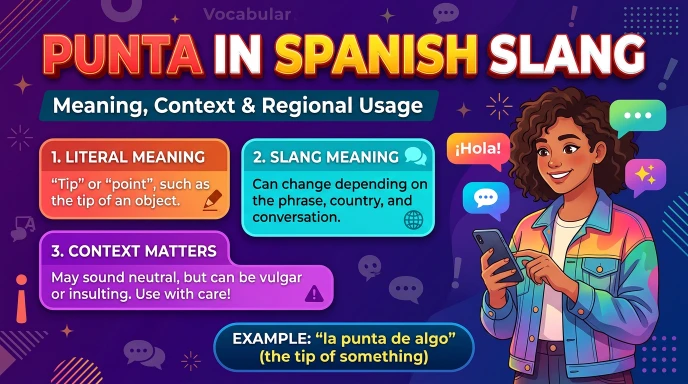
The word “punta” in Spanish usually means “tip,” “point,” or “end,” but its slang meaning can change depending on the country and conversation.
In some contexts, it can refer to a large amount of something, a sharp comment, or a vulgar expression.
If you saw punta in a text message, song lyric, social media comment, or conversation, the surrounding words can help you understand its intended meaning. The word is not automatically offensive; its tone depends on how and where someone uses it.
Spanish slang varies across Mexico, Central America, the Caribbean, and South America, so one translation does not fit every situation.
Quick Answer
What does punta mean in Spanish slang?
- Literal meaning: Tip, point, or end of something.
- Informal meaning: In some Spanish speaking regions, it can mean a lot or a large number of something.
- Regional slang: It may refer to a sharp remark, an insult, or another local expression.
- Vulgar meaning: In some slang contexts, it can have a sexually explicit or offensive meaning.
Example: La punta del lápiz means “the tip of the pencil.” In a regional expression, however, punta may carry a completely different meaning.
The safest approach is to read the whole sentence instead of translating the word by itself.
What Does Punta Mean Literally in Spanish?
In standard Spanish, punta is a feminine noun that generally means the pointed end, tip, or extremity of something. It is an ordinary Spanish word, not slang by default.
Here are common examples:
| Spanish phrase | English meaning |
| La punta del lápiz | The tip of the pencil |
| La punta del cuchillo | The tip of the knife |
| La punta del dedo | The fingertip |
| La punta del zapato | The toe or tip of the shoe |
| La punta de la montaña | The peak or top of the mountain |
| De punta a punta | From one end to the other |
For example:
- Spanish: La punta del lápiz está rota.
- English: The tip of the pencil is broken.
Another example:
- Spanish: Caminamos de punta a punta de la ciudad.
- English: We walked from one end of the city to the other.
In these sentences, punta has a normal, neutral meaning. There is no insult or hidden slang involved.
What Does Punta Mean in Spanish Slang?
The slang meaning of punta depends on the region and the words around it. Some uses are casual, while others can sound rude or offensive.
1. Punta Can Mean “A Lot” in Some Regions
In certain varieties of Spanish, especially in parts of Central America and the Southern Cone, punta can refer to a large or unspecified amount of something.
For example:
- Spanish: Hay una punta de cosas que hacer.
- English: There are a ton of things to do.
- Spanish: Llegó una punta de gente.
- English: A whole lot of people arrived.
The exact phrasing and naturalness vary by country, so these examples illustrate a regional use rather than a universal expression.
Remember: When punta describes a quantity, it does not necessarily refer to a physical tip or point.
2. Punta Can Refer to a Sharp Remark
In some contexts, punta can refer to an indirect jab, pointed comment, or remark aimed at someone.
For example, a person might describe a sarcastic comment as una punta when it indirectly criticizes another person.
A related expression is tirar una punta, which can describe making an indirect remark or taking a verbal jab at someone, depending on local usage.
Example:
- Spanish: Me tiró una punta durante la conversación.
- English: They made a pointed remark at me during the conversation.
The expression may sound playful, sarcastic, or critical depending on the relationship between the speakers and the situation.
3. Punta Can Have a Vulgar Meaning
In some informal or sexually explicit contexts, punta may be used with a vulgar meaning. Some slang dictionaries also record sexual meanings associated with female genitalia.
However, this is not the standard meaning of the word throughout the Spanish speaking world. The exact interpretation depends on the local variety of Spanish and the surrounding expression.
If someone uses punta while joking about sex, insulting another person, or making an explicit comment, the word may have a vulgar undertone.
Do not assume that every use is sexual or insulting. In ordinary conversation, the word often means nothing more than “tip” or “point.”
4. Punta Can Have Other Regional Meanings
Spanish dictionaries record several country specific meanings for punta. Depending on the location, it can refer to a knife or blade, a group of people, a small quantity of a substance, or other locally understood concepts.
For example, some regional uses describe a cutting tool, while others use the word for a large amount of something.
The speaker’s country and the full sentence are important clues. A meaning used in Mexico may not be the meaning understood in Chile, Venezuela, or Uruguay.
Is Punta a Bad Word in Spanish?
No, punta is not automatically a bad word. In standard Spanish, it is a common and generally neutral noun.
Its tone depends on how it is used.
| Context | Likely tone | Example meaning |
| Talking about a pencil | Neutral | Pencil tip |
| Describing a mountain | Neutral | Peak or point |
| Talking about a large group | Informal or regional | A lot of people |
| Making an indirect remark | Potentially sarcastic | A verbal jab |
| Using a sexually explicit expression | Potentially vulgar | Depends on the expression |
| Insulting someone | Potentially offensive | Depends on the local slang |
For instance, la punta de la mesa means “the corner or end of the table.” There is nothing rude about it.
On the other hand, using a regional expression to mock someone could make the word sound insulting.
If you are learning Spanish, it is better to understand the complete phrase before deciding if it is appropriate to repeat.
How Is Punta Used in Texting and Social Media?
When punta appears in a text message or social media comment, it generally keeps its Spanish meaning, but the context may make it informal, sarcastic, or vulgar.
People may use the word in conversations, captions, comments, memes, or Spanish language music. Seeing it online does not automatically mean it is a new internet slang term.
Here are a few examples of how to interpret it.
Example 1: Talking About an Object
Message: Se rompió la punta del lápiz.
Meaning: The pencil tip broke.
Tone: Neutral.
The sentence describes an object and uses the ordinary Spanish meaning.
Example 2: Talking About a Large Quantity
Message: Había una punta de personas allí.
Possible meaning: There were loads of people there.
Tone: Informal or regional.
This interpretation is possible in varieties where punta is used to describe a large amount. Other speakers may prefer different wording.
Example 3: Making a Sarcastic Comment
Message: Siempre me tira una punta cuando hablamos.
Meaning: They always make a pointed remark at me when we talk.
Tone: Potentially sarcastic or critical.
Here, the expression suggests indirect criticism rather than a physical point.
Example 4: Using It in a Song or Meme
If you hear punta in a Spanish language song, meme, or joke, pay attention to the full lyric or sentence.
The word may be literal, regional slang, or part of a vulgar expression. A single word is not enough to determine the intended meaning reliably.
Does Punta Mean the Same Thing in Mexico and Other Spanish Speaking Countries?
No. Spanish has many regional variations, and punta is a good example of why location matters.
Mexico
In Mexico, punta commonly has its ordinary meaning of “tip” or “point.” Regional dictionaries also record specialized slang uses, including references to a blade and certain derogatory uses involving groups of people.
The meaning depends on the sentence and local usage.
Central America
In parts of Central America, the word has regional meanings that may differ from standard Spanish. In some places, it can refer to a large quantity or have a specialized cultural meaning.
South America
In some South American varieties, particularly in the Southern Cone, punta can be used informally to mean “a lot” or “a large number.” The exact expression may sound more natural in one country than another.
Caribbean Spanish
In the Caribbean, as elsewhere, the basic meaning remains “tip” or “point,” while additional slang meanings depend on the country and the expression. Do not assume that a vulgar meaning recorded in one location applies to every Caribbean speaker.
The main takeaway: Spanish slang is regional. To understand punta accurately, consider both the country and the sentence.
Punta vs. Puta: What Is the Difference?
The words punta and puta look similar, but they are different Spanish words. Confusing them can change the meaning significantly.
| Word | Basic meaning | Important note |
| Punta | Tip, point, or end | Usually neutral in its literal use |
| Puta | A vulgar term for a sex worker; also used as an insult | Often offensive, depending on context |
For example:
- Punta del lápiz means “tip of the pencil.”
- Puta is a vulgar Spanish word that can be used to insult someone.
The words are not interchangeable. Do not replace one with the other when writing or speaking Spanish.
If you heard one of these words in a song or conversation, listening carefully to the pronunciation and surrounding sentence can help you identify which word was used.
Common Mistakes When Understanding Punta
Spanish learners sometimes assume that every word found in a slang search has one fixed, modern meaning. That is not always true.
Avoid these common mistakes:
- Assuming it is always vulgar: Punta is a normal Spanish noun with many neutral uses.
- Assuming it always means “tip”: Some regional expressions use it differently.
- Treating it as universal slang: Meanings and naturalness vary across Spanish speaking communities.
- Confusing it with “puta”: The spelling difference matters.
- Ignoring the surrounding sentence: A conversation about an object is different from a sexually suggestive joke or an insult.
- Assuming every social media use is new slang: Sometimes people are simply using an ordinary Spanish word.
The best way to interpret unfamiliar slang is to consider the sentence, the speaker’s location, and the tone of the conversation.
Frequently Asked Questions About Punta in Spanish Slang
1. What does punta mean in English?
Punta usually translates as “tip,” “point,” or “end.” In regional slang, it may refer to a large amount, a sharp remark, or another local meaning.
2. Is punta a Spanish slang word?
It can be used in slang, but it is also an ordinary Spanish word. Its literal meaning is common throughout the language, while slang meanings vary by region.
3. Does punta mean a bad word?
Not by itself in every context. The word is normally neutral when describing the tip of an object. Some regional expressions or sexually explicit uses can be offensive.
4. What does punta mean in a text message?
It depends on the message. It might mean “tip” or “point,” refer to a quantity, or be part of a regional expression. Read the complete sentence to determine the intended meaning.
5. Does punta mean the same thing as puta?
No. Punta generally means “tip” or “point,” while puta is a vulgar word that can refer to a sex worker or be used as an insult.
6. Can punta mean “a lot” in Spanish?
Yes, in some regional varieties. This usage is informal and is not equally common everywhere.
7. Is it safe to use punta when speaking Spanish?
It is generally fine when you use it in its ordinary meaning, such as la punta del lápiz. If you are unsure about a regional slang expression, learn its meaning before repeating it.
8. What does punta mean in a Spanish song?
The meaning depends on the lyrics. It may refer to a literal point, a regional expression, or a vulgar meaning. The surrounding lyrics provide the necessary context.
Final Thoughts on Punta in Spanish Slang
Punta in Spanish slang does not have one universal definition. Its everyday meaning is “tip,” “point,” or “end,” but regional speech can give it additional meanings, including “a lot,” an indirect jab, or a vulgar expression.
If you encounter it in a text, song, meme, or conversation, look at the complete sentence before interpreting it. Also remember that punta and puta are different words.
Understanding Spanish slang means more than translating individual words. The country, context, and speaker’s tone often determine what a word really means.
Discover More Articles:

I research internet slang, texting abbreviations, and online language to create clear, accurate, and easy-to-understand content. My goal is to make modern internet language simple by publishing well-researched, regularly updated explanations based on trusted sources.