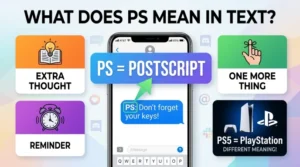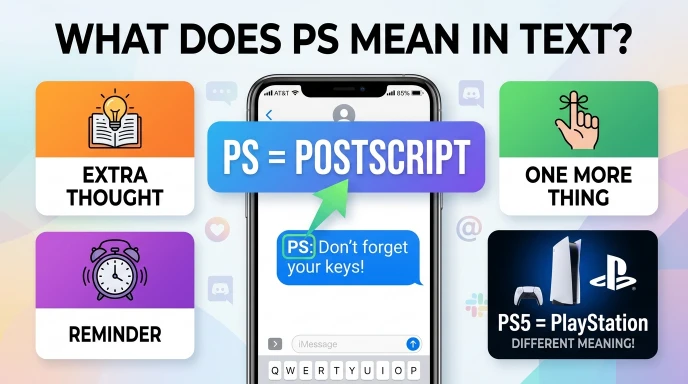
PS usually means “postscript” in text messages, emails, and online conversations. It is used to add an extra thought or message after the main part of a conversation, often something the writer remembered at the end.
You may see PS in texting, Instagram messages, Snapchat, WhatsApp chats, emails, Facebook posts, or comments. For example, someone might write, “PS: Don’t forget your jacket!” after finishing the main message.
The term can be confusing because PS can have other meanings in different contexts. In gaming or entertainment, for example, PS may refer to PlayStation. But in ordinary writing and messaging, “PS” most commonly means postscript.
Understanding the context is important when you see PS online. If someone adds it at the end of a message, they are usually adding one more thought, reminder, joke, or detail they did not include earlier.
PS Meaning in Text
PS means “postscript.”
A postscript is an extra note added after the main message has already been written. The abbreviation comes from the Latin phrase post scriptum, which means “written after.”
In everyday texting, however, you do not need to know the Latin origin to understand it. When someone writes PS, they are basically saying:
“Oh, and one more thing…”
For example:
“I’ll see you at 7 tonight. PS: Bring your charger.”
The main message is about meeting at 7. The PS adds an additional reminder about the charger.
Another example is:
“Thanks for helping me today! PS: I really liked your new haircut.”
The second thought is separate from the main message, so the writer adds it as a postscript.
Is PS Slang, an Acronym, or an Abbreviation?
PS is an abbreviation, rather than typical slang.
It is short for postscript, and it has been used in written communication for a long time. Although people use it in casual internet conversations today, the term itself existed long before smartphones, social media, or texting.
You may see it written as:
- PS
- P.S.
- ps
- P.S.:
All of these can communicate the same basic idea.
The punctuation style can vary depending on the person’s writing habits. In casual texting, people often write simply PS without periods.
What Does PS Mean in Everyday Chat?
In everyday conversation, PS usually introduces an additional thought.
Imagine that your friend sends:
“I’m going to the mall after work. Want to come?”
Then they send:
“PS: I found that hoodie you wanted.”
The second message is an extra piece of information they remembered after writing the main message.
PS can also be used to add:
- a reminder
- a joke
- an important detail
- a compliment
- an afterthought
- a correction
- something the writer forgot to mention
PS at the End of a Message
PS is usually placed after the main message.
For example:
“Thanks for coming today. I had a great time.
PS: Send me those photos when you can.”
The main message is complete before the PS begins.
That is what makes PS different from an ordinary sentence in the middle of a message. It signals that the writer has finished the main thought and wants to add something extra.
Where People Use PS Mean in Text
PS can appear in many types of communication. It is especially common when someone wants to add an extra thought without rewriting the entire message.
PS in Text Messages
In regular texting, PS can be used when someone remembers something after sending or writing the main message.
For example:
“I’ll call you when I get home. PS: Can you pick up some milk?”
The PS makes the second request feel like an additional thought.
Another example:
“Good luck with your exam tomorrow! PS: Don’t stay up too late tonight.”
This is a natural way to add a friendly reminder.
PS on TikTok
On TikTok, PS may appear in captions, comments, direct messages, or replies.
For example:
“This song has been stuck in my head all day. PS: The ending is so good.”
A TikTok commenter might also write:
“PS: Watch until the end 😂”
In these cases, PS still means “postscript.” It does not automatically have a special TikTok specific meaning.
PS on Snapchat
Snapchat conversations are usually informal, so someone may use PS to add an extra thought.
For example:
“I’ll send you the address in a minute. PS: Bring a hoodie.”
Or:
“That picture was hilarious 😂 PS: You still owe me coffee.”
The abbreviation helps separate the additional thought from the main message.
PS on Instagram
Instagram users may use PS in DMs, captions, comments, or even story text.
For example:
“Thanks everyone for the birthday wishes! PS: You guys made my day.”
A person might also write:
“New photos are up. PS: Swipe to the last one.”
Here, PS simply introduces information that the person wants to add after the main statement.
PS on WhatsApp
WhatsApp users may use PS when chatting with friends, family, classmates, or coworkers.
For example:
“I’ll be there around 6. PS: Tell Mom I’m bringing dinner.”
Because WhatsApp messages can be informal and conversational, PS can fit naturally into the conversation.
PS in Emails
PS has traditionally been common in letters and emails.
For example:
“Thank you for meeting with me today. I enjoyed our conversation.
P.S. I’ll send the documents tomorrow morning.”
In an email, PS can be used for a small additional note that is not central to the main message.
Real Chat Examples of PS Mean in Text
The easiest way to understand PS is to see how people might actually use it in conversations.
Example 1: Making Plans
A: I’ll meet you outside the café at 6.
B: Sounds good.
A: PS: Don’t forget the tickets.
Here, PS adds a reminder.
Example 2: Talking to a Friend
A: Thanks for helping me move today. Seriously, I appreciate it.
B: No problem!
A: PS: Your pizza is still in my fridge 😂
The PS introduces a funny extra detail.
Example 3: School Conversation
A: Did you finish the science assignment?
B: Yeah, I submitted it last night.
A: PS: The teacher said we also need to bring our notebooks tomorrow.
The second statement is an additional reminder.
Example 4: Instagram DM
A: Your vacation pictures look amazing!
B: Thank you!
A: PS: I need the name of that hotel.
The writer adds a request after the main compliment.
Example 5: Snapchat
A: I’ll send you the location when I get there.
B: Okay.
A: PS: Bring your camera!
The PS is simply another reminder.
Example 6: Family Chat
A: I’m leaving work now and should be home in about 30 minutes.
B: Okay.
A: PS: Do we need anything from the store?
The writer remembered another question.
Example 7: Friendly Message
A: Hope you have an amazing birthday! You deserve a great day.
B: Thank you so much ❤️
A: PS: I have a surprise for you.
The PS creates a little suspense.
Example 8: Funny Conversation
A: I promise I won’t eat your snacks this time.
B: Good 😂
A: PS: I already ate them.
The PS is used as a punchline.
Example 9: Work Chat
A: The meeting is scheduled for 10 a.m. tomorrow.
B: Got it.
A: PS: Please bring the latest sales report.
The second sentence adds an extra work related reminder.
Example 10: Casual Text
A: I’m heading home now. Talk later!
B: Okay!
A: PS: Your dog is adorable 😂
The writer adds a final unrelated thought.
How to Reply When Someone Says “PS”
There is no special response required when someone uses PS.
You simply respond to the information that comes after it.
For example:
Them: “PS: Can you bring some snacks?”
You could say:
“Sure, what kind do you want?”
Your response depends on what the person actually says after PS.
Funny Replies
If the PS is clearly a joke, you can reply playfully.
Them: “PS: I ate your fries.”
You: “PS: You’re officially banned from my kitchen 😂”
Another example:
Them: “PS: I forgot your birthday gift.”
You: “PS: I’m pretending I didn’t read that 😂”
Casual Replies
For a normal conversation, keep your response simple.
Them: “PS: Bring your charger.”
You: “Sure, I will.”
Or:
“Thanks for reminding me!”
Friendly Replies
If someone adds a thoughtful message, respond warmly.
Them: “PS: Good luck tomorrow!”
You: “Thank you! I really appreciate it.”
You could also say:
“Thanks! I needed that.”
Neutral Replies
If the conversation is more formal or straightforward, answer directly.
Them: “PS: Please send the document before 5.”
You: “Okay, I’ll send it before 5.”
The abbreviation does not change the basic response.
Is PS Rude or Offensive?
No, PS is not normally rude or offensive.
It is simply a way to introduce an additional thought. There is nothing inherently insulting or inappropriate about the abbreviation.
However, the message after PS can have any tone depending on what the person writes.
For example:
“PS: Don’t forget to bring your umbrella.”
is friendly and helpful.
But:
“PS: You still haven’t paid me back.”
could sound more serious or annoyed.
The tone comes from the actual statement, not from “PS” itself.
Is PS Safe to Use?
Yes. PS is generally safe to use in ordinary conversations.
It is widely understood and does not normally carry offensive meaning.
Still, as with any abbreviation, the communication setting matters.
Can You Use PS at School?
You can use PS in casual messages to classmates or friends.
For example:
“PS: Don’t forget the project tomorrow.”
But in formal academic writing, you should generally avoid unnecessary texting style abbreviations.
If you are writing an essay or formal assignment, follow your teacher’s preferred style.
Can You Use PS at Work?
PS can be appropriate in some workplace emails, especially when the communication is informal.
For example:
“P.S. I’ll also bring the printed copies.”
However, in very formal business writing, it may be better to include the information naturally in the main body of the email rather than adding a postscript.
The important point is that PS itself is not unprofessional, but its suitability depends on the tone and purpose of the message.
Who Uses This Term?
PS is not limited to one generation.
Unlike some internet expressions that are strongly associated with younger users, PS has been used in written communication for a very long time.
Teenagers may use it in texting. Adults may use it in emails. Older generations may recognize it from letters and traditional correspondence.
Gen Z Usage
Gen Z users may use PS in casual messages, social media posts, captions, and DMs.
However, PS is not exclusively Gen Z slang.
You may see it alongside modern texting abbreviations such as:
- LOL
- IDK
- BTW
- TBH
- IMO
- FYI
- RN
The difference is that PS is much older than most modern internet slang.
Millennials and Older Users
Millennials and older internet users may also use PS regularly.
Many people encountered the abbreviation through letters, emails, greeting cards, or older forms of digital communication before social media became dominant.
Common Platforms
PS can appear on almost any platform where people write messages, including:
- TikTok
- Snapchat
- Discord
- SMS
- online forums
Its meaning generally remains the same.
Origin of the Term PS
The term postscript comes from the Latin phrase post scriptum, meaning “written after.”
Historically, a postscript was used when someone had already finished writing a letter but wanted to add another thought afterward.
Instead of rewriting the entire letter, the writer could simply add a short note at the end.
Over time, P.S. became the familiar abbreviation for this additional message.
The concept existed long before texting and social media. Digital communication simply carried the tradition into newer forms of writing.
How PS Became Common Online
When email became widely used, people continued using P.S. in digital messages.
Later, texting and social media made the abbreviation even more familiar.
Today, someone can type:
“PS: Don’t forget!”
in a WhatsApp message just as easily as someone could have written a postscript in a handwritten letter decades ago.
The meaning remained largely unchanged.
Why Does PS Still Exist?
The idea behind PS is useful because people frequently remember something after finishing their main thought.
Instead of editing the entire message, they can simply add:
“PS: One more thing…”
That makes the abbreviation practical even in modern communication.
PS Can Have Other Meanings
Although postscript is a common meaning in writing and texting, PS can mean different things depending on context.
This is important because not every “PS” you see online means postscript.
PS as PlayStation
In gaming conversations, PS may refer to PlayStation.
For example:
“I bought it on PS5.”
Here, PS is connected to the PlayStation gaming platform, not postscript.
PS as a Unit of Horsepower
In some automotive contexts, PS can refer to a measurement of engine power related to metric horsepower.
For example, a car specification may list an engine’s power in PS.
This is a completely different meaning from the texting abbreviation.
How Do You Know Which Meaning Is Intended?
Look at the surrounding words.
If someone writes:
“PS: Call me later.”
they almost certainly mean postscript.
If someone says:
“I play it on PS5.”
they mean PlayStation.
Context is what tells you which definition makes sense.
Real World Usage Example
Imagine that two friends are planning to meet for dinner.
One friend sends:
“I booked the restaurant for 8 p.m. We can meet outside at 7:45.”
Then, after finishing the message, they remember something important:
“PS: The restaurant doesn’t have parking.”
The PS works perfectly because the writer has already completed the main message and remembered an additional detail.
The friend now knows both the meeting time and the parking information.
Another everyday example could happen in an email:
“Thanks for sending the photos. They look great. P.S. Could you also send the original files?”
The request is an additional thought that the writer wants to mention after the main message.
This is the basic purpose of a postscript: finish the main message, then add something extra.
When Should You Use PS Mean in Text?
PS is most useful when you have already completed your main thought and suddenly remember something else.
You can use it for:
- reminders
- extra information
- quick questions
- jokes
- compliments
- small requests
- additional instructions
- personal comments
For example:
“See you tomorrow! PS: Bring your headphones.”
It would also work for a playful message:
“Thanks for the coffee. PS: You still owe me lunch 😂”
However, if the extra information is extremely important, it may be better to put it directly in the main message rather than hiding it after a PS.
PS vs. Other Common Text Abbreviations
PS is sometimes grouped with other common abbreviations because people frequently encounter all of them online.
However, their meanings and purposes are different.
| Term | Meaning | Type | Usage | Popularity |
| PS | Postscript | Abbreviation | Adding an extra thought | Common |
| IDK | I don’t know | Initialism | Showing uncertainty | Very common |
| IDC | I don’t care | Initialism | Showing indifference | Common |
| IMO | In my opinion | Initialism | Giving an opinion | Common |
| BRB | Be right back | Initialism | Temporarily leaving a chat | Common |
The biggest difference is how PS functions.
IDK tells someone that you do not know something.
IDC communicates that you do not care about something.
IMO introduces an opinion.
BRB tells someone you will temporarily leave the conversation.
PS, on the other hand, usually adds something after the main message.
Common Mistakes About PS Mean in Text
Because PS has been used for so long and can have multiple meanings, beginners sometimes misunderstand it.
Mistake 1: Thinking PS Is Always Slang
PS is not really modern slang in the same way as many internet expressions.
It is better described as an abbreviation for postscript.
Mistake 2: Assuming PS Always Means PlayStation
If you see PS at the end of a message followed by a colon, it probably means postscript, not PlayStation.
For example:
“PS: Don’t forget your keys.”
This has nothing to do with gaming.
Mistake 3: Thinking PS Is Rude
PS itself is not rude.
The tone depends on what comes after it.
Mistake 4: Using PS for Every New Sentence
A PS is generally useful for an additional thought after the main message.
If your entire message contains multiple important points, it is usually clearer to organize them in the main body instead of adding several postscripts.
Mistake 5: Using It in Every Formal Document
Although PS is widely recognized, it is not always necessary in formal writing.
When writing professionally, think about whether the additional information belongs naturally in the main message.
Frequently Asked Questions about PS Mean in Text
What does PS mean in text messages?
PS usually means “postscript.” It introduces an additional thought, reminder, question, or detail added after the main message.
What does PS mean on TikTok?
On TikTok, PS generally means “postscript” when it appears as an extra note at the end of a caption, comment, or message. In other contexts, it can have different meanings.
Is PS slang?
PS is better described as an abbreviation than slang. It is short for “postscript” and has been used in written communication for a long time.
Is PS rude or offensive?
No. PS is not inherently rude or offensive. The tone depends on the message that follows it.
How should you reply to PS?
You do not need a special response. Simply respond to the information after PS. For example, if someone writes “PS: Bring your charger,” you can say, “Sure, I will.”
Final Thoughts
PS usually means “postscript” in text and online communication. It is used when someone has finished the main part of a message but wants to add one more thought, reminder, question, joke, or detail.
You may see PS in text messages, WhatsApp, Instagram, Snapchat, TikTok, emails, and other forms of digital communication.
The abbreviation itself is not rude or offensive, and it is generally easy to understand. However, PS can mean different things in different contexts. In gaming, for example, it may refer to PlayStation.
The easiest way to understand it is to look at where and how it appears. When you see something like “PS: Don’t forget your keys,” the writer is simply adding an extra note after the main message.
For casual communication, PS is perfectly natural. In formal writing, use it thoughtfully and make sure the extra information would not be clearer as part of the main message.
Discover More Articles:

I research internet slang, texting abbreviations, and online language to create clear, accurate, and easy-to-understand content. My goal is to make modern internet language simple by publishing well-researched, regularly updated explanations based on trusted sources.