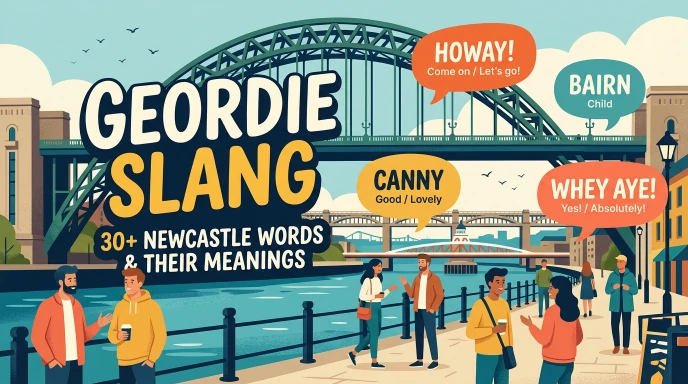
Geordie slang refers to the local words, expressions, and distinctive ways of speaking associated with Newcastle upon Tyne and the surrounding Tyneside area in northeast England. Words like canny, howay, bairn, and whey aye are familiar parts of the region’s everyday language.
If you have watched a British TV show, chatted with someone from Newcastle, or heard a Geordie accent, you may have come across expressions that sound unfamiliar at first. Some are easy to understand once you know their meanings, while others make more sense when you hear them in conversation.
Geordie is more than a collection of slang words. It is a regional dialect connected to local identity, history, and culture. Its vocabulary, pronunciation, and expressions help distinguish it from other varieties of British English.
In this guide, you’ll discover common Geordie slang words, what they mean in standard English, and how people use them in everyday conversations.
Quick Answer
Geordie slang is the informal vocabulary and regional dialect associated mainly with Newcastle upon Tyne and the surrounding Tyneside area in northeast England.
Here are some popular examples:
- Canny: Nice, good, or pleasant.
- Howay: Come on, hurry up, or an expression of encouragement.
- Whey aye: Yes, of course.
- Bairn: A child or baby.
- Pet: An affectionate way to address someone.
- Gan: To go.
- Divvent: Don’t.
- Scran: Food.
- The Toon: Newcastle, especially its city centre or local football culture.
- Alreet: All right; often used as a greeting.
The exact meaning of a phrase can depend on the situation, the speaker, and local usage. Not every person in northeast England speaks exactly the same way.
What Does Geordie Slang Mean?
Geordie slang is the collection of local expressions and informal words used by Geordies, particularly people from Newcastle and Tyneside.
The term Geordie can describe a person from the area, the local accent, or the dialect associated with the region. Although people sometimes use it broadly for the northeast of England, its strongest association is with Newcastle and Tyneside.
Unlike internet slang that becomes popular through social media, many Geordie expressions have been used in everyday speech for generations. They are heard in family conversations, shops, workplaces, pubs, football crowds, and casual chats between friends.
For example, someone might ask:
“Alreet, pet? How’s things?”
In standard English, this means something like, “Hi, how are you?”
Another person might say:
“I’m gannin doon the Toon.”
That means, “I’m going into Newcastle.”
Some expressions have straightforward English equivalents. Others carry a local tone or cultural meaning that is difficult to capture with a single translation.
The easiest way to understand Geordie slang is to learn the words alongside the situations in which people use them.
30+ Common Geordie Slang Words and Their Meanings
The following words will help you understand many everyday conversations in and around Newcastle. Spellings can vary because regional dialects are often written phonetically rather than according to standard English spelling.
1. Canny
Meaning: Nice, good, pleasant, or sometimes fairly or quite, depending on the sentence.
Canny is one of the best known Geordie expressions. It can describe a person, experience, place, or thing.
Examples:
- “That’s a canny place.” That’s a nice place.
- “She’s a canny lass.” She’s a nice girl or woman.
- “It’s canny cold today.” It’s fairly cold today.
The precise meaning depends on how the word is used.
2. Howay
Meaning: Come on, hurry up, or an expression of encouragement.
Howay is strongly associated with Newcastle and is especially recognizable in football culture.
Examples:
- “Howay, man! We’re going to be late.” Come on, we’re going to be late.
- “Howay the lads!” Come on, lads!
- “Howay, give it a try.” Come on, give it a try.
It can express impatience, encouragement, excitement, or disbelief.
3. Whey Aye
Meaning: Yes, of course, or certainly.
You may also see it written as wey aye or way aye. It is a familiar regional expression used to give an enthusiastic yes.
Example:
“Are you coming to the match?”
“Whey aye, man!”
Translation: “Yes, of course!”
The expression is often associated with the friendly, expressive style of Geordie speech.
4. Bairn
Meaning: A child or baby.
Bairn is a traditional northern English and Scottish word, not something exclusive to Newcastle.
Example:
“She took her bairn to the park.”
Translation: “She took her child to the park.”
You may hear it in family conversations when people talk about their children.
5. Pet
Meaning: An affectionate or familiar way to address someone.
In Geordie speech, pet can be used similarly to “dear,” “love,” or “mate,” depending on the person and situation.
Examples:
- “Alreet, pet?” Hi, how are you?
- “Thanks, pet.” Thanks, dear.
- “You all right, pet?” Are you okay?
It is not necessarily romantic. Someone may use it with a friend, a customer, or another person in an everyday interaction.
6. Hinny
Meaning: An affectionate term of address, similar to “dear” or “love.”
Hinny is particularly associated with parts of northeast England. It can sound warm and familiar.
Example:
“Come here a minute, hinny.”
Translation: “Come here for a moment, dear.”
Usage varies across the region, and it may be more familiar to some speakers than others.
7. Gan
Meaning: Go or going.
Gan is a traditional dialect form that appears in common expressions.
Examples:
- “I’m gan hyem.” I’m going home.
- “Let’s gan doon the street.” Let’s go down the street.
- “Where are ye gannin?” Where are you going?
You may also encounter forms such as gannin and gannin yem, depending on the phrase and local spelling.
8. Divvent
Meaning: Don’t.
This is a common regional word that can make a sentence sound very different to someone unfamiliar with Geordie speech.
Examples:
- “Divvent worry.” Don’t worry.
- “Divvent dee that.” Don’t do that.
- “Divvent be late.” Don’t be late.
Once you recognize the word, many everyday expressions become easier to understand.
9. Aye
Meaning: Yes.
Aye is widely used across several parts of Britain, including Scotland and northern England.
Example:
“Are you ready?”
“Aye, let’s gan.”
Translation: “Yes, let’s go.”
It can sound casual, direct, or enthusiastic depending on the tone.
10. Alreet
Meaning: All right; commonly used as a greeting or to ask how someone is.
Example:
“Alreet, mate? How’s work?”
Translation: “Hi, mate. How’s work?”
It can also be used as a response to a question about how someone is doing.
11. Toon
Meaning: Newcastle, especially the city centre; it can also refer to Newcastle United in football related contexts.
Example:
“I’m heading into the Toon.”
Translation: “I’m going into Newcastle.”
Football supporters may also use the Toon when talking about Newcastle United.
12. Bait
Meaning: Food.
In northeast England, bait can refer to a meal or something to eat.
Example:
“Bring some bait for the journey.”
Translation: “Bring some food for the journey.”
It is a useful word to recognize when hearing local conversations about lunch or meals.
13. Scran
Meaning: Food or something to eat.
Scran is used in several parts of northern England and other British settings, including northeast England.
Examples:
- “Let’s get some scran.” Let’s get something to eat.
- “That was good scran.” That was good food.
- “I’m starving for some scran.” I’m really hungry and want food.
It is informal and often appears in conversations about grabbing a meal.
14. Mint
Meaning: Excellent, great, or really good.
This is a positive expression used in informal conversation.
Examples:
- “That jacket is mint.” That jacket is great.
- “The concert was mint.” The concert was excellent.
- “Your new car looks mint.” Your new car looks fantastic.
The word is not exclusive to Geordie speech, but it fits naturally into many regional conversations.
15. Belta
Meaning: Something excellent, impressive, or especially enjoyable.
Example:
“That was a belta of a match!”
Translation: “That was an excellent match!”
It can describe a great experience, event, performance, or achievement.
16. Champion
Meaning: Great, excellent, or very good.
In casual Geordie conversation, champion can be used as an adjective rather than referring to a sports winner.
Example:
“I’m champion, thanks.”
Depending on the context, this can mean “I’m great, thanks.”
Someone might also say, “That’s champion,” to express approval.
17. Canny good
Meaning: Pretty good, very good, or good to a noticeable degree.
Canny can work as an intensifier in some expressions.
Example:
“That was canny good.”
Translation: “That was really good.”
The exact strength depends on the speaker and context.
18. Minging
Meaning: Disgusting, unpleasant, or horrible.
This informal word can describe a smell, taste, appearance, or experience.
Examples:
- “These socks are minging.” These socks are disgusting.
- “That smell is minging.” That smell is horrible.
- “The food went minging.” The food became unpleasant or spoiled.
It is not exclusive to Geordies, but you may hear it in regional British conversation.
19. Clamming
Meaning: Very hungry.
You may hear someone say they are clamming when they really want something to eat.
Example:
“I’m clamming. Let’s get some scran.”
Translation: “I’m starving. Let’s get some food.”
Regional spellings and pronunciation can differ, so not everyone will use the word in the same way.
20. Dafty
Meaning: A silly person or someone acting foolishly.
Example:
“Don’t be a dafty!”
Translation: “Don’t be silly!”
It is often used teasingly among people who know each other, although tone matters.
21. Clarty
Meaning: Dirty, muddy, or messy.
Example:
“Your shoes are clarty after that walk.”
Translation: “Your shoes are dirty after that walk.”
It is a regional word that can describe clothing, surfaces, or places covered in dirt.
22. Me
Meaning: My, in certain dialect expressions.
Geordie speakers may use me where standard English uses my.
Example:
“Me mam’s at home.”
Translation: “My mum is at home.”
The word is part of a broader pattern of regional grammar and pronunciation, not simply a trendy slang abbreviation.
23. Mam
Meaning: Mum or mother.
Example:
“I’m going to see me mam.”
Translation: “I’m going to see my mum.”
Mam is also used in other parts of Britain and Ireland, so it is not uniquely Geordie.
24. Hyem or Yem
Meaning: Home.
The spelling varies in written representations of the dialect.
Example:
“I’m gannin hyem.”
Translation: “I’m going home.”
You might hear different pronunciations depending on the speaker and location.
25. Neet
Meaning: Night.
Example:
“See ye the neet.”
Translation: “See you tonight.”
It is a regional pronunciation and spelling associated with northeast English dialects.
26. Nowt
Meaning: Nothing.
Nowt is used across several northern English dialects.
Examples:
- “There’s nowt to worry about.” There’s nothing to worry about.
- “I’ve got nowt to do.” I’ve got nothing to do.
You may also hear owt, meaning “anything,” in some northern expressions.
27. Radgie
Meaning: An angry, agitated, or wild person; sometimes used for someone behaving aggressively or dramatically.
Example:
“He went radgie when he heard the news.”
Translation: “He got really angry when he heard the news.”
The word can be teasing or critical, depending on how it is used.
28. Mortal
Meaning: Very drunk, in certain regional slang contexts.
Example:
“He was mortal after the night out.”
Translation: “He was extremely drunk after the night out.”
This is informal and context dependent. The word mortal has other standard English meanings, so the surrounding conversation matters.
29. Ta
Meaning: Thanks.
This short expression is used in many parts of Britain, including the northeast.
Example:
“Ta for your help.”
Translation: “Thanks for your help.”
It is brief, casual, and usually friendly.
30. Wor
Meaning: Our, in dialect expressions.
Example:
“Wor lass is coming over.”
Translation: “Our girl is coming over.”
The precise meaning of a phrase containing wor depends on its local use and the rest of the sentence.
31. Haddaway
Meaning: An expression of disbelief, objection, or dismissal, often similar to “get away!” or “you must be joking!”
Example:
“Haddaway, man! You can’t be serious.”
Translation: “Come on! You can’t be serious.”
It is especially associated with northeast England and is recognizable in local expressions.
32. Giz a Deek
Meaning: Give me a look; let me see.
Example:
“Giz a deek at your new phone.”
Translation: “Let me have a look at your new phone.”
It is an informal request to see or inspect something.
33. Fettle
Meaning: Condition, state, or mood, depending on the expression.
For example, someone might ask how you are doing or refer to being in a particular state.
“I’m in a bad fettle.”
This can mean the person is in a bad mood or not feeling quite right, depending on the local context.
34. Belta of a Day
Meaning: A really good or enjoyable day.
Example:
“We had a belta of a day at the beach.”
Translation: “We had a fantastic day at the beach.”
This is a phrase built around belta, meaning something excellent.
Common Geordie Phrases and Their Meanings
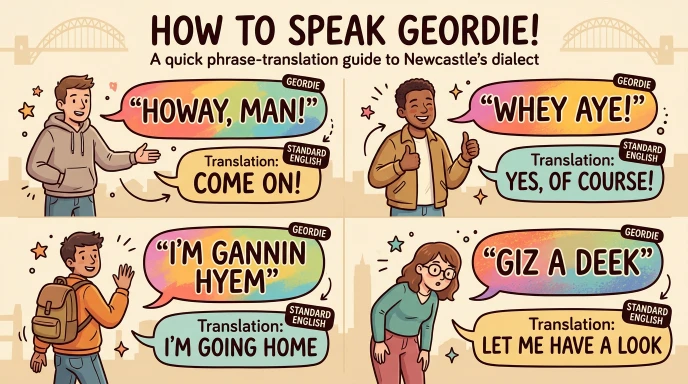
Individual words are useful, but complete expressions are often easier to understand when you see them in context.
| Geordie phrase | Standard English meaning |
| “Alreet, pet?” | “Hi, how are you?” |
| “Howay, man!” | “Come on!” |
| “Whey aye!” | “Yes, of course!” |
| “I’m gannin hyem.” | “I’m going home.” |
| “Divvent worry.” | “Don’t worry.” |
| “I’m clamming.” | “I’m very hungry.” |
| “Let’s get some scran.” | “Let’s get some food.” |
| “That’s canny.” | “That’s nice or good.” |
| “Giz a deek.” | “Let me have a look.” |
| “See ye the neet.” | “See you tonight.” |
| “I’ve got nowt.” | “I’ve got nothing.” |
| “Haddaway, man!” | “Come on! You must be joking!” |
These translations are approximate. A phrase can carry extra emotion or local meaning that is not captured by its standard English equivalent.
How Geordie Slang Is Used in Everyday Conversation
Geordie expressions are part of normal communication, not just jokes or phrases used for entertainment. People use them when greeting friends, talking about food, arranging plans, expressing frustration, and supporting local football teams.
Talking to Friends
A typical informal exchange might sound like this:
Person A: “Alreet, pet? What ye up to the neet?”
Person B: “Nowt much. Fancy getting some scran?”
Translation:
Person A: “Hi, how are you? What are you doing tonight?”
Person B: “Nothing much. Do you fancy getting something to eat?”
This conversation combines a greeting, a question about evening plans, and an invitation to get food.
Expressing Excitement
Geordie expressions can also communicate enthusiasm.
Person A: “Did you see the match?”
Person B: “Whey aye! It was a belta!”
Translation:
Person A: “Did you see the match?”
Person B: “Of course! It was fantastic!”
The words help communicate excitement beyond the literal meaning.
Telling Someone to Hurry Up
Person A: “I’m still getting ready.”
Person B: “Howay, man! We’re late!”
Translation:
Person A: “I’m still getting ready.”
Person B: “Come on! We’re late!”
This is a straightforward example of how howay can express impatience.
What Is the Difference Between Geordie Slang and a Geordie Accent?
Geordie slang refers to local vocabulary and expressions, while a Geordie accent refers to the way someone pronounces words. They are connected, but they are not the same thing.
For example, bairn and canny are vocabulary items. They have meanings that someone unfamiliar with the region may need to learn.
An accent, on the other hand, involves pronunciation, vowel sounds, rhythm, and intonation. Someone may recognize a Geordie accent even when the speaker is using ordinary English words.
A person can also use Geordie vocabulary without having a strong local accent, particularly if they have moved away from Newcastle or learned the expressions from family and friends.
The dialect includes more than pronunciation and slang. It also has regional grammar patterns and distinctive forms that may differ from standard written English.
In short, the accent is how someone sounds, while slang is part of the vocabulary they use.
Is Geordie Slang the Same as Other Northern English Slang?
No. Geordie slang shares some words with other northern English dialects, but it also has distinctive expressions associated with Newcastle and Tyneside.
For example, nowt and bairn appear in more than one northern region. Words such as howay and expressions such as whey aye are particularly recognizable as northeast English speech.
Other regional varieties have their own vocabulary, pronunciation, and cultural associations.
A few examples illustrate the differences:
- Geordie: Strongly associated with Newcastle and Tyneside.
- Mackem: Associated particularly with Sunderland and its local dialect.
- Scouse: Associated with Liverpool.
- Yorkshire dialect: Associated with Yorkshire and its many local varieties.
- Scottish dialects: Include distinct regional vocabulary and pronunciation across Scotland.
These labels describe broad regional identities, not perfectly uniform ways of speaking. Different towns and communities may have their own expressions, and people do not all speak alike.
It is also worth remembering that some words overlap between neighboring regions. Hearing one northern expression does not necessarily mean someone is from Newcastle.
Is Geordie Slang Still Used Today?
Yes. Geordie dialect and slang remain part of everyday life in northeast England.
People use regional expressions at home, among friends, at work, in local businesses, and in social settings. Some words are more common among particular generations or communities, while others remain widely recognized.
Television, football, music, and social media have also helped make Geordie expressions familiar to people outside the region. A person who has never visited Newcastle may still recognize howay, canny, or whey aye.
However, media portrayals can exaggerate accents or repeat a limited set of expressions for entertainment. Real conversations are more varied than scripted dialogue.
Younger speakers may mix traditional regional vocabulary with modern British slang, texting abbreviations, and internet expressions. Older words can remain in use while new expressions enter the language.
Geordie is a living regional dialect, not a fixed list of words from the past.
Why Is Geordie Slang Difficult for Beginners?
People unfamiliar with Geordie speech may find it difficult for several reasons.
Unfamiliar Vocabulary
Words such as bairn, scran, and divvent may not be immediately recognizable to someone who has learned only standard English.
Different Pronunciation
A familiar English word can sound noticeably different when spoken with a regional accent. This can make listening more difficult until the ear becomes accustomed to the sounds.
Local Grammar and Word Forms
Expressions such as “I’m gannin hyem” use regional forms that may look unusual in writing but make sense to local speakers.
Context Dependent Meanings
A word such as canny can mean good or nice in one situation and work more like “quite” in another. Understanding the whole sentence is often more useful than translating each word separately.
Different Spellings
There is no single spelling system used by everyone when writing dialect speech. You may see wey aye and whey aye, or different written versions of other regional pronunciations.
The best way to learn is to start with common words, read examples, and listen to real speakers rather than trying to memorize every possible spelling.
Frequently Asked Questions About Geordie Slang
What does Geordie mean in slang?
Geordie refers to someone from Newcastle or, more broadly, the Tyneside area of northeast England. It can also describe the local accent and dialect.
What are the most common Geordie slang words?
Some recognizable examples are canny (good or nice), howay (come on), whey aye (yes, of course), bairn (child), pet (an affectionate form of address), and divvent (don’t).
What does “Howay, man” mean?
“Howay, man” generally means “Come on!” It can express encouragement, impatience, excitement, or disbelief depending on the situation.
What does “canny” mean in Geordie slang?
Canny often means good, nice, or pleasant. In some expressions, it can also mean fairly or quite.
What does “whey aye” mean?
“Whey aye,” also written as “wey aye,” is an expression meaning “Yes, of course” or an enthusiastic “Yes!”
What does “bairn” mean?
A bairn is a child or baby. The word is used in northeast England and several other northern English and Scottish dialects.
What does “pet” mean in Geordie slang?
Pet is an affectionate way to address someone, similar to “dear” or “love.” It is not necessarily romantic.
What does “scran” mean?
Scran means food or something to eat. For example, “Let’s get some scran” means “Let’s get something to eat.”
Is Geordie a language or a dialect?
Geordie is generally described as a regional dialect of English, with distinctive vocabulary, pronunciation, and grammatical features.
Do all people from Newcastle speak Geordie?
No. People in Newcastle have different accents and ways of speaking. Some use many traditional Geordie expressions, while others use fewer, depending on their background, age, and personal speech habits.
Is Geordie slang rude?
Most common Geordie expressions are not rude. Words such as canny, howay, and pet are often friendly or neutral. As with any dialect, some expressions can be insulting or inappropriate in certain contexts.
Final Thoughts
Geordie slang gives you a glimpse into the language and culture of Newcastle and the surrounding Tyneside area. From “canny” for something good to “howay” for come on and “bairn” for a child, these expressions make regional conversations distinctive.
Remember that Geordie is not simply a collection of funny words or a strong accent. It is a living dialect with local history, everyday uses, and variations between speakers.
If you are learning Geordie slang, begin with the common greetings and phrases, pay attention to context, and remember that local pronunciation and spelling can vary.
Discover More Articles:

I research internet slang, texting abbreviations, and online language to create clear, accurate, and easy-to-understand content. My goal is to make modern internet language simple by publishing well-researched, regularly updated explanations based on trusted sources.