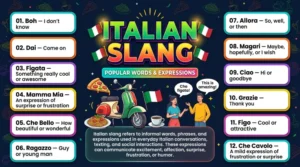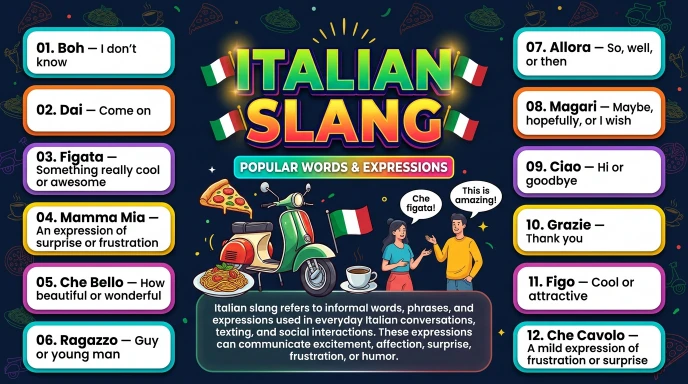
Italian slang consists of informal words, expressions, and phrases that Italians use in everyday conversations, text messages, social media, and casual situations. Words like figo, boh, dai, bella, raga, and che casino are common examples of informal Italian language.
Italian slang makes conversations sound more natural, friendly, funny, and expressive. Some expressions are used among friends, while others can sound rude or inappropriate in formal situations.
if you’re learning Italian, watching Italian movies, or trying to understand conversations on TikTok, knowing popular Italian slang can help you understand how people communicate in real life.
Quick Answer
Italian slang is informal language used by Italian speakers in everyday communication. Popular expressions include:
- Boh: I don’t know.
- Figo: Cool or awesome.
- Dai: Come on.
- Raga: Guys or friends.
- Bella: Hey or what’s up.
- Che casino: What a mess.
- Magari: If only, hopefully, or maybe.
- Mamma mia: An expression of surprise or frustration.
These expressions can have different meanings depending on the situation, tone, and region.
Key Takeaways
- Italian slang is commonly used in casual conversations and online messages.
- Many Italian slang words have meanings that differ from their literal translations.
- Expressions such as boh, dai, and figo are widely recognizable.
- Some Italian slang is friendly, while other expressions can be offensive.
- Regional Italian slang can vary between northern, central, and southern Italy.
What Is Italian Slang?
Italian slang refers to informal vocabulary and expressions that people use outside formal conversations. It includes shortened words, humorous phrases, regional expressions, and popular terms influenced by music, television, and internet culture.
For example, a textbook might teach you to say:
“Non lo so.”
This means “I don’t know.”
However, in a casual conversation, an Italian speaker might simply say:
“Boh!”
Both communicate uncertainty, but boh sounds much more informal.
Italian slang is especially common among friends, classmates, family members, and people communicating through social media.
Popular Italian Slang Words and Their Meanings
Here are some widely recognized Italian slang expressions and how people use them.
1. Boh
Meaning: I don’t know.
Boh is one of the most common informal Italian expressions. People use it when they are unsure, confused, or have no answer.
Examples:
- “Boh, non lo so.” I don’t know.
- “Dove andiamo?” “Boh!” Where are we going? No idea!
2. Figo
Meaning: Cool, awesome, or attractive.
Figo is an informal word used to describe something impressive or someone attractive. The feminine form is figa, which can be vulgar or have sexual meanings depending on context, so use it carefully.
Examples:
- “Che figo!” That’s so cool!
- “Questo film è figo.” This movie is awesome.
3. Dai
Meaning: Come on, go ahead, or really?
Dai is extremely versatile. It can encourage someone, express disbelief, or persuade someone to do something.
Examples:
- “Dai, andiamo!” Come on, let’s go!
- “Dai, davvero?” Come on, really?
4. Raga
Meaning: Guys or friends.
Raga is a shortened form of ragazzi. It is commonly used when addressing a group of friends.
Examples:
- “Ciao raga!” Hey guys!
- “Raga, che facciamo stasera?” Guys, what are we doing tonight?
5. Bella
Meaning: Hey, what’s up, or nice.
Bella can be used as a casual greeting, particularly among friends. Its meaning depends on the situation.
Examples:
- “Bella, come stai?” Hey, how are you?
- “Bella raga!” What’s up, guys!
6. Mamma Mia
Meaning: Oh my goodness!
This familiar Italian expression communicates surprise, excitement, frustration, or disbelief.
Examples:
- “Mamma mia, che caldo!” Oh my goodness, it’s so hot!
- “Mamma mia, è incredibile!” Wow, that’s unbelievable!
7. Che Casino
Meaning: What a mess!
Casino literally refers to a casino, but in this expression it means confusion, chaos, or a messy situation.
Examples:
- “Che casino in questa stanza!” What a mess in this room!
- “C’è un casino di gente.” There are loads of people.
8. Magari
Meaning: If only, hopefully, or maybe.
Magari is a useful Italian expression. It can communicate a wish, possibility, or enthusiastic agreement.
Examples:
- “Magari!” I wish! / Absolutely!
- “Magari domani.” Maybe tomorrow.
9. Boh, Vediamo
Meaning: I don’t know, we’ll see.
This casual phrase is used when someone is uncertain about a future decision.
Example:
“Vieni alla festa?” “Boh, vediamo.” Are you coming to the party? I don’t know, we’ll see.
10. Spacca
Meaning: It’s amazing or it rocks.
Spacca is informal slang used to describe something excellent, exciting, or impressive.
Examples:
- “Questa canzone spacca!” This song rocks!
- “La festa spacca!” The party is amazing!
11. Tipo
Meaning: Like, kind of, or sort of.
It is often used as a filler word when explaining something informally.
Example:
“Era tipo incredibile.” It was, like, incredible.
12. Tranquillo
Meaning: Relax, don’t worry, or it’s okay.
This expression is used to reassure someone or tell them not to stress.
Examples:
- “Tranquillo, nessun problema.” Don’t worry, no problem.
- “Stai tranquillo.” Stay calm.
13. Che Figata
Meaning: How cool! / That’s awesome!
Figata is an informal expression used to show excitement about something.
Examples:
- “Che figata questo posto!” This place is so cool!
- “È stata una figata!” It was amazing!
14. Sbatti
Meaning: Hassle, effort, or something annoying.
Sbatti is informal slang used when something feels like too much trouble.
Examples:
- “Che sbatti!” What a hassle!
- “Non ho voglia di fare tutta questa sbatti.” I don’t feel like dealing with all this hassle.
15. Boh, Vabbè
Meaning: Well, whatever.
Vabbè is a shortened form of va bene. It can mean okay, fine, or never mind.
Example:
“Vabbè, facciamo domani.” Fine, let’s do it tomorrow.
Italian Slang Words Used by Young People
Younger Italians often use informal expressions in conversations, group chats, and social media posts. Some words are traditional slang, while others have become popular through online culture.
| Italian Slang | English Meaning |
| Raga | Guys |
| Figo | Cool |
| Spacca | It rocks |
| Bro | Bro |
| Fra | Short for fratello; bro |
| Amo | Short for amore; affectionate way to address someone |
| Sbatti | Hassle |
| Cringe | Embarrassing or awkward |
| Chill | Relaxed |
| Top | Excellent or the best |
| Flexare | To show off |
| Ghostare | To suddenly stop responding |
| Crush | Someone you like romantically |
| Random | Unexpected or unusual |
| Mood | Relatable feeling or situation |
Not every expression is uniquely Italian. Some are borrowed from English and adapted into Italian conversations.
Italian Slang for Friends
If you want to speak casually with Italian friends, these expressions are useful.
Fra
Fra is a shortened form of fratello, meaning brother. It is similar to saying “bro” or “mate.”
Example: “Come va, fra?” How’s it going, bro?
Bro
Italian speakers also use the English word bro when addressing friends.
Example: “Bro, hai visto?” Bro, did you see that?
Amico
Amico means friend. It is not necessarily slang, but it is commonly used in casual conversations.
Example: “Ciao, amico!” Hey, friend!
Vecchio
Literally meaning “old,” vecchio can be used informally to address a male friend in some contexts.
Example: “Ehi, vecchio, tutto bene?” Hey, mate, everything good?
Compare
Compare is a familiar form of address used in parts of southern Italy, particularly in some regional speech. Its exact social meaning depends on the area and relationship.
Read More:
Chuzz Meaning Slang? Meaning, Examples & How to Use It
Italian Slang Used in Text Messages
Italian speakers often shorten words and use casual expressions when texting.
Here are some examples:
| Expression | Meaning |
| Cmq | Comunque anyway |
| Xké | Perché why/because |
| Grz | Grazie thanks |
| Tvb | Ti voglio bene I care about you |
| Nn | Non not |
| C6? | Ci sei? Are you there? |
| Ke | Che what/that |
| Tt | Tutto everything |
| Boh | I don’t know |
| Vbb | Vabbè okay/fine |
These spellings are informal texting shortcuts. They are not appropriate for every situation, especially professional messages or formal writing.
Italian Slang for Social Media
Italian slang appears frequently on TikTok, Instagram, WhatsApp, and other social platforms.
Some examples include:
- Cringe: Something embarrassing or awkward.
- Flexare: Showing off possessions, achievements, or lifestyle.
- Ghostare: Suddenly stopping communication with someone.
- Chill: Relaxed or calm.
- Top: Excellent or outstanding.
- Mood: A feeling or situation that people relate to.
- Bro: A casual way to address a friend.
- Fomo: Fear of missing out.
Example social media captions:
- “Questa canzone spacca!” This song rocks!
- “Che figata!” That’s awesome!
- “Troppo cringe!” So embarrassing!
- “Mood del lunedì.” Monday mood.
Funny Italian Slang Expressions
Italian informal language is full of expressive phrases. Some are funny because of their exaggeration, while others are used to react dramatically to everyday situations.
| Expression | Meaning |
| Che casino! | What a mess! |
| Mamma mia! | Oh my goodness! |
| Ma dai! | Come on! / Really? |
| Non ci credo! | I can’t believe it! |
| Che palle! | How annoying! (vulgar) |
| Figurati! | Don’t mention it! / No problem! |
| Sei fuori! | You’re amazing! |
| Boh! | No idea! |
| Va be’! | Fine! / Whatever! |
| In bocca al lupo! | Good luck! |
Some expressions, such as che palle, are vulgar or impolite. It is better to avoid them in formal conversations.
Italian Slang Words You Should Use Carefully
Not all Italian slang is friendly. Some expressions can sound offensive, vulgar, or disrespectful.
| Expression | General Meaning | Usage |
| Cazzo | Vulgar exclamation or reference to male anatomy | Very informal and offensive |
| Stronzo | Insult meaning jerk or asshole | Rude |
| Vaffanculo | Strong insult meaning “fuck off” | Highly offensive |
| Figa | Vulgar word that can refer to female anatomy; also used in some slang contexts | Use carefully |
| Rompipalle | Annoying person | Vulgar |
| Minchia | Regional vulgar expression used for surprise or emphasis | Informal and potentially offensive |
Understanding these words can help you recognize them in movies, conversations, or online posts, but that does not mean they are suitable for everyday use.
Italian Slang vs. Standard Italian
The main difference between Italian slang and standard Italian is the level of formality.
Standard Italian is generally used in education, professional communication, official documents, and formal situations. Slang is more common among friends and in relaxed conversations.
| Standard Italian | Informal Expression | English Meaning |
| Non lo so | Boh | I don’t know |
| Andiamo | Dai, andiamo | Come on, let’s go |
| Molto bello | Figo | Very cool |
| Ragazzi | Raga | Guys |
| Va bene | Vabbè | Okay |
| Che confusione | Che casino | What a mess |
| Fantastico | Che figata | That’s awesome |
Learning both forms helps you understand Italian more naturally and choose the right language for different situations.
Does Italian Slang Change by Region?
Yes. Italian slang and informal expressions can vary significantly from one region to another.
Italy has many regional dialects and local varieties. People in Rome, Milan, Naples, Sicily, and other areas may use different words and expressions.
For example:
- Rome: Romanesco expressions and pronunciation influence everyday speech.
- Naples: Neapolitan expressions are common alongside standard Italian.
- Milan: Local Lombard influences and modern urban expressions can appear in casual conversations.
- Sicily: Sicilian vocabulary and expressions influence local informal speech.
A word that sounds normal in one city might be unfamiliar or have a different meaning somewhere else.
Frequently Asked Questions
What are the most common Italian slang words?
Some recognizable Italian slang words include boh, figo, dai, raga, bella, vabbè, spacca, and che casino.
What does “boh” mean in Italian?
Boh means “I don’t know” or “I have no idea.” It is commonly used when someone is uncertain or does not have an answer.
What does “figo” mean in Italian slang?
Figo means cool, awesome, or attractive. It is an informal expression used to describe something impressive.
What does “bella” mean in Italian slang?
Bella can be used as a casual greeting, similar to “Hey!” or “What’s up?” among friends.
What does “raga” mean?
Raga is a shortened form of ragazzi, meaning guys or young people. It is often used to address a group of friends.
How do you say “cool” in Italian slang?
Common informal ways to say “cool” include figo, forte, and spacca. The best choice depends on the context.
Is Italian slang different from regular Italian?
Yes. Standard Italian is used in formal communication, while slang is informal language commonly used with friends, family, and online communities.
Do Italians use English slang?
Yes. Words such as bro, cringe, chill, mood, and crush are used in some Italian conversations, particularly among younger speakers and online communities.
Final Thoughts
Italian slang makes everyday conversations more expressive and natural. Words like boh, figo, dai, raga, bella, and che casino are useful examples of how Italians communicate informally.
If you’re learning Italian, start by understanding common expressions and how people use them in real situations. Pay attention to tone and context, because the same word can sound friendly, sarcastic, or rude depending on how it is said.

I research internet slang, texting abbreviations, and online language to create clear, accurate, and easy-to-understand content. My goal is to make modern internet language simple by publishing well-researched, regularly updated explanations based on trusted sources.