French slang is a collection of informal words, expressions, and phrases that French speakers use in everyday conversations, text messages, social media, and casual situations. These expressions make conversations sound more natural and relaxed than formal textbook French.
French slang is often called argot. It includes shortened words, playful expressions, borrowed English terms, and phrases that have developed through everyday speech. You may hear it among friends, young people, students, and online communities.
if you are learning French, watching French movies, listening to French music, or chatting with French speakers, understanding slang can help you follow conversations more easily.
Quick Answer
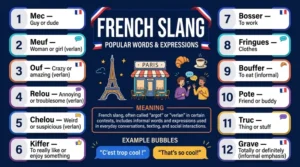
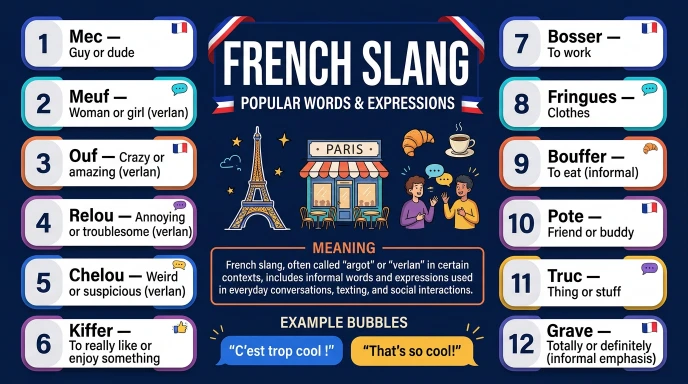
French slang refers to informal French vocabulary used in casual conversations. Some popular examples include:
- Ça va? How’s it going?
- Mec Guy or dude
- Meuf Woman or girl
- Ouf Wild or amazing
- Relou Annoying
- Chelou Weird or suspicious
- Kiffer To love or really enjoy something
- Boulot Work or job
- Fringues Clothes
- Bouffe Food
- Grave Totally or definitely
- Wesh Hey or what’s up?
These expressions are common in informal French, but some are more regional, generational, or context dependent than others.
What Is French Slang Called?
French slang is commonly known as argot. The word describes informal vocabulary that differs from standard or formal French.
Argot has a long history in France. Over time, slang has developed through different social groups, cities, music scenes, and generations. Modern French slang also includes words influenced by Arabic, English, regional languages, and popular culture.
One interesting feature is verlan, a type of French wordplay that reverses syllables or sounds.
For example:
- Femme → Meuf: An informal slang word for woman or girl.
- Louche → Chelou: An informal way to describe something strange or suspicious.
- Fou → Ouf: A slang expression meaning wild or amazing.
Not every informal French word is verlan. Some are shortened forms, borrowed expressions, or words that have developed a new meaning in everyday speech.
50+ Popular French Slang Words and Their Meanings
Here are popular French slang words you may encounter in conversations, films, music, and online posts.
1. Mec
Meaning: Guy, dude, or man.
Mec is a very common informal French word for a man or guy.
Examples:
- “C’est un bon mec.” He’s a good guy.
- “Salut, mec!” Hey, dude!
2. Meuf
Meaning: Girl or woman.
Meuf is verlan slang formed from femme. It is widely used in informal French.
Examples:
- “C’est une bonne meuf.” She’s a good girl.
- “Cette meuf est sympa.” This girl is nice.
It can sound casual or disrespectful depending on the situation and tone.
3. Ouf
Meaning: wild, unbelievable, or amazing.
Ouf comes from fou through verlan.
Examples:
- “C’est ouf!” That’s wild!
- “Cette soirée était ouf.” That party was amazing.
4. Chelou
Meaning: Weird, strange, or suspicious.
This word comes from louche through verlan.
Examples:
- “Ce type est chelou.” That guy is weird.
- “C’est un peu chelou.” That’s a little suspicious.
5. Relou
Meaning: Annoying or irritating.
Relou comes from lourd through verlan.
Examples:
- “Il est trop relou.” He’s so annoying.
- “Cette situation est relou.” This situation is irritating.
6. Kiffer
Meaning: To love, enjoy, or really like something.
Kiffer is commonly used to express strong enjoyment.
Examples:
- “Je kiffe cette chanson.” I love this song.
- “Tu kiffes le cinéma?” Do you really like movies?
7. Boulot
Meaning: Work or job.
This is a familiar everyday alternative to travail.
Examples:
- “Je vais au boulot.” I’m going to work.
- “J’ai beaucoup de boulot.” I have a lot of work.
8. Fringues
Meaning: Clothes.
Fringues is an informal word for clothing.
Examples:
- “J’aime tes fringues.” I like your clothes.
- “Je dois acheter des fringues.” I need to buy some clothes.
9. Bouffe
Meaning: Food.
This informal word is often used in casual conversations.
Examples:
- “La bouffe est bonne.” The food is good.
- “On va chercher de la bouffe.” We’re going to get some food.
10. Grave
Meaning: Totally, definitely, or really.
In casual French, grave can be used to strongly agree with someone or emphasize a statement.
Examples:
- “Tu viens demain?” Are you coming tomorrow?
- “Grave!” Definitely!
Another example: “C’est grave bien.” It’s really good.
11. Wesh
Meaning: Hey, what’s up, or a casual greeting.
Wesh is associated with contemporary French urban slang. It can express a greeting, surprise, or attitude depending on the speaker.
Examples:
- “Wesh, ça va?” Hey, how’s it going?
- “Wesh! C’est quoi ça?” Hey! What’s that?
12. Truc
Meaning: Thing or stuff.
Truc is an extremely useful informal word when someone does not know or does not want to specify the name of something.
Examples:
- “C’est quoi ce truc?” What’s that thing?
- “J’ai oublié un truc.” I forgot something.
13. Chouette
Meaning: Nice, lovely, or cool.
This friendly informal expression is often used to show approval.
Examples:
- “C’est chouette!” That’s nice!
- “On a passé une chouette journée.” We had a lovely day.
14. Pote
Meaning: Friend or buddy.
Pote is a familiar word for a friend.
Examples:
- “C’est mon pote.” He’s my friend.
- “Je sors avec mes potes.” I’m going out with my friends.
15. Fric
Meaning: Money or cash.
Fric is an informal word for money.
Examples:
- “J’ai besoin de fric.” I need money.
- “Il gagne beaucoup de fric.” He makes a lot of money.
16. Thune
Meaning: Money or cash.
Like fric, thune is a casual word for money.
Examples:
- “J’ai plus de thune.” I don’t have any money left.
- “Ça coûte trop de thune.” That costs too much money.
17. Bosser
Meaning: To work or study hard.
Bosser is a casual alternative to travailler.
Examples:
- “Je dois bosser.” I have to work.
- “Elle bosse beaucoup.” She works a lot.
18. Crevé
Meaning: Exhausted or extremely tired.
Examples:
- “Je suis crevé.” I’m exhausted.
- “Après le voyage, on était crevés.” After the trip, we were exhausted.
19. Nickel
Meaning: Perfect, excellent, or all good.
This informal expression is often used when something is working well.
Examples:
- “Tout est nickel.” Everything is perfect.
- “C’est nickel pour moi.” That’s perfect for me.
20. Flipper
Meaning: To panic, get scared, or feel frightened.
Examples:
- “Ne flippe pas!” Don’t panic!
- “J’ai flippé hier soir.” I got scared last night.
21. Se marrer
Meaning: To laugh or have a good time.
Examples:
- “On s’est bien marrés.” We had a good laugh.
- “Arrête de te marrer!” Stop laughing!
22. Péter un câble
Meaning: To lose your temper or freak out.
Examples:
- “Il va péter un câble.” He’s going to lose it.
- “J’ai failli péter un câble.” I almost lost my temper.
23. Laisse tomber
Meaning: Forget it, never mind, or let it go.
Examples:
- “Laisse tomber, c’est pas grave.” Forget it, it’s not a big deal.
- “Laisse tomber cette idée.” Drop that idea.
24. Ça roule?
Meaning: Everything good? or How’s it going?
Examples:
- “Salut, ça roule?” Hey, everything good?
- “Ouais, ça roule.” Yeah, all good.
25. À plus
Meaning: See you later.
This is a shortened informal form of à plus tard.
Examples:
- “Je dois partir, à plus!” I have to go, see you later!
- “À plus demain.” See you tomorrow.
26. C’est mort
Meaning: No way, it’s not happening, or it’s over.
Examples:
- “Tu peux venir ce soir?” Can you come tonight?
- “C’est mort.” No way.
The expression can also mean that a situation is finished or hopeless.
27. Ça craint
Meaning: That’s bad, unpleasant, or worrying.
Examples:
- “Ce quartier craint la nuit.” This neighborhood feels unsafe at night.
- “Ça craint vraiment.” That’s really bad.
28. Nul
Meaning: Bad, useless, or terrible.
Examples:
- “Ce film est nul.” This movie is terrible.
- “Je suis nul en maths.” I’m bad at math.
29. Canon
Meaning: Very attractive or good looking.
Examples:
- “Elle est canon.” She’s gorgeous.
- “Il est vraiment canon.” He’s really good looking.
30. Daron / Darone
Meaning: Dad / Mom.
These informal words are used in some French speaking communities.
Examples:
- “Mon daron est sympa.” My dad is nice.
- “Je vais voir ma daronne.” I’m going to see my mom.
31. Avoir la flemme
Meaning: To feel too lazy or unmotivated to do something.
Examples:
- “J’ai la flemme de sortir.” I don’t feel like going out.
- “Elle a la flemme de travailler.” She can’t be bothered to work.
32. Se casser
Meaning: To leave or go away.
Examples:
- “On se casse!” Let’s get out of here!
- “Je me casse à huit heures.” I’m leaving at eight.
This can sound blunt depending on the situation.
33. Balèze
Meaning: Impressive, strong, or very skilled.
Examples:
- “Il est balèze en informatique.” He’s really good at computers.
- “C’est un joueur balèze.” He’s a talented player.
34. Bidule
Meaning: Thingamajig or what’s it called.
Examples:
- “Passe moi le bidule.” Pass me that thing.
- “Comment s’appelle ce bidule?” What’s that thing called?
35. Gênant
Meaning: Awkward or embarrassing.
Although it is also standard French, it is frequently used in casual speech and online comments.
Examples:
- “C’était gênant.” That was awkward.
- “La situation est gênante.” The situation is embarrassing.
36. Stylé
Meaning: Stylish, cool, or impressive.
Examples:
- “Ton sac est stylé.” Your bag is cool.
- “C’est vraiment stylé!” That’s really impressive!
37. Trop
Meaning: Too much or very.
In casual French, trop is often used to mean “very” or “really.”
Examples:
- “C’est trop bien!” That’s really good!
- “Elle est trop sympa.” She’s really nice.
38. Oseille
Meaning: Money or cash.
This is another informal French word for money.
Examples:
- “Il a beaucoup d’oseille.” He has a lot of money.
- “Je cherche de l’oseille.” I’m looking for money.
39. Piger
Meaning: To understand or get something.
Examples:
- “Tu piges?” Do you get it?
- “J’ai rien pigé.” I didn’t understand anything.
40. Bouquin
Meaning: Book.
Examples:
- “Je lis un bouquin.” I’m reading a book.
- “C’est un bon bouquin.” It’s a good book.
41. Vachement
Meaning: Really, very, or extremely.
Examples:
- “C’est vachement intéressant.” That’s really interesting.
- “Il est vachement sympa.” He’s really nice.
42. Ça marche
Meaning: Okay, that works, or agreed.
Examples:
- “On se voit à six heures?” Shall we meet at six?
- “Ça marche!” Sounds good!
43. Dégueu
Meaning: Disgusting or gross.
This is a shortened informal form related to dégoûtant.
Examples:
- “Ce plat est dégueu.” This dish is disgusting.
- “C’est dégueu!” That’s gross!
44. Pépère
Meaning: Relaxed, easygoing, or comfortable.
Examples:
- “On reste pépère à la maison.” We’ll relax at home.
- “Il mène une vie pépère.” He has a quiet, comfortable life.
45. Relativement
Meaning: Relatively.
This is standard French rather than a slang term, but it sometimes appears in casual speech. It should not be treated as a distinctive slang expression.
46. Se prendre la tête
Meaning: To stress, argue, or overcomplicate something.
Examples:
- “Ne te prends pas la tête.” Don’t stress about it.
- “Ils se prennent la tête pour rien.” They’re arguing over nothing.
47. Ça me saoule
Meaning: That annoys me or I’m fed up with it.
Examples:
- “Cette situation me saoule.” This situation annoys me.
- “Ça me saoule d’attendre.” I’m fed up with waiting.
48. Oklm
Meaning: Calmly, peacefully, or without stress.
Oklm is an internet style spelling of au calme.
Examples:
- “Je reste oklm chez moi.” I’m just chilling at home.
- “On est oklm.” We’re relaxing.
49. BG
Meaning: Handsome guy or good looking person.
BG is short for beau gosse.
Examples:
- “Salut BG!” Hey, handsome!
- “Il est BG.” He’s good looking.
50. MDR
Meaning: Laughing hard.
MDR stands for mort de rire, which literally translates to “dead from laughing.” It is similar to LOL in English texting.
Examples:
- “C’est trop drôle MDR.” That’s so funny, LOL.
- “MDR, j’arrive pas à croire ça.” LOL, I can’t believe that.
51. PTDR
Meaning: Laughing extremely hard.
PTDR stands for pété de rire. It is a more emphatic version of MDR.
Example:
- “J’ai vu cette vidéo, PTDR!” I saw that video, I’m dying laughing!
52. JPP
Meaning: I can’t take it anymore.
JPP stands for j’en peux plus. It can express exhaustion, frustration, or laughter depending on context.
Examples:
- “JPP de cette journée.” I can’t take this day anymore.
- “JPP, c’est trop drôle.” I can’t, that’s too funny.
Popular French Slang Expressions for Everyday Conversations
Individual words are useful, but complete expressions can help you sound more natural in casual French.
| French expression | English meaning |
| Ça va? | How are you? |
| Quoi de neuf? | What’s new? |
| Pas de souci | No problem |
| T’inquiète | Don’t worry |
| C’est clair | Absolutely / That’s clear |
| N’importe quoi! | That’s ridiculous! |
| J’en ai marre | I’m fed up |
| Ça suffit! | That’s enough! |
| À tout à l’heure | See you later |
| On se capte | Let’s meet up / See you |
| Fais gaffe! | Be careful! |
| C’est la galère | It’s a struggle |
| Ça passe | It’s okay / It works |
| J’hallucine! | I can’t believe it! |
| Laisse moi tranquille | Leave me alone |
These expressions are useful in informal conversations, but they are not all slang in the strict sense. Some are simply familiar everyday French.
French Slang Words Used in Texting and Social Media
French speakers use abbreviations and shortened expressions to make online conversations quicker.
Here are some common examples:
| French abbreviation | Full French expression | English meaning |
| MDR | Mort de rire | LOL |
| PTDR | Pété de rire | Laughing hard |
| JPP | J’en peux plus | I can’t take it anymore |
| TKT | T’inquiète | Don’t worry |
| STP | S’il te plaît | Please |
| SVP | S’il vous plaît | Please (formal or plural) |
| PK | Pourquoi | Why |
| Quelques | A few / some | |
| DSL | Désolé | Sorry |
| BCP | Beaucoup | A lot |
| A+ | À plus | See you later |
| RDV | Rendez vous | Appointment / meeting |
| Cc | Coucou | Hey / hi |
| Oklm | Au calme | Relaxed / chilling |
For example, a friend might send:
“Cc, tkt, on se capte demain. MDR!”
This means something like: “Hey, don’t worry, we’ll meet tomorrow. LOL!”
Text abbreviations are informal. In school assignments, business messages, and formal emails, standard French spelling is usually more appropriate.
What Is Verlan in French Slang?
Verlan is a French form of wordplay that reverses the syllables or sounds of a word. It is an important part of modern French slang, especially in informal speech.
The name verlan itself comes from reversing the syllables of l’envers, meaning “the reverse.”
Some familiar examples include:
| Original French | Verlan | Meaning |
| Femme | Meuf | Woman / girl |
| Fou | Ouf | Amazing |
| Louche | Chelou | Weird / suspicious |
| Lourd | Relou | Annoying |
| Arabe | Beur | Arab (historical slang usage) |
Verlan can make French conversations confusing for learners because the words may look completely different from their original forms.
Some verlan expressions have become widely recognized, while others are associated with particular generations or communities.
Read More:
Fn Meaning Slang: What Does FN Mean in Text and Social Media?
French Slang by Situation
Not every slang expression works in every situation. Some words are suitable for friendly conversations, while others can sound rude or overly familiar.
French Slang for Friends
These expressions are commonly used in relaxed conversations:
- Mec: Dude or guy.
- Pote: Friend or buddy.
- Ça roule?: Everything good?
- À plus: See you later.
- T’inquiète: Don’t worry.
- On se capte: Let’s meet up.
French Slang for Money
If you hear French speakers talking about money informally, you may encounter:
- Fric: Money.
- Thune: Cash or money.
- Oseille: Money.
For example, “J’ai plus de thune” means “I don’t have any money left.”
French Slang for Food
Some informal words for food include:
- Bouffe: Food.
- Bouffer: To eat.
- Bouffer un truc: To grab something to eat.
For example, “On va bouffer?” means “Shall we get something to eat?”
French Slang for Saying Something Is Good
You can use these expressions to show approval:
- Nickel: Perfect.
- Chouette: Nice.
- Stylé: Cool or stylish.
- Ouf: Amazing or unbelievable.
- Grave bien: Really good.
French Slang for Annoying Situations
These expressions can help you understand frustration:
- Relou: Annoying.
- Ça me saoule: That annoys me.
- Ça craint: That’s bad.
- J’en ai marre: I’m fed up.
- Péter un câble: Lose your temper.
Is French Slang Different in France and Other French Speaking Countries?
Yes. French slang can vary considerably between France, Belgium, Switzerland, Canada, and other French speaking regions.
A word that sounds familiar in Paris may be less common or have a different meaning elsewhere.
For example:
- France: Words such as meuf, ouf, relou, and wesh are recognizable in informal speech.
- Quebec, Canada: Local expressions include magasiner (to shop) and c’est le fun (that’s fun).
- Belgium: Some familiar expressions and local vocabulary differ from everyday French in France.
- Switzerland: French speaking Swiss communities also have regional vocabulary and expressions.
French is spoken across many countries, so learning slang from France does not automatically mean you understand every informal expression used by French speakers worldwide.
Is French Slang Appropriate in Formal Conversations?
French slang is generally best reserved for casual situations. It can help you sound natural with friends, but some expressions may seem disrespectful or unprofessional in formal settings.
Consider these examples:
| Informal French | More formal French | English meaning |
| Boulot | Travail | Work |
| Bouffe | Nourriture | Food |
| Fric | Argent | Money |
| Bosser | Travailler | To work |
| Pote | Ami | Friend |
| Meuf | Femme | Woman |
| Mec | Homme | Man |
For example, you might say “Je vais au boulot” when talking with a friend. In a formal conversation, “Je vais au travail” is more appropriate.
The same principle applies to emails, job interviews, academic writing, and professional meetings.
Tips for Learning French Slang
Learning slang takes more than memorizing a list of words. You need to understand how people use expressions in real conversations.
Here are some helpful tips:
- Watch French movies and shows: Pay attention to how characters speak with friends compared with how they speak in formal situations.
- Listen to French music: Rap and hip hop often include informal vocabulary and verlan.
- Learn complete sentences: Understanding a word in context is easier than memorizing its translation alone.
- Notice the speaker’s tone: Some expressions are playful, while others can sound rude.
- Practice with familiar phrases: Start with simple expressions such as ça roule, t’inquiète, and à plus.
- Learn regional differences: Remember that slang varies between France, Quebec, Belgium, and other French speaking communities.
- Avoid using every slang word: Some expressions may sound unnatural if you use them without understanding their context.
Frequently Asked Questions About French Slang
What is the most common French slang word?
There is no single most common French slang word. However, expressions such as mec, pote, boulot, truc, grave, and kiffer are widely recognizable in informal French.
What does “wesh” mean in French?
Wesh is an informal greeting similar to “Hey” or “What’s up?” It can also express surprise or attitude, depending on the conversation.
What does “meuf” mean?
Meuf means woman or girl. It is verlan formed from femme. It is informal and may sound disrespectful in certain contexts.
What does “ouf” mean?
Ouf means wild, unbelievable, or amazing. It comes from the French word fou through verlan.
What does “mec” mean in French?
Mec means guy, dude, or man. It is commonly used in casual conversations.
What does “kiffer” mean?
Kiffer means to love, enjoy, or really like something. For example, “Je kiffe cette chanson” means “I love this song.”
What does “MDR” mean in French texting?
MDR stands for “mort de rire,” which literally means “dead from laughing.” It is the French equivalent of LOL.
Is French slang the same as verlan?
No. Verlan is one type of French slang, created by reversing the syllables or sounds of words. French slang also includes shortened expressions, borrowed words, and other informal vocabulary.
Can I use French slang with everyone?
Not always. Most slang is suitable for relaxed conversations with friends, but some expressions can sound rude or overly familiar. Use standard French in formal or professional situations.
Final Thoughts
French slang makes everyday conversations more expressive, relaxed, and natural. Words such as mec, meuf, ouf, chelou, relou, kiffer, boulot, and grave are useful examples to recognize when listening to French speakers or reading informal messages.
Remember that slang depends on context, tone, region, and age group. Some expressions are widely understood, while others are more closely associated with particular communities.
Start by learning a few common expressions and understanding how they fit into complete sentences. With practice, you will find it easier to recognize informal French in conversations, films, music, and social media.

I research internet slang, texting abbreviations, and online language to create clear, accurate, and easy-to-understand content. My goal is to make modern internet language simple by publishing well-researched, regularly updated explanations based on trusted sources.