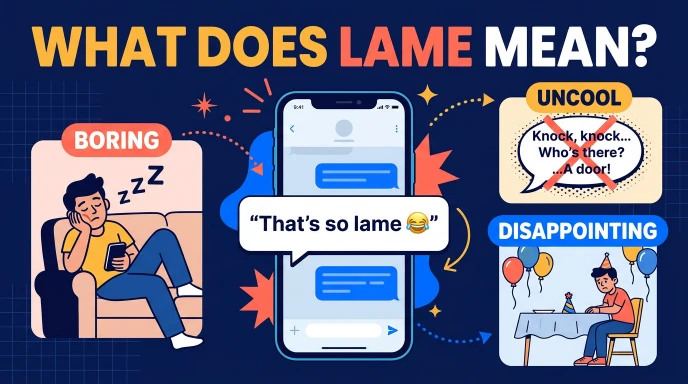
In slang, “lame” means boring, uncool, disappointing, or not impressive. People use it in text messages and on social media to describe something they dislike, a weak excuse, an unfunny joke, or a situation that feels disappointing.
You may see “lame” in TikTok comments, Instagram captions, Snapchat messages, gaming chats, or everyday conversations. For example, if someone cancels plans at the last minute, a friend might reply, “That’s so lame.”
The word can sound playful between friends, but it can also feel rude or insulting when directed at someone personally. Its meaning depends on the situation, the speaker’s tone, and the relationship between the people talking.
Quick Answer of Lame Slang Meaning
Lame slang meaning: Boring, uncool, weak, disappointing, or not fun.
People often use “lame” when something fails to meet their expectations or does not seem interesting.
Examples:
- “That party was lame.” The party was boring or disappointing.
- “That’s a lame excuse.” The excuse seems weak or unconvincing.
- “Don’t be lame!” Don’t be boring, uncooperative, or unwilling to join in.
- “That joke was lame 😂” The joke was not funny.
Is lame rude? It can be. Calling a situation lame is usually casual criticism, but calling a person lame may hurt their feelings.
What Does Lame Mean in Slang?
In everyday slang, lame describes something that feels boring, disappointing, uncool, or unimpressive. It is a casual way to express dissatisfaction without explaining every detail.
The word can describe many different things, including plans, jokes, excuses, parties, behavior, and online content.
For example, imagine your friends plan a movie night, but the movie is dull and everyone loses interest. Someone might say, “This movie is lame.”
Here, “lame” does not mean the movie is literally unable to move. It means the speaker thinks the movie is boring or not worth watching.
The meaning changes slightly depending on the context.
1. Lame Means Boring
This is one of the most common slang uses. People call something lame when it is dull, uninteresting, or not enjoyable.
Examples:
- “This game is lame.”
- “The class was so lame today.”
- “That party sounds lame.”
In each example, the speaker is saying that the activity does not seem fun or exciting.
2. Lame Means Uncool
People also use “lame” to criticize something they consider unfashionable, embarrassing, or socially unimpressive.
Examples:
- “That outfit is lame.”
- “He thinks being rude makes him cool, but it’s lame.”
- “Making fun of people isn’t cool. It’s lame.”
This meaning often appears in conversations about fashion, social behavior, trends, and online culture.
3. Lame Means Disappointing
Sometimes something is not necessarily boring, but it fails to meet expectations.
Examples:
- “You forgot my birthday? That’s lame.”
- “The event got canceled. So lame.”
- “I waited an hour for that? What a lame experience.”
Here, “lame” expresses disappointment or frustration.
4. Lame Means Weak or Unconvincing
When someone gives an excuse that seems dishonest, unconvincing, or poorly thought out, another person may call it a lame excuse.
Examples:
- “That’s a lame excuse for being late.”
- “He gave me some lame reason for not coming.”
- “Don’t use a lame excuse to avoid the conversation.”
In this context, “lame” means weak or unconvincing rather than simply boring.
5. Lame Means Unfunny
A joke, meme, or comment may be called lame when it fails to make people laugh.
Examples:
- “That joke was lame.”
- “Bro’s jokes are getting lame 😂”
- “I know that pun was lame, but I had to say it.”
Friends may use this meaning playfully, especially when someone tells an obvious joke or makes a predictable pun.
What Does Lame Mean in Text Messages?
In texting, “lame” is a quick way to express boredom, disappointment, annoyance, or playful criticism. It is usually informal and does not require a long explanation.
The tone can change depending on the conversation.
| Text message | Meaning |
| “That’s lame.” | That is disappointing, boring, or uncool. |
| “You’re lame 😂” | A playful tease or criticism, depending on the relationship. |
| “Such a lame excuse.” | The excuse is weak or unconvincing. |
| “This weekend is gonna be lame.” | The weekend sounds boring or uneventful. |
| “Bro, that’s so lame 💀” | The speaker finds something uncool, disappointing, or ridiculous. |
| “Don’t be lame, come with us.” | Stop refusing or join the activity. |
| “That movie was kinda lame.” | The movie was not very entertaining. |
Example Text Conversation
Alex: “Are you coming to the game tonight?”
Jordan: “Nah, I think I’ll just stay home.”
Alex: “Bro, don’t be lame 😂”
Meaning: Alex is teasing Jordan and encouraging him to join the group.
This does not automatically mean Alex is angry. The laughing emoji and their friendship may make the message playful.
Can “Lame” Be a One Word Reply?
Yes. Someone might simply text:
“Lame.”
This usually communicates disapproval, disappointment, or a lack of enthusiasm.
For example:
Person A: “The concert was postponed again.”
Man B: “Lame.”
Person B is expressing disappointment with the situation.
However, a one word reply can sound dismissive. If you are unsure how the sender feels, consider the conversation that came before it.
What Does Lame Mean on TikTok?
On TikTok, “lame” is commonly understandable as a negative reaction to a video, joke, trend, opinion, or behavior. It may appear in comments, captions, reaction videos, or conversations about viral content.
1. Lame in TikTok Comments
Someone may comment “lame” when they find a video boring, predictable, or unoriginal.
Examples:
- “This trend is getting lame.”
- “That prank was lame.”
- “Lame content, honestly.”
These comments express a negative opinion. They do not establish an objective fact about the video; they show how that viewer feels about it.
2. Lame as a Reaction to a Trend
Internet trends can become repetitive. When viewers get tired of a trend, they may call it lame.
For example:
“Everybody is doing the same thing now. It’s getting lame.”
The speaker means that the trend has become less interesting or original.
3. Lame in Funny Videos
Sometimes creators use the word to make fun of themselves.
Example:
“POV: You tell the most boring joke in the group and laugh at it yourself.”
Here, the word creates humor by showing that the joke is not particularly funny.
4. Lame in Arguments
In a disagreement, someone might call another person’s behavior lame.
Example:
“Making a fake account just to insult people is lame.”
In this case, the speaker is criticizing the behavior rather than describing something boring.
Remember: A TikTok comment saying “lame” does not have a secret platform specific meaning. It generally carries the same informal meaning it has in everyday conversation.
What Does Lame Mean on Instagram and Snapchat?
On Instagram and Snapchat, “lame” appears in casual chats, story replies, comments, captions, and messages between friends.
The word can express disappointment, tease someone, or criticize an activity.
Lame on Instagram
Instagram users might call a post, trend, caption, or behavior lame when they find it unoriginal or unimpressive.
Examples:
- “That caption is lame.”
- “This trend is getting old and lame.”
- “Posting fake stories for attention is lame.”
A comment like “lame” can sound harsh because it provides criticism without explaining what the person dislikes.
Lame on Snapchat
On Snapchat, the word often appears in short conversations between friends.
Examples:
Friend: “I can’t come over today.”
You: “Aww, lame 😭”
This may mean you are disappointed that your friend cannot come.
Another example:
Friend: “I made a joke.”
You: “That was so lame 😂”
This could be playful teasing if you usually joke with each other.
Does Lame Mean Someone Is Ignoring You?
Not by itself.
If someone calls your response lame or says “that’s lame” after you cancel plans, they may be disappointed. But the word does not automatically mean they feel ignored, rejected, or angry.
Look at the surrounding messages and ask for clarification if the conversation matters to you.
What Does “Don’t Be Lame” Mean?
“Don’t be lame” usually means “don’t be boring,” “don’t ruin the fun,” or “don’t be unwilling to participate.”
It is often used when someone wants another person to join an activity or stop acting in a way they consider uncool.
Examples:
- “Don’t be lame, come to the party.”
- “Don’t be lame! Let’s try the new game.”
- “Come on, don’t be lame. Everyone’s going.”
Depending on the relationship, the phrase can be friendly encouragement or unwanted pressure.
For example, if a friend does not want to attend a party, “Don’t be lame” might be a playful attempt to persuade them. But if they have a genuine reason for saying no, the phrase may feel dismissive.
A useful distinction: Being called lame does not mean you have to agree to something. You can decline an invitation even if someone uses the phrase to pressure you.
What Does “Lame Excuse” Mean?
A lame excuse is a reason that sounds weak, unconvincing, or insufficient to explain someone’s actions.
People use this expression when they believe someone is avoiding responsibility or making up a poor reason.
Examples:
- “He said his phone died, but that sounds like a lame excuse.”
- “That’s a lame excuse for missing the deadline.”
- “Stop giving me lame excuses and tell me what happened.”
The phrase can communicate skepticism or frustration. However, calling an explanation lame does not prove that the person is lying.
For example, someone may have a genuine reason for missing an event, even if it sounds unconvincing to another person.
Lame Excuse vs. Bad Excuse
These expressions are very similar.
- Lame excuse: An excuse that sounds weak or unconvincing.
- Bad excuse: A reason that seems inadequate, unreasonable, or unacceptable.
“Lame excuse” often sounds more conversational and can carry a stronger sense of dismissiveness.
Is Lame an Insult?
Yes, “lame” can be an insult, but it is not always intended that way.
The meaning depends on if the speaker is describing an activity, criticizing behavior, or attacking someone personally.
When It Is Usually Mild
Calling a movie, joke, or party lame is generally a casual expression of dislike.
Examples:
- “That movie was lame.”
- “The joke was lame.”
- “This game feels lame.”
The speaker is criticizing the experience or content.
When It Can Feel Personal
Calling someone lame may sound more insulting because it targets the person rather than the situation.
Examples:
- “You’re so lame.”
- “Only a lame person would do that.”
- “You’re lame for canceling again.”
Even if the speaker intends to joke, the recipient may feel judged or embarrassed.
When It Is Used Playfully
Close friends sometimes use “lame” as light teasing.
Example:
Friend A: “I still watch cartoons on weekends.”
Friend B: “You’re so lame 😂”
If both friends understand the joke, the comment may not cause offense.
However, the same words can sound mean when spoken by someone you barely know.
A Note About Disability Related Language
The word “lame” has also historically been used to describe difficulty walking or a physical impairment. Because of this history, some people consider its casual use negative or ableist, especially when it is used to equate disability with something bad, inferior, or undesirable.
If you want to avoid that association, you can use alternatives such as boring, disappointing, weak, unoriginal, or uncool, depending on what you mean.
Better Alternatives to Lame
If you want to express the same idea more precisely, choose a word that describes what you actually dislike.
| Alternative | Meaning | Example |
| Boring | Not interesting or entertaining | “The movie was boring.” |
| Uncool | Not socially appealing or acceptable | “That behavior is uncool.” |
| Weak | Not convincing or impressive | “That’s a weak excuse.” |
| Cringe | Awkward or embarrassing to watch | “That video is cringe.” |
| Mid | Average or disappointing, especially compared with expectations | “The new song is mid.” |
| Annoying | Causing irritation | “That habit is annoying.” |
| Disappointing | Not as good as expected | “The ending was disappointing.” |
| Unoriginal | Lacking new or creative ideas | “The joke feels unoriginal.” |
| Corny | Clichéd, cheesy, or overly predictable | “That pickup line was corny.” |
| Weak sauce | Informal expression for something unimpressive or inadequate | “That excuse is weak sauce.” |
These alternatives are not exact synonyms in every situation. For example, “cringe” focuses on embarrassment, while “boring” focuses on a lack of interest.
Lame vs. Cringe vs. Mid
People sometimes use these words similarly online, but each one emphasizes a different reaction.
Lame
Something is boring, uncool, disappointing, or unimpressive.
Example: “Canceling at the last minute was lame.”
Cringe
Something makes you feel embarrassed, uncomfortable, or awkward on someone else’s behalf.
Example: “That forced joke was cringe.”
Mid
Something is average or underwhelming, especially when people expected it to be better.
Example: “Everyone hyped up the movie, but it was mid.”
Which Word Should You Use?
Use “lame” when you want to express general disapproval or disappointment. It“cringe” when the main reaction is embarrassment. Use “mid” when something seems ordinary or fails to live up to the hype.
These words overlap in online conversations, but they do not mean exactly the same thing.
How to Reply When Someone Calls You Lame
If someone calls you lame, you do not need to respond aggressively. The best reply depends on if they are joking, criticizing you, or trying to pressure you.
1. If They Are Joking
You can respond with humor.
- “And I’m proud of it 😂”
- “Let me live!”
- “That’s my specialty.”
- “Okay, comedian 💀”
These replies keep the conversation light.
2. If They Are Disappointed
If someone says you’re lame because you canceled plans, acknowledge their feelings without agreeing to something you do not want.
- “Sorry you’re disappointed. I really can’t make it.”
- “I know it’s not ideal, but I have a reason.”
- “Let’s plan something another day.”
3. If They Are Being Rude
You can set a boundary without insulting them back.
- “You can disagree without calling me names.”
- “That’s your opinion.”
- “I don’t think it’s fair to call me lame for that.”
4. If You Want to Keep It Casual
A short response may be enough.
- “Lol, maybe.”
- “Fair enough 😂”
- “Whatever works for you.”
- “Not everyone has to like it.”
Tip: If someone repeatedly calls you lame to pressure you into doing things, you do not have to prove yourself to them. A respectful friend should be able to accept your choices.
Common Mistakes About the Word Lame
1. Thinking Lame Always Means Boring
Although boredom is a common meaning, “lame” can also describe a weak excuse, disappointing situation, or behavior someone considers uncool.
2. Assuming It Is Always a Serious Insult
Friends may use the word jokingly. The relationship, tone, and surrounding conversation help determine if it is playful or hurtful.
3. Confusing Lame With Lazy
These words have different meanings.
- Lame: Boring, uncool, weak, or disappointing.
- Lazy: Unwilling to make an effort or work.
Someone might call a plan lame because it sounds boring, but that does not mean the person organizing it is lazy.
4. Thinking Lame Is Only Internet Slang
The slang use of “lame” is also common in spoken English. People use it in everyday conversations, not just online.
5. Assuming “Lame” Proves Someone Is Angry
The word can express frustration, but it can also be a casual joke or mild criticism. You need more context to understand the speaker’s emotions.
Frequently Asked Questions
What does lame mean in slang?
Lame means boring, uncool, disappointing, weak, or unimpressive. People use it to describe things such as jokes, excuses, plans, behavior, and experiences.
What does lame mean in a text from a guy?
A guy may use “lame” to say something is boring, criticize an excuse, express disappointment, or tease you. The word alone does not reveal if he is flirting, angry, or joking.
What does lame mean from a girl?
A girl might use “lame” to express disappointment, say something is uncool, or tease someone. The exact meaning depends on the conversation rather than the sender’s gender.
What does “that’s lame” mean?
“That’s lame” means something is boring, disappointing, uncool, weak, or unimpressive. For example, if a concert gets canceled, someone might say, “That’s lame.”
What does “you’re lame” mean?
“You’re lame” means the speaker thinks your behavior is boring, uncool, or disappointing. It can be playful teasing between friends or a personal insult, depending on the tone.
What does “lame AF” mean?
“Lame AF” means extremely boring, uncool, or disappointing. “AF” is an abbreviation for “as f***,” used as an intensifier. Because it includes profanity, the phrase is informal and may sound harsh.
Is lame a bad word?
Lame is not generally considered profanity, but it can be insulting. Some people also avoid its casual use because of its historical connection to physical disability.
Is lame the same as cringe?
No. Lame usually means boring, uncool, or disappointing. Cringe describes something awkward or embarrassing to witness. A situation can be both lame and cringe, but the terms emphasize different reactions.
What does “don’t be lame” mean in texting?
It usually means “don’t be boring,” “join in,” or “don’t ruin the fun.” It can be playful encouragement, but it can also pressure someone to do something they do not want to do.
What is the opposite of lame in slang?
Depending on the context, opposites include cool, fun, awesome, exciting, impressive, and fire. For example, “That party was lame” can become “That party was awesome.”
Final Thoughts for Lame Slang Meaning
Lame in slang means boring, uncool, disappointing, weak, or unimpressive. It is a common informal word used in text messages, TikTok comments, Instagram conversations, Snapchat chats, gaming discussions, and everyday speech.
Someone might say “that’s lame” when a plan falls through, call a joke lame when it is not funny, or describe an excuse as lame when it sounds unconvincing.
The word can be playful among friends, but it can also hurt when directed at someone personally. Pay attention to the context and tone to understand the intended meaning.
Discover More Articles:

I research internet slang, texting abbreviations, and online language to create clear, accurate, and easy-to-understand content. My goal is to make modern internet language simple by publishing well-researched, regularly updated explanations based on trusted sources.