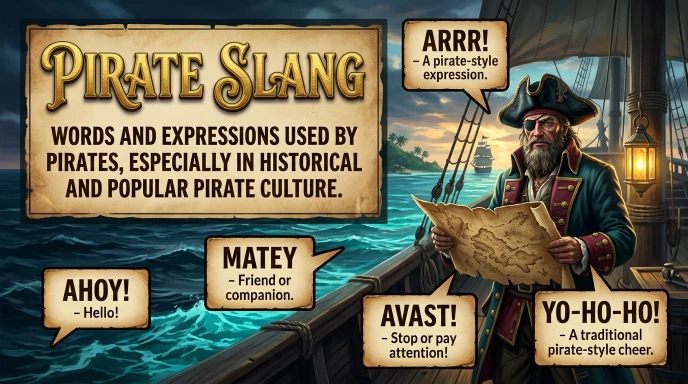
Pirate slang refers to the funny, colorful words and expressions associated with pirates and sailors, such as “Ahoy,” “Matey,” “Arrr,” and “Avast.”
People use these expressions to sound like pirates, make jokes, create playful messages, and add an adventurous tone to conversations.
You may come across pirate slang in movies, TikTok videos, gaming chats, memes, Halloween costumes, and social media captions. Although some expressions come from traditional nautical language, many popular pirate phrases became famous through books, movies, and entertainment.
Pirate style language is usually playful rather than serious. if someone calls a friend “matey” or says “Shiver me timbers!” after hearing surprising news, these expressions make ordinary conversations more entertaining.
Quick Answer: What Does Pirate Slang Mean?
Pirate slang means informal words, phrases, and expressions associated with pirates, ships, sailors, treasure, and life at sea.
Here are some popular examples:
| Pirate slang | Meaning |
| Ahoy | Hello or attention |
| Matey | Friend or companion |
| Arrr | Expression of emotion or agreement |
| Avast | Stop or pay attention |
| Aye | Yes |
| Landlubber | Someone inexperienced with the sea |
| Scallywag | A mischievous or dishonest person |
| Buccaneer | Pirate or sea raider |
| Booty | Treasure or valuables |
| Plunder | To steal or take goods |
| Grog | A traditional sailors’ alcoholic drink |
| Bilge rat | Pirate style insult |
| Savvy? | Do you understand? |
| Shiver me timbers! | An expression of surprise |
| Jolly Roger | The traditional pirate flag |
What Does Pirate Slang Mean in Everyday Conversations?
Pirate slang is a playful way of speaking that imitates the language commonly associated with fictional pirates.
Instead of saying “Hello, my friend,” someone might say:
“Ahoy, matey!”
Instead of saying “Yes,” they might respond:
“Aye!”
These expressions give conversations a humorous, adventurous, and sometimes dramatic feeling.
People also use pirate expressions to tease friends, create funny usernames, write social media captions, and participate in pirate themed games.
Pirate slang is not one official language or dialect. It combines nautical vocabulary, historical expressions, regional language, and phrases popularized by entertainment.
Popular Pirate Slang Words and Their Meanings
Here are some commonly recognized pirate words and expressions, along with their meanings and examples.
1. Ahoy
Ahoy means hello or a call used to get someone’s attention.
It is one of the most recognizable nautical greetings.
Example:
“Ahoy, matey! How are you today?”
2. Matey
Matey means friend, companion, or buddy.
Pirate characters often use this word when addressing their friends or fellow crew members.
Example:
“Come aboard, matey!”
3. Arrr
Arrr is a traditional pirate style expression used to show excitement, agreement, frustration, or enthusiasm.
It is especially recognizable in fictional pirate speech.
Example:
“Arrr! We finally found the treasure!”
4. Avast
Avast means stop, wait, or pay attention.
It is a nautical command commonly associated with pirate speech.
Example:
“Avast, everyone! Look at that ship!”
5. Aye
Aye means yes or agreement.
It is an old nautical expression that remains popular in pirate themed language.
Example:
“Are you ready to sail?”
“Aye, Captain!”
6. Landlubber
Landlubber means someone who is inexperienced with sailing or life at sea.
Pirates often use it humorously to describe people unfamiliar with ships.
Example:
“Come on, landlubber! Learn how to sail!”
7. Scallywag
Scallywag means a mischievous, troublesome, or dishonest person.
It is often used as a playful pirate style insult.
Example:
“Get back here, you little scallywag!”
8. Buccaneer
Buccaneer means a pirate or sea raider, particularly one historically associated with the Caribbean.
Example:
“The brave buccaneer searched for hidden treasure.”
9. Booty
Booty means treasure, stolen goods, or valuable items in pirate language.
Example:
“The crew discovered a chest full of booty.”
The word also has modern slang meanings unrelated to treasure, so context matters.
10. Plunder
Plunder means to steal or take valuable goods, especially by force.
Example:
“The pirates planned to plunder the enemy ship.”
11. Grog
Grog refers to an alcoholic drink historically associated with sailors.
Example:
“The sailors gathered together and talked about their journey.”
12. Bilge Rat
Bilge rat is a pirate style insult used to describe an unpleasant or troublesome person.
Example:
“Get away from my treasure, you bilge rat!”
13. Savvy
Savvy means understanding something or knowing what someone is talking about.
Example:
“Follow the captain’s instructions, savvy?”
14. Shiver Me Timbers
Shiver me timbers is an expression of surprise, shock, or amazement.
Example:
“Shiver me timbers! That’s a huge treasure chest!”
15. Jolly Roger
Jolly Roger refers to the traditional pirate flag featuring a skull and crossbones.
Example:
“The Jolly Roger was flying above the pirate ship.”
Pirate Slang Phrases and Expressions
Pirate expressions are often more entertaining than individual words. They help create the dramatic speaking style associated with pirates in movies and stories.
Here are some popular phrases:
| Pirate phrase | Everyday meaning |
| Ahoy, matey! | Hello, friend! |
| Shiver me timbers! | Wow! That’s surprising! |
| Walk the plank! | A dramatic pirate threat |
| Yo ho ho! | A cheerful pirate style expression |
| Dead men tell no tales | Dead people cannot reveal secrets |
| Avast, ye scallywag! | Stop, you troublemaker! |
| Where be the treasure? | Where is the treasure? |
| All hands on deck! | Everyone needs to help |
| Batten down the hatches! | Prepare for a storm or trouble |
| Fair winds! | Wishing someone a safe journey |
These phrases are particularly useful when writing pirate characters, creating jokes, or making themed messages.
Pirate Slang in Texting and Social Media
Pirate slang is still popular online, but people generally use it for humor, entertainment, and creative expression rather than everyday communication.
You may encounter pirate expressions on different platforms.
Pirate Slang on TikTok
On TikTok, pirate words often appear in comedy videos, themed content, and memes.
For example:
“Ahoy, mateys! Welcome aboard!”
Creators may use pirate expressions to make videos more entertaining or create a fictional pirate character.
Pirate Slang on Instagram
Instagram users sometimes include pirate words in captions, comments, and themed posts.
Example:
“Searching for treasure and good vibes. Arrr! 🏴☠️”
Pirate Slang on Discord
On Discord, pirate expressions may appear in gaming servers, role playing communities, and group chats.
Example:
“Ahoy, crew! Who’s joining the game tonight?”
Pirate Slang on Reddit
Reddit users may use pirate expressions in jokes, discussions, and memes.
Example:
“Avast, ye scallywags! The weekend has arrived!”
Pirate Slang in Gaming
Pirate language is especially common in games involving ships, adventures, exploration, and treasure hunting.
Example:
“Captain, we’ve found the enemy ship!”
Players may use expressions such as “matey,” “plunder,” “booty,” and “aye” to make gaming conversations more immersive.
Pirate Slang Insults and Funny Names
Pirate style insults are often exaggerated and humorous. They are useful for fictional characters, jokes, games, and playful conversations.
Here are some examples:
| Pirate insult | Meaning |
| Scallywag | Mischievous person |
| Landlubber | Inexperienced sailor |
| Bilge rat | Unpleasant person |
| Scurvy dog | Playful pirate insult |
| Barnacle brain | Silly or foolish person |
| Swab | Sailor or crew member; can be used dismissively |
| Sea rat | Pirate style insult |
| Coward | Someone who lacks courage |
Examples:
- “Move along, ye scurvy dog!”
- “You’re nothing but a landlubber!”
- “Stop acting like a barnacle brain!”
- “Avast, ye little scallywag!”
These expressions are mostly associated with fictional pirate speech rather than a standardized historical collection of insults.
Pirate Slang for Women
Pirate themed stories sometimes use traditional words to describe women.
Here are a few examples:
| Word | Meaning |
| Lass | Girl or young woman |
| Lady | A woman |
| Wench | An old fashioned term for a woman, sometimes insulting |
| Maiden | Young woman or unmarried woman |
| Fair lass | A poetic way to describe a woman |
Examples:
- “Ahoy, fair lass!”
- “The captain met a brave maiden.”
- “Good evening, lass!”
Lass is generally friendlier, while wench can sound rude or disrespectful depending on the context.
How Do You Talk Like a Pirate?
Talking like a pirate is easier when you understand a few common expressions and how to use them naturally.
Try these simple changes:
| Normal English | Pirate style English |
| Hello, friend! | Ahoy, matey! |
| Yes, Captain! | Aye, Captain! |
| Stop right there! | Avast! |
| Where is the treasure? | Where be the booty? |
| Come with me! | Come aboard, matey! |
| Let’s go! | Set sail! |
| Do you understand? | Savvy? |
| Everyone, get ready! | All hands on deck! |
| That’s amazing! | Shiver me timbers! |
| Goodbye, friend! | Fair winds, matey! |
You can also use words such as ye, yer, me, and be to create a traditional pirate style voice.
However, avoid putting too many pirate expressions into one sentence. A few familiar words usually sound more natural and entertaining.
Pirate Slang vs. Sailor Slang
Pirate slang and sailor slang are closely related because both are associated with ships and life at sea.
However, they are not exactly the same.
Sailor slang includes practical nautical expressions used in maritime life, while pirate slang often combines nautical language with dramatic expressions associated with fictional pirates.
| Pirate slang | Sailor or nautical terminology |
| Matey | Crew member |
| Scallywag | Port |
| Avast | Starboard |
| Booty | Aft |
| Plunder | Bow |
| Shiver me timbers! | All hands on deck! |
Some expressions overlap, but many pirate expressions are theatrical rather than technical sailing terminology.
For example, “port” and “starboard” are genuine nautical terms used to identify the left and right sides of a vessel.
Is Pirate Slang Still Used Today?
Yes! Pirate slang remains popular in modern entertainment and online culture.
People use it in:
- Pirate themed movies and television shows.
- Halloween costumes and parties.
- Video games and role playing communities.
- TikTok videos and Instagram captions.
- Funny text messages and group chats.
- Children’s stories and creative writing.
- Pirate themed celebrations.
One particularly popular celebration is International Talk Like a Pirate Day, observed every September 19.
During this celebration, people enjoy using pirate expressions, dressing like pirates, and sharing pirate themed jokes.
The internet has also helped pirate style language remain recognizable through memes and online trends.
Common Misunderstandings About Pirate Slang
People sometimes confuse pirate expressions with actual historical language. Here are a few important differences.
1. All pirates spoke the same way.
No. Historical pirates came from different countries and backgrounds, so they spoke different languages and dialects.
2. Every pirate regularly said “Arrr.”
Not necessarily. The famous pirate accent and exaggerated “Arrr” are strongly associated with popular entertainment.
3. Pirate slang is the same as sailor slang.
No. They overlap, but sailor terminology includes practical maritime language that is not necessarily associated with pirates.
4. Booty always means treasure.
No. Booty has several modern slang meanings, including meanings unrelated to pirate treasure.
5. Pirate slang is a real language.
No. Pirate slang is a collection of words and expressions rather than one standardized language.
Frequently Asked Questions About Pirate Slang
What are some common pirate slang words?
Common pirate slang words include Ahoy, Matey, Arrr, Avast, Aye, Scallywag, Landlubber, Buccaneer, Booty, and Plunder.
What do pirates say instead of hello?
Pirates commonly say “Ahoy!” or “Ahoy, matey!” as a playful greeting.
How do pirates say yes?
Pirates often say “Aye!” instead of yes.
What does matey mean in pirate slang?
Matey means friend, companion, or buddy. It is commonly used when addressing another person in pirate style speech.
What does landlubber mean?
Landlubber describes someone who is unfamiliar with sailing or life at sea. Pirates often use it humorously to tease inexperienced sailors.
What does booty mean in pirate slang?
Booty means treasure, loot, or valuable goods taken during a raid.
What does scallywag mean?
Scallywag means a mischievous, troublesome, or dishonest person. It is often used as a playful insult.
What are some cool pirate phrases?
Some popular pirate phrases include “Ahoy, matey!”, “Shiver me timbers!”, “Avast, ye scallywag!”, “Walk the plank!”, and “Dead men tell no tales.”
What is the difference between a pirate and a buccaneer?
A pirate is someone who attacks and robs ships or coastal settlements at sea. A buccaneer historically referred particularly to certain privateers and sea raiders operating in the Caribbean.
How do you say I love you in pirate slang?
A playful way to say it is “I love ye, matey!” This is a fictional pirate style expression rather than an official historical translation.
Conclusion
Pirate slang is a collection of colorful words and expressions associated with pirates, sailors, treasure, and adventures at sea. Words such as Ahoy, Matey, Arrr, Avast, Aye, Scallywag, and Landlubber are among the most recognizable examples.
Today, people mainly use pirate slang for jokes, memes, gaming, social media, Halloween, and creative storytelling. Although some expressions have genuine nautical roots, many familiar pirate phrases became popular through books, movies, and entertainment.
Understanding these expressions makes it easier to recognize pirate style conversations and even create your own playful pirate messages.
Discover More Articles:

I research internet slang, texting abbreviations, and online language to create clear, accurate, and easy-to-understand content. My goal is to make modern internet language simple by publishing well-researched, regularly updated explanations based on trusted sources.