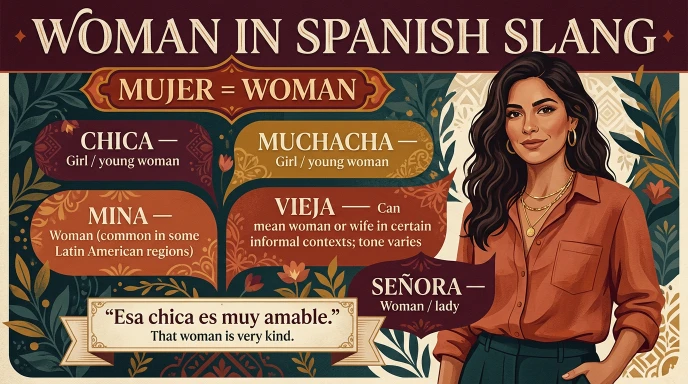
Spanish has several slang words for woman, and the right expression depends on the country, situation, and relationship between speakers. Common informal terms include chica, chava, morra, mina, vieja, güera, and tipa.
Some are friendly and casual, while others can sound rude, flirtatious, or disrespectful.
You may hear these expressions in Spanish speaking countries, Latin music, movies, social media, and everyday conversations. However, a word that sounds normal in Mexico might have a different meaning or tone in Argentina, Spain, or Colombia.
This guide explains popular Spanish slang for woman, where people use it, and which expressions are appropriate in different situations.
Quick Answer
Here are some common Spanish slang words for woman:
- Chica: Girl or young woman; widely understood and casual.
- Chava: Girl or young woman; common in Mexico and some Central American countries.
- Morra: Girl or young woman; informal Mexican slang.
- Mina: Woman or girl; common in Argentina and Uruguay.
- Vieja: Can mean woman, wife, or girlfriend in some regional contexts; tone matters.
- Tipa: A woman or a particular person; informal and sometimes dismissive.
- Güera: A light skinned or blonde woman in Mexican Spanish; not a general word for woman.
- Piba: Girl or young woman; common in Argentina.
- Tía: Informal way to refer to a woman in Spain.
- Mujerón: A slang like compliment for an impressive, confident, or attractive woman.
Best general choices: Use chica for a casual, widely understood expression. Use chava or morra in informal Mexican conversations, and mina or piba in Argentina.
What Does Woman Mean in Spanish Slang?
The standard Spanish word for woman is mujer. However, native speakers often use informal alternatives when talking with friends, describing someone, or having relaxed conversations.
For example:
- “Esa chica es muy amable.” That girl is very kind.
- “La chava viene con nosotros.” The girl is coming with us.
- “Esa mina es divertida.” That woman is fun.
These expressions are not always interchangeable. Some refer to a girl or young woman, while others can refer to an adult woman.
The important thing is to understand regional usage and tone before using a slang term.
25+ Spanish Slang Words for Woman
Here are popular informal words used to describe or refer to women in different Spanish speaking regions.
1. Chica
Chica means girl or young woman. It is one of the most widely understood casual words in Spanish.
It is not strongly regional and usually sounds friendly or neutral.
Examples:
- “Esa chica es muy simpática.” That girl is very nice.
- “Hola, chicas.” Hi, girls.
- “Conocí a una chica en la fiesta.” I met a girl at the party.
2. Chava
Chava is an informal word for a girl or young woman, especially common in Mexico and also used in parts of Central America.
It sounds relaxed and conversational.
Examples:
- “Esa chava es muy divertida.” That girl is really fun.
- “Voy a salir con una chava.” I’m going out with a girl.
- “¿Quién es esa chava?” Who is that girl?
3. Morra
Morra is popular Mexican slang for a girl or young woman. It is especially common in casual conversations among younger speakers.
Depending on the situation, it can sound friendly, playful, or overly informal.
Examples:
- “Esa morra es buena onda.” That girl is cool.
- “Voy con una morra al cine.” I’m going to the movies with a girl.
- “¿Quién es esa morra?” Who’s that girl?
4. Mina
Mina means woman or girl in informal Argentine and Uruguayan Spanish.
It is common in casual speech and can be neutral, although its tone depends on the speaker and situation.
Examples:
- “Esa mina es muy inteligente.” That woman is very intelligent.
- “Conocí a una mina ayer.” I met a girl yesterday.
- “La mina vive cerca.” The woman lives nearby.
5. Piba
Piba is an informal Argentine word for a girl or young woman. The masculine form is pibe.
It is especially common in everyday conversation.
Examples:
- “Esa piba es muy simpática.” That girl is very nice.
- “La piba está estudiando.” The girl is studying.
- “Vi a una piba en el café.” I saw a girl at the café.
6. Tipa
Tipa is an informal word for a woman or a particular female person. It is used in Spain and several Latin American countries.
It can sound neutral in some contexts but dismissive or disrespectful in others.
Examples:
- “¿Quién es esa tipa?” Who is that woman?
- “Conocí a una tipa muy interesante.” I met a very interesting woman.
- “Esa tipa siempre llega tarde.” That woman is always late.
7. Vieja
Vieja literally means “old woman,” but in some Latin American countries it can also refer informally to a woman, wife, or girlfriend.
The meaning depends heavily on the country and relationship. It can sound affectionate among familiar people, but it may also sound rude or disrespectful.
Examples:
- “Mi vieja está en casa.” My wife or partner is at home, depending on context.
- “Esa vieja es mi vecina.” That woman is my neighbor.
- “Voy a llamar a mi vieja.” I’m going to call my mother or partner, depending on the speaker’s regional usage.
Avoid using it for a woman you do not know unless you understand the local context.
8. Güera
Güera is Mexican Spanish slang for a woman with light skin or blonde/light colored hair. The masculine form is güero.
It describes appearance rather than simply meaning woman.
Examples:
- “La güera trabaja aquí.” The blonde or light skinned woman works here.
- “¿Conoces a esa güera?” Do you know that blonde woman?
- “La güera de la tienda es muy amable.” The blonde woman at the store is very nice.
9. Tía
In Spain, tía is a common informal word for a woman or girl. It can be used when talking about a friend, stranger, or someone being discussed.
Its tone depends on the sentence.
Examples:
- “Esa tía es muy simpática.” That girl is really nice.
- “¿Quién es esa tía?” Who’s that woman?
- “La tía vive cerca.” The woman lives nearby.
Outside Spain, tía often means aunt.
10. Muchacha
Muchacha means girl or young woman. It is widely understood across Spanish speaking regions, although how commonly people use it varies.
It can sound casual, traditional, or slightly old fashioned depending on the country.
Examples:
- “La muchacha trabaja conmigo.” The young woman works with me.
- “Esa muchacha es muy amable.” That girl is very kind.
- “Hola, muchachas.” Hello, girls.
11. Nena
Nena means baby girl or little girl literally, but people also use it affectionately for a young woman, girlfriend, or someone they care about.
It can sound sweet or flirtatious depending on the relationship.
Examples:
- “Hola, nena.” Hey, girl or hey, babe.
- “Esa nena es muy simpática.” That girl is very sweet.
- “¿Cómo estás, nena?” How are you, babe?
12. Chiquilla
Chiquilla is an affectionate or informal word for a girl or young woman. It can sound playful, warm, or familiar.
Examples:
- “Ven aquí, chiquilla.” Come here, girl.
- “Esa chiquilla es muy alegre.” That girl is very cheerful.
- “Hola, chiquilla.” Hi, girl.
13. Señorita
Señorita means young lady or Miss. It is polite and sometimes playful, but it is not really modern slang.
Examples:
- “Buenos días, señorita.” Good morning, young lady.
- “La señorita está esperando.” The young lady is waiting.
- “Pase, señorita.” Come in, miss.
14. Mujerón
Mujerón is an expressive word for an impressive woman. It can describe someone who is confident, attractive, strong, or remarkable.
It is often used as a compliment.
Examples:
- “¡Qué mujerón!” What an amazing woman!
- “Ella es un mujerón.” She’s an incredible woman.
- “Eres un mujerón.” You’re an amazing woman.
15. Dama
Dama means lady. It is more formal than slang, but people sometimes use it humorously or respectfully in casual conversations.
Examples:
- “Esa dama es muy elegante.” That lady is very elegant.
- “Pase primero, dama.” Please go first, ma’am.
- “Una dama increíble.” An amazing woman.
16. Chavala
Chavala is an informal Spanish word for a girl or young woman, especially associated with Spain.
It is the feminine form of chaval.
Examples:
- “Esa chavala es muy divertida.” That girl is really fun.
- “Conocí a una chavala ayer.” I met a girl yesterday.
- “La chavala está estudiando.” The girl is studying.
17. Piba Linda
Piba linda means pretty girl or lovely young woman. It is a casual expression associated especially with Argentina and nearby regions.
Examples:
- “Es una piba linda.” She’s a pretty girl.
- “Hola, piba linda.” Hey, pretty girl.
- “Qué piba tan linda.” What a lovely girl.
18. Chulita
Chulita is an affectionate diminutive related to chula. It can mean a cute or attractive girl, depending on the region.
Examples:
- “Hola, chulita.” Hey, cutie.
- “Qué chulita eres.” You’re so cute.
- “Esa chulita tiene mucho estilo.” That cute girl has a lot of style.
19. Reina
Reina literally means queen. As an affectionate expression, it can be used to compliment or address a woman.
Examples:
- “Gracias, reina.” Thanks, queen.
- “Hola, reina.” Hey, queen.
- “Tú puedes, reina.” You can do it, queen.
20. Hermosa
Hermosa means beautiful. It is not slang by itself, but it is a common affectionate or complimentary way to address a woman.
Examples:
- “Hola, hermosa.” Hi, beautiful.
- “Gracias, hermosa.” Thank you, beautiful.
- “Qué hermosa eres.” You’re so beautiful.
21. Flaca
Flaca literally means thin or skinny woman. In some Latin American countries, especially Argentina, it is also used as a familiar nickname even when the person is not particularly thin.
Examples:
- “¿Cómo estás, flaca?” How are you, girl?
- “Hola, flaca.” Hey, girl.
- “La flaca viene más tarde.” The girl is coming later.
Because it refers to body size, it may feel uncomfortable or offensive to some people.
22. Gata
Gata literally means female cat. In some slang contexts, it can refer to a woman, but its tone varies significantly and may sound objectifying or insulting.
It is best to understand the local context before using it.
Example:
- “Mira a esa gata.” Look at that woman.
This expression is not a safe general substitute for mujer.
23. Mamacita
Mamacita is a flirtatious expression used in some Latin American countries to compliment an attractive woman.
It can sound playful or sexualized, depending on the speaker and situation.
Examples:
- “Hola, mamacita.” Hey, beautiful.
- “Qué mamacita.” She’s very attractive.
- “Esa mamacita tiene mucho estilo.” That attractive woman has a lot of style.
Use caution because some women may consider it disrespectful, especially from strangers.
24. Bombón
Bombón literally means a small sweet or chocolate. Informally, it can describe someone attractive, often as a flirtatious compliment.
Examples:
- “Hola, bombón.” Hey, sweetheart.
- “Es un bombón.” She’s a real cutie.
- “Qué bombón de mujer.” What a beautiful woman.
25. Muñeca
Muñeca means doll. In affectionate or flirtatious speech, it can describe a pretty woman.
Examples:
- “Hola, muñeca.” Hey, doll.
- “Esa muñeca es preciosa.” That beautiful girl is gorgeous.
- “Qué muñeca.” What a beauty.
Spanish Slang for Woman by Country
Spanish slang changes from one country to another. A word that sounds natural in Mexico may sound unusual or carry a different tone somewhere else.
Here is a quick regional guide:
| Country or region | Common informal terms | General meaning |
| Mexico | Chava, morra, güera | Girl, young woman, or woman described by appearance |
| Argentina | Mina, piba, flaca | Woman, girl, or familiar nickname |
| Uruguay | Mina, piba | Woman or girl |
| Spain | Tía, chavala, chica | Woman or young woman |
| Colombia | Muchacha, pelada, vieja | Girl or woman, depending on context |
| Venezuela | Chama, jeva | Girl, young woman, or girlfriend |
| Cuba | Chica, jeva | Girl, woman, or girlfriend |
| Puerto Rico | Chica, jeva | Girl, woman, or girlfriend |
| Dominican Republic | Chica, jeva | Girl, woman, or girlfriend |
| Central America | Chava, muchacha | Girl or young woman |
Regional usage is not uniform. Even within one country, slang can vary by city, age group, and social circle.
Spanish Slang for a Beautiful or Attractive Woman
If you want to compliment a woman rather than simply refer to her, these expressions may be useful.
| Spanish expression | English meaning | Tone |
| Hermosa | Beautiful | Warm or affectionate |
| Guapa | Pretty or attractive | Casual |
| Bonita | Pretty | Friendly |
| Preciosa | Gorgeous | Affectionate |
| Mamacita | Very attractive woman | Flirtatious |
| Bombón | Cutie or hottie | Flirtatious |
| Chulita | Cutie | Playful |
| Reina | Queen | Affectionate |
| Mujerón | Incredible woman | Admiring |
| Bella | Beautiful | Romantic or complimentary |
For a respectful compliment, “guapa,” “bonita,” and “hermosa” are generally safer choices than more sexualized expressions.
Spanish Slang for a Girl or Girlfriend
Some Spanish words refer to a girlfriend or romantic partner rather than women in general.
Here are a few common examples:
- Novia: Girlfriend; standard Spanish, not slang.
- Chica: Girl; can refer to a romantic interest depending on context.
- Nena: Babe or sweetheart; affectionate.
- Mamacita: Attractive woman; often flirtatious.
- Mi reina: My queen; affectionate.
- Mi amor: My love; romantic or affectionate.
- Mi vida: My life; affectionate.
- Jeva: Girl or girlfriend in some Caribbean and Latin American varieties.
For example:
- “Ella es mi novia.” HShe’s my girlfriend.
- “Hola, nena.” Hey, babe.
- “¿Dónde está mi reina?” Where is my queen?
- “Voy a salir con mi chica.” I’m going out with my girl.
Remember that not every word for a woman means girlfriend. The relationship and context determine the meaning.
Rude or Disrespectful Spanish Slang for Women
Some informal words can sound insulting, dismissive, or objectifying. It is useful to recognize them, but that does not mean you should use them.
| Word | Possible meaning | Tone |
| Tipa | That woman or female person | Can sound dismissive |
| Vieja | Woman, wife, or older woman | Depends heavily on context |
| Gata | Woman or girl in some slang contexts | Can be objectifying |
| Zorra | Insulting term for a woman | Offensive |
| Puta | Very offensive insult | Vulgar and disrespectful |
| Perra | Literally female dog; also used as an insult or reclaimed expression | Context dependent |
Be careful with these expressions. Some are strongly offensive, and their meaning can vary across regions. It is better to use mujer, chica, or another neutral term when speaking to someone you do not know.
How to Use Spanish Slang for Woman in Everyday Conversations
Here are natural examples showing how these words appear in everyday Spanish conversations.
Example 1: Talking About a Friend
A: “¿Quién es esa chica?”
B: “Es una amiga de mi hermana.”
Meaning:
A: “Who is that girl?”
B: “She’s a friend of my sister.”
Example 2: Mexican Spanish
A: “¿Conoces a esa morra?”
B: “Sí, estudia conmigo.”
Meaning:
A: “Do you know that girl?”
B: “Yes, she studies with me.”
Example 3: Argentine Spanish
A: “¿Quién es esa mina?”
B: “Es una compañera de trabajo.”
Meaning:
A: “Who is that woman?”
B: “She’s a coworker.”
Example 4: Spanish From Spain
A: “Esa tía es muy divertida.”
B: “Sí, siempre nos hace reír.”
Meaning:
A: “That girl is really funny.”
B: “Yes, she always makes us laugh.”
Example 5: Giving a Compliment
A: “¡Qué guapa eres!”
B: “Muchas gracias.”
Meaning:
A: “You’re so pretty!”
B: “Thank you very much.”
Frequently Asked Questions About Woman in Spanish Slang
What is the most common slang word for woman in Spanish?
Chica is one of the most widely understood informal words for a girl or young woman. Other popular terms include chava in Mexico, mina in Argentina, and tía in Spain.
What is Mexican slang for woman?
Common Mexican expressions include chava and morra. Güera can describe a blonde or light skinned woman, but it does not simply mean woman.
What is Argentine slang for woman?
Mina is a common informal Argentine word for woman, while piba usually means girl or young woman. Flaca can also be used as a familiar nickname.
What is Spanish slang for a beautiful woman?
You can use guapa, hermosa, bonita, preciosa, or bella. More flirtatious expressions include mamacita and bombón, although these may not be appropriate in every situation.
What does mina mean in Spanish?
In Argentine and Uruguayan slang, mina commonly means woman or girl. Its tone is generally informal, and the exact meaning depends on the conversation.
What does morra mean in Spanish?
Morra is informal Mexican slang for a girl or young woman. Friends often use it in casual conversations.
What does chava mean in Spanish?
Chava is a casual word for a girl or young woman, especially in Mexico and parts of Central America.
What does vieja mean when referring to a woman?
Literally, vieja means old woman. In some Latin American contexts, it can also refer informally to a wife, girlfriend, mother, or another woman. Its tone depends on the relationship and region.
Is mamacita a respectful word?
Not always. Mamacita is often flirtatious and can sound sexualized or disrespectful when used toward a stranger. It is best used only when the relationship and situation make it welcome.
What is a polite way to say woman in Spanish?
The standard word is mujer. You can also use señora for an adult woman in a respectful context or chica for a girl or young woman.
Final Thoughts
Spanish has many informal ways to refer to a woman, but the best expression depends on the country, relationship, and tone of the conversation.
Use chica for a widely understood casual term, chava or morra for informal Mexican Spanish, mina or piba in Argentina, and tía in Spain. If you want to compliment someone, words like guapa, hermosa, and bonita are generally more respectful.
Most importantly, remember that some expressions can sound rude or overly familiar. Understanding regional slang helps you communicate naturally without accidentally offending someone.
Discover More Articles:

I research internet slang, texting abbreviations, and online language to create clear, accurate, and easy-to-understand content. My goal is to make modern internet language simple by publishing well-researched, regularly updated explanations based on trusted sources.